
A two-seat electric passenger tricycle is the cheapest per-seat vehicle a city operator can put into fare service, and it is also the easiest one to buy wrong. The platform itself is simple: a steel tube body-on-frame, one front wheel, two rear wheels on a differential axle, an 800W hub motor, and a bench. What decides whether the vehicle earns money or sits in a workshop is a set of decisions made months before delivery, about which legal class you register it in, which trim level you order, and how many battery packs you hold per vehicle.
This guide works through those decisions in the order they actually bind: vehicle class first, because it fixes motor and speed limiter; duty cycle second, because it fixes battery count; passenger fit-out third, because it is where fare revenue is won or lost; and the commercial terms last. The numbers below are the specification of a real 800W passenger platform, not a wish list.
Start With the Vehicle Class, Not the Vehicle
Every other decision hangs off the class you register in. Change class after import and you are re-certifying, re-insuring, and sometimes re-homologating a machine you already paid for. Settle it in writing before the purchase order goes out.
| Operating path | Typical class | Motor / speed ceiling | What it fixes downstream |
|---|---|---|---|
| EU city for-hire | L2e light tricycle | Up to 4 kW, 45 km/h | eMark type approval, AM or B licence, registration plate |
| EU heavy passenger | L5e tricycle | Above 1 kW, above 45 km/h | Full vehicle homologation, B licence, annual inspection |
| US low-speed shuttle | State moped or NEV | 750W to several kW, speed-capped | Varies by state: plate, licence, insurance band |
| Resort / campus private hire | Off-road or private-land vehicle | Governed 25 km/h | No public-road registration, restricted to site roads |
The commercial consequence is bigger than the legal one. A 25 km/h governed build lets you hire drivers with an ordinary car licence in most jurisdictions, which widens your labour pool in exactly the market where drivers are scarce. A 45 km/h L2e build carries a motorcycle-class licence requirement in several EU states. The certification scope per market is compared in our EU vs US certification guide, the state-by-state position in the tricycle law guide, and the speed-class reasoning in the motor power guide.
Read the Trim Levels as Three Different Vehicles
Passenger tricycles are sold in trim bands, and the bands are not cosmetic. On this platform there are three, and the gap between the first and the third is the difference between a campus runabout and a fare-earning taxi.
| Parameter | Standard 500W | Comfort 800W | Taxi 800W LFP |
|---|---|---|---|
| Motor | 500W hub, 60V | 800W hub, 60V | 800W hub, 60V |
| Battery | 60V 20Ah NMC | 60V 20Ah NMC | 60V 32Ah LFP |
| Range (loaded) | 40–45 km | 45–55 km | 55–60 km |
| Seating | 2-person bench | 2-person bench + armrest | 2 or 3-person bench |
| Canopy | Optional fabric | Fabric standard | Hard-top + windshield |
| Max load | 250 kg | 300 kg | 300 kg |
| Price (FOB) | $850–1,050 | $1,080–1,300 | $1,250–1,480 |
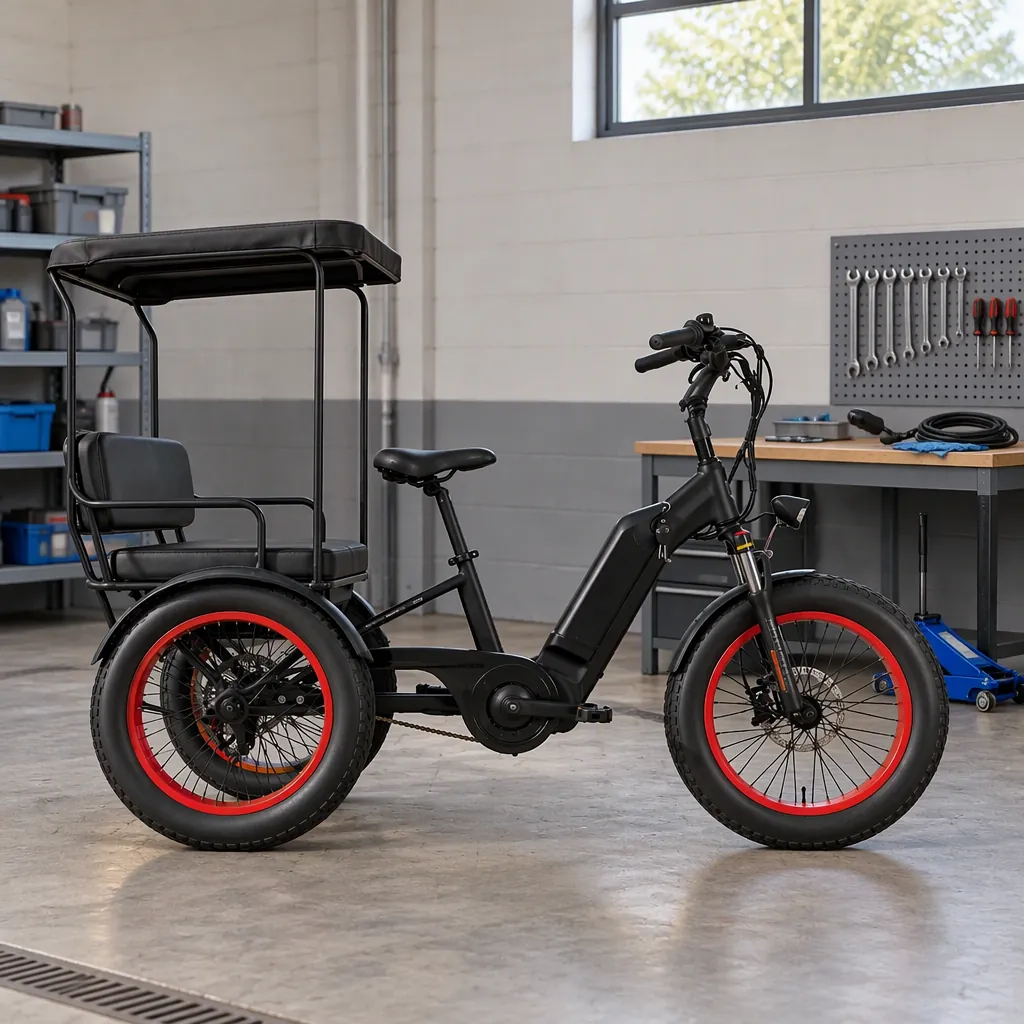
The platform-level envelope behind all three: 500W or 800W brushless hub with a rear differential axle, 60V 20Ah or 60V 32Ah lithium with an LFP option, under-seat battery mount, 25–35 km/h top speed, 6–8 hour charge, hydraulic 180 mm front disc with dual mechanical drum rear, 120–160 kg kerb weight with battery, 300 kg total load, 3.00-12 front and 3.50-12 dual rear tires on road tread, steel tube body-on-frame with e-coat plus powder coat, LCD display with speed, battery gauge and forward/reverse indicator, and full LED lighting with horn.
The one line that matters most for fare work is the LFP battery in the Taxi trim. An NMC pack is rated for roughly 800 cycles to 80 percent capacity; an LFP pack for 2,000-plus. On a vehicle doing a full charge cycle almost every working day, that is the difference between replacing the pack inside the first three years and running it out past five. The chemistry trade-off is set out in our battery technology guide and the battery pack OEM guide.
The Duty Cycle Arithmetic That Sets Your Fleet Size
Operators consistently under-buy batteries and over-buy vehicles. The arithmetic that avoids both starts from charging time, not from range.
A 60V 32Ah pack on the standard 5A charger needs 6–8 hours to refill. That is an overnight cycle: one pack per vehicle is sufficient for a single-shift operation where the trike returns to the depot in the evening. It is not sufficient for a double shift. A second shift starting at 14:00 on a trike that came in at 13:00 with a flat pack does not run — and no amount of range on paper fixes it, because the constraint is charger throughput, not energy.
Three ways out, in ascending order of cost:
- Two packs per vehicle, swapped at midday. The pack is under-seat mounted and comes out as a unit. This is the cheapest correct answer for double-shift fleets, and it keeps the vehicle earning through the charge window while the spare sits on the rack.
- A higher-current charger per vehicle. Fast chargers in the range run 4A to 10A, which cuts refill time proportionally, but the depot electrical capacity and the pack's own charge acceptance become the limit. Charger selection and connector compatibility are covered in the charger guide.
- A larger depot with more vehicles than shifts. Simple, capital-heavy, and the right answer only when the site already has the parking.
Whichever you choose, size the depot charging capacity against pack count rather than vehicle count. A ten-vehicle double-shift fleet needs twenty charging positions if every pack charges on its own charger, and the site electrical survey should be done before the purchase order, not after. The fleet-level calculation is worked through in our fleet charging guide, and the 60V versus 72V architecture question in the 60V vs 72V guide.
What the Passengers Actually Judge
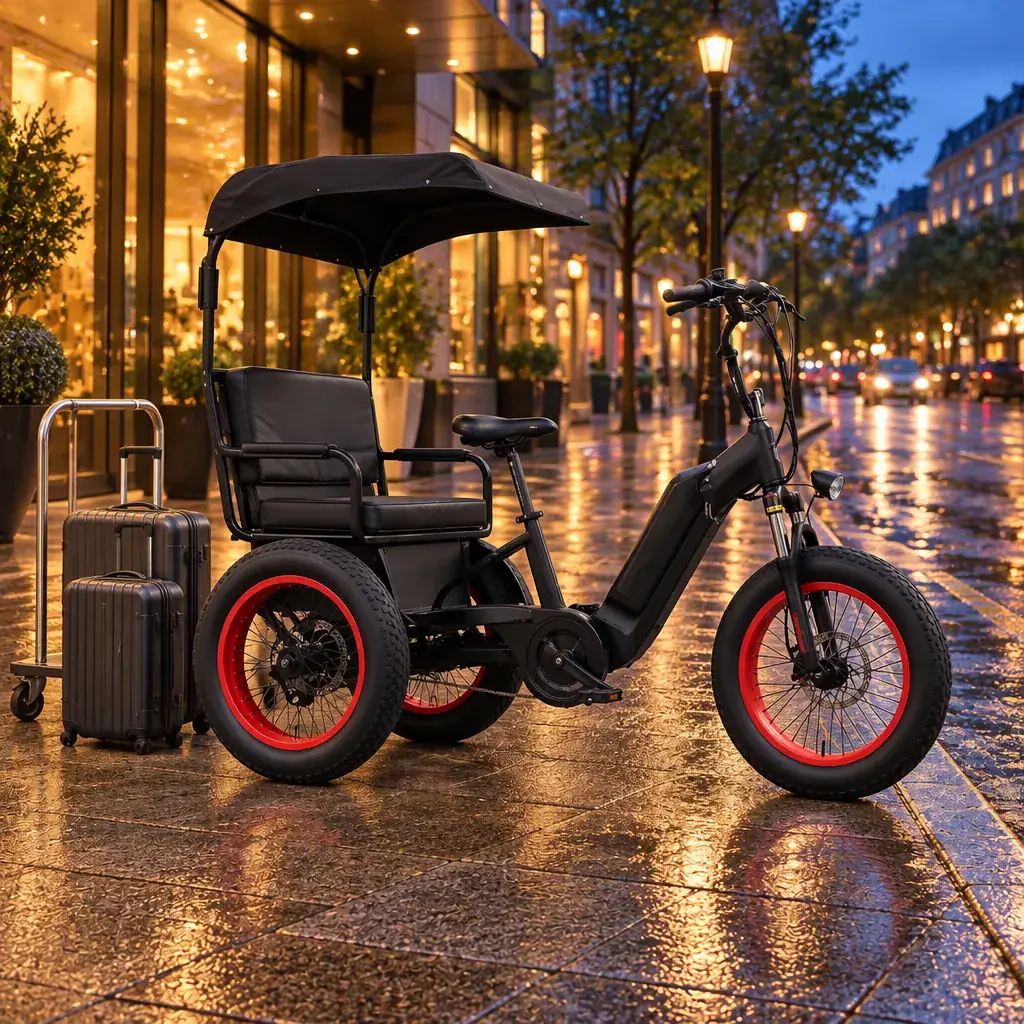
Fare revenue is decided in the first thirty seconds of a ride, and almost none of it is about the motor. On a passenger trike the revenue-bearing features are the rear bench with backrest and armrests, the canopy, and the step-up geometry.
A fabric canopy with roll-up sides is the standard fit and the practical minimum: it keeps the vehicle working in light rain, when a good share of a competing open fleet is parked. The Taxi trim's hard-top with windshield extends that further and reduces canopy replacement over the vehicle's life. Step-up height is the feature most often ignored in the quote and most often complained about by passengers — older riders and anyone with luggage will notice a high step on every single trip.
The fit-out items that convert a trike into a fare vehicle, all of which should appear as explicit line items on the purchase order rather than being assumed:
- Rear bench with backrest and armrests, in the two- or three-person configuration you actually intend to sell.
- Flat floor and foot space under the bench, so luggage sits flat instead of on a passenger's knees.
- A flat dashboard area sized for a meter or a phone mount, plus a 12V or USB outlet for the driver's device.
- A rear luggage tray or rack — station and airport transfers are the highest-value fare segment, and they are won or lost on whether a suitcase fits.
- LED headlight, tail and brake lights, turn signals and horn, all standard on this platform and all required for public-road operation in most markets.
The seating and stability architecture behind these choices is the same delta layout used across the passenger range; the geometry and ergonomics are set out in our passenger e-tricycle OEM guide, and the platform-level cabin options in the canopy guide.
For-Hire Licensing and Insurance
Passenger-for-hire changes the compliance picture more than the vehicle specification does, and it is the step where operators most often discover a problem too late.
Taxi and hackney licences are almost always municipal, and many cities cap them. Shuttle, resort transfer and private-hire permits are generally easier to obtain but come with route or site restrictions. The sequence that works: confirm the licence category and any cap before ordering, then confirm the vehicle class that licence requires, then order. Doing it in the other order means owning vehicles you cannot legally put into fare service.
On insurance, the pricing follows the class rather than the price of the vehicle. A 25 km/h governed build registered in a low-speed or bicycle-adjacent class typically attracts premiums close to powered-scooter rates; an L2e or NEV-registered vehicle is priced as a motor vehicle. The registration and insurance mechanics are covered in our insurance and registration guide, and the safety equipment that insurers and regulators ask about in the safety features guide.
Running Costs and the Parts That Fail First
A passenger trike is a low-maintenance vehicle, but it is not a maintenance-free one, and the failure list is predictable.
- Brakes. Continuous stop-and-go duty is the harshest brake test there is. The hydraulic 180 mm front disc does most of the work; the dual mechanical drum rear set needs periodic adjustment rather than pad replacement. Inspect front pads on a mileage interval, not a calendar one. The full braking specification is in our brake systems guide.
- Tires. 3.00-12 front and 3.50-12 dual rear, road tread. Rear pairs wear together and should be replaced as a pair so the differential is not working against mismatched rolling radius. Sizing and load rating are covered in the tires guide.
- The differential axle. It is what keeps the drivetrain alive in tight U-turns at low speed, which is exactly what a taxi does all day. It needs its oil checked on schedule, and it is the single component where a cheap substitute shows up fastest. See the differential guide.
- Controller and wiring. Heat and water ingress are the two killers. Keep the controller dry, keep connections clean, and treat intermittent faults as a wiring problem before assuming a controller failure. Covered in the motor controller guide.
The full service schedule, including the checks that belong on a weekly rather than annual list, is in our maintenance guide. Stock brake pads, a spare tire pair, and one controller per ten vehicles before the first season, not after the first failure.
Commercial Terms and the First-Month Pilot
Manufacturing terms on this platform are straightforward, and the numbers should be confirmed against the quote rather than assumed: minimum order quantity 50 units, standard lead time 15–30 days, with custom canopy or bench configuration adding roughly 10 days on a first order. FOB pricing runs $850–1,050 for the Standard 500W trim, $1,080–1,300 for Comfort, and $1,250–1,480 for the Taxi 800W LFP build.
Before committing a full fleet, run a pilot of two to four vehicles on your hardest route for a full month. The things a pilot reveals that a specification sheet cannot: real step-up complaints from actual passengers, real charge-window pressure at your depot, real brake wear on your gradients, and whether your drivers prefer the two- or three-person bench for the routes you actually sell. Instrument it — record trips, distance, and charge start and end times per vehicle for four weeks, and the pack count per vehicle falls out of the data instead of out of a guess.
The documents to collect with the order: eMark or the applicable type approval for your market, UN 38.3 transport reports for the battery packs, IEC 62133 and UL 2271 pack certifications where your market requires them, and the CE and RoHS declarations for the vehicle. Your licensing office and your insurer will both ask, and both will ask before you expect them to. The import side — HS classification, container loading, and landed cost — is covered in our China import guide, and the negotiation structure in the OEM buying guide and the dealer and distributor guide.
A Short Spec Sheet to Take to the Quote
If you are briefing a supplier this week, these are the decisions to have settled: the vehicle class and the licence category it maps to; the trim level, with LFP specified explicitly if the vehicle will cycle daily; the seating configuration, two or three passengers; canopy type, fabric or hard-top with windshield; pack count per vehicle, driven by your shift pattern rather than by range anxiety; the depot charging positions, sized on pack count; and the pilot size and duration. Everything else is detail that follows.
Spec a Passenger Trike Fleet for Your Routes
Tell us your operating model (taxi rank, airport shuttle, campus transit, or resort transfer), the shift pattern, and the vehicle class you intend to register in. We will spec the trim level, pack count, seating configuration, canopy, and certification documents for continuous-duty fare service.
