
The passenger e-tricycle is the least glamorous and most underestimated category in light electric mobility. It does not win on top speed, it does not win on range per kilogram, and it will never be featured in a performance review. It wins on one specification that no two-wheeler can match: a rider who never has to put a foot down, and a passenger who never has to balance. That single geometric fact is why the category sells steadily into mobility dealers, senior-mobility distributors, tourism operators, municipal transport programmes and family buyers, and why the engineering decisions that matter are completely different from those of an e-bike or an e-scooter.
This guide is written for the OEM buyer who has to specify, price and defend a passenger tricycle programme. It covers the platform as it is actually built, the arithmetic of occupant load and payload, the voltage and chemistry decision, canopy and cabin configurations, compliance documentation, and the commercial terms that determine whether a container lands at a workable cost. Every number below comes from the production configuration of the passenger tricycle platform, not from a wish list.
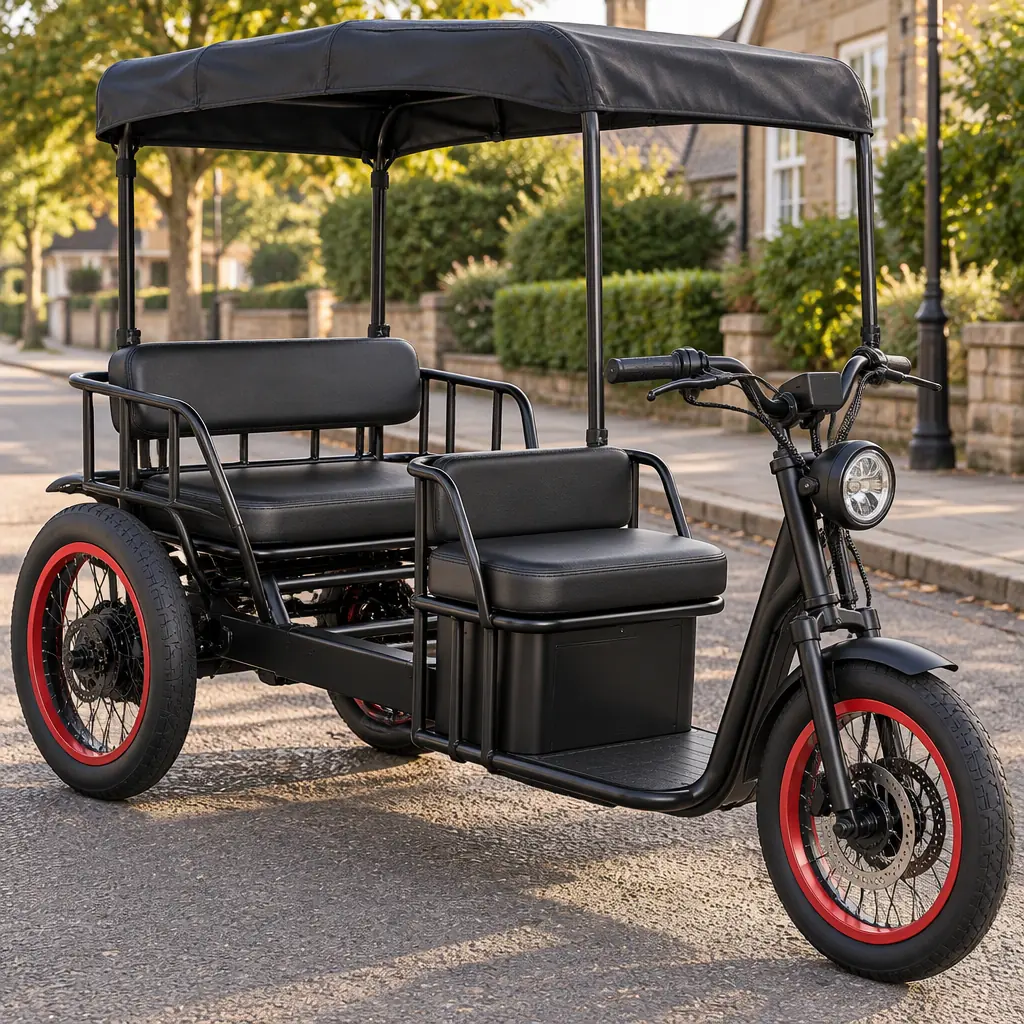
What the Platform Actually Is
Strip away the marketing and a passenger e-tricycle is a steel tube body-on-frame chassis with a single front wheel, a differential rear axle carrying two wheels, a brushless hub motor in the 500W to 800W class, and an under-seat battery compartment. The production configuration has an e-coated and powder-coated frame, a 3.00-12 front tyre and dual 3.50-12 rear tyres on road tread, a front hydraulic disc brake with a 180 mm rotor, dual mechanical drum brakes at the rear, and a kerb weight of 120 to 160 kg with the battery installed.
That weight figure is the first number a buyer should write down, because it competes directly with payload. A 160 kg vehicle with a 300 kg total load rating leaves 140 kg for people and cargo. Three adults plus shopping is already at the limit. This is why the first specification conversation is never about motor power, it is about who is actually going to be sitting on the bench.
| Parameter | Production specification |
|---|---|
| Motor | 500W / 800W brushless hub, rear differential axle |
| Battery | 60V 20Ah / 60V 32Ah lithium, LFP option, under-seat mount |
| Range | 40-60 km loaded at moderate speed |
| Top speed | 25-35 km/h |
| Charging time | 6-8 hours |
| Brakes | Hydraulic disc front (180 mm) + dual mechanical drum rear |
| Kerb weight | 120-160 kg with battery |
| Load capacity | 300 kg total (driver + 2-3 passengers) |
| Tyres | 3.00-12 front / 3.50-12 rear dual, road tread |
| Frame | Steel tube body-on-frame, e-coated + powder coated |
| Seating | Front driver seat + rear bench (2-person) with backrest and armrest |
| Canopy | Optional fabric canopy with roll-up sides on steel tube frame |
| Display | LCD speedometer, battery gauge, forward/reverse indicator |
| Lights | LED headlight, tail/brake, turn signals, horn |
Occupant Load Is the Real Specification
Most tricycle quotation errors trace back to a misread of the payload number. A 300 kg rating is a total figure that includes the driver. Work through the load cases for a typical senior-mobility or taxi account before choosing a motor:
- Driver only, 85 kg. 215 kg of headroom. Adequate for any configuration, and the case where the 500W motor feels entirely sufficient.
- Driver plus two adult passengers, 85 kg each. 255 kg. Still inside the rating, but only 45 kg of margin. On a 6 to 8 percent grade this is where the 500W configuration starts to feel laboured.
- Driver plus three adults with bags. 340 kg. This is over the rating. It is also the exact load that a daily taxi route will generate in week one. Specify the 800W motor and the 60V 32Ah pack, or specify a 3-person bench and accept a reduced per-passenger allowance in writing.
- Driver plus two passengers plus weekly shopping. 280-300 kg. Combined load with a high centre of gravity. Here the armrest and backrest of the rear bench stop being comfort features and become load-retention features.
The practical rule is to size the motor against the worst realistic load case, not the average one. The 800W variant exists precisely because passenger trikes spend their working lives near the top of their load envelope, and a motor that is merely adequate when empty will be marginal when full and hot.
Voltage, Chemistry and the Cycle-Cost Decision
The platform ships with a 60V 20Ah pack as standard and a 60V 32Ah pack as the volume option. Range is quoted at 40 to 60 km loaded at moderate speed, and charging takes 6 to 8 hours. For a private buyer doing 15 km a day, the 20Ah pack is fine and cheaper. For any vehicle doing multiple daily trips with passengers, the 32Ah pack is the correct specification, because the alternative is a mid-shift charging stop that no taxi or shuttle operator can schedule around.
The more consequential decision is cell chemistry. Lithium iron phosphate carries 2,000-plus cycles to 80 percent capacity against roughly 800 cycles for NMC, it does not undergo thermal runaway below 200 degrees Celsius, and it operates across -20 to 60 degrees Celsius with limited fade at sustained ambient temperatures above 45 degrees. The upgrade adds roughly $120 to $180 per unit. The break-even is straightforward: a fleet expecting more than 500 charge cycles per vehicle, or operating in South Asia, the Middle East or sub-Saharan Africa where summer ambient temperatures routinely exceed 35 degrees, should take LFP. A temperate-climate operator selling a low annual mileage vehicle should take NMC and keep the upfront cost down.
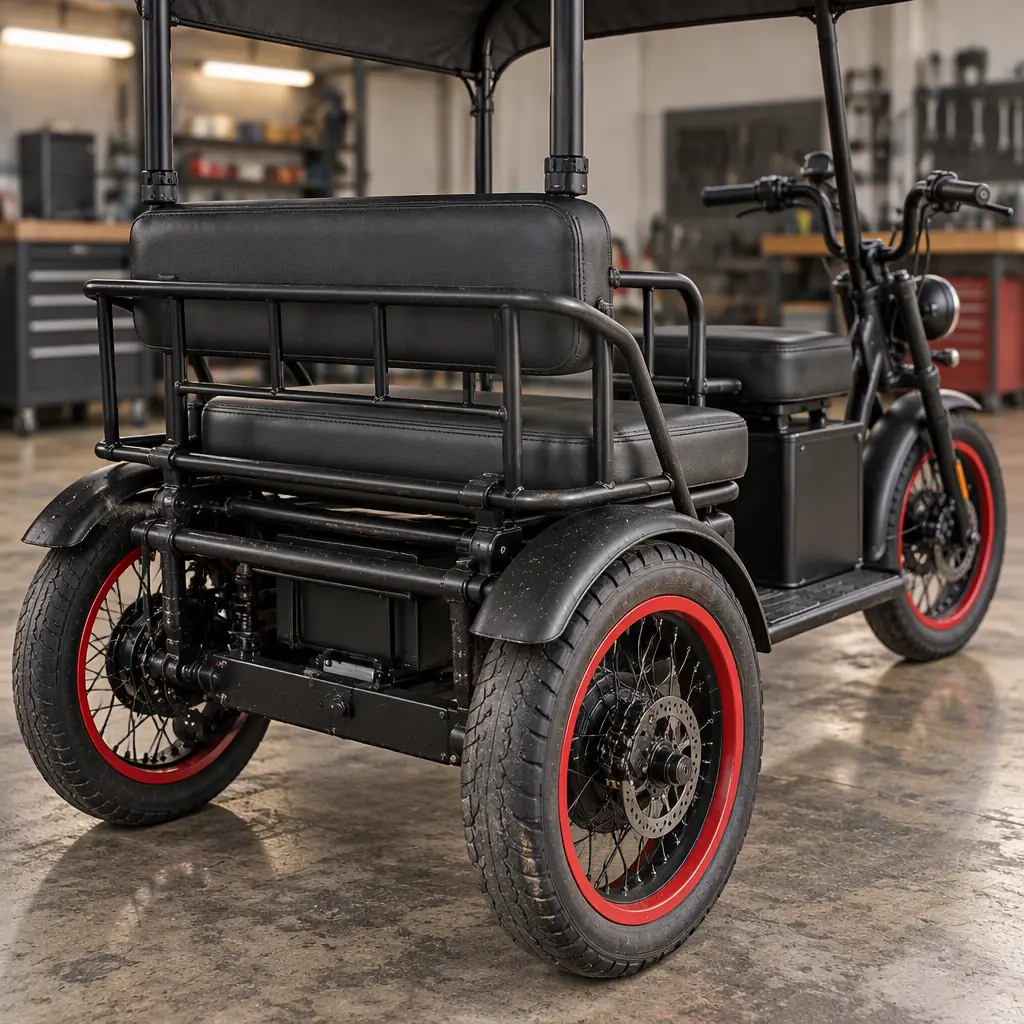
Canopy, Cabin and the Three Configuration Tiers
There is no single passenger tricycle. There are three configurations that serve genuinely different buyers, and confusing them is the second most common specification error.
Tier one, open bench with fabric canopy. PVC-coated polyester canopy with roll-up side curtains on all four sides, on a steel tube frame powder-coated to match the body. This is the tourism and resort configuration. It provides sun and rain protection while keeping the open-air experience, and the canopy panels are the natural place to print operator branding. Custom colour and logo printing across all panels is included at 50 units and above.
Tier two, weather-enclosed shuttle. A full enclosure with zip-down clear vinyl panels adds roughly $80 to $120 per unit and converts the vehicle into something usable in northern European or East Asian winters. Passengers stay dry, visibility stays intact, and the vehicle remains an open-frame design at heart.
Tier three, taxi-spec hard cabin. A full hard-top cabin with moulded ABS roof, acrylic windshield, manual wiper and lockable passenger doors, available on larger orders. This is the configuration that competes with conventional taxis under municipal air-quality replacement programmes, and it is the one that most changes the compliance story, because a lockable enclosed passenger compartment reads very differently to a vehicle-type-approval authority than an open bench does.
Seating itself is more configurable than buyers expect. The standard rear bench is a 2-person unit with backrest and armrest. A 3-person wide bench with extended foot platform adds approximately $45 to $65 per unit. Upholstery is marine-grade vinyl with accent welt piping available in a chosen colour, and seat foam density can be specified firmer or softer for markets with a strong preference either way.
The Compliance File Is Part of the Product
Passenger tricycles sit in an awkward place between bicycle and motor-vehicle regulation, and the documentation package is what lets a buyer establish a defensible position in their own jurisdiction. The production compliance set covers CE marking planning for the electrical system under the Low Voltage Directive, electromagnetic compatibility documentation for the motor controller, RoHS documentation extending to every component in the wiring harness, lighting assembly and dashboard electronics, and UN 38.3 test reports for the battery covering the T.1 through T.8 sequences including altitude simulation, thermal cycling, vibration, shock, external short circuit, impact, overcharge and forced discharge.
For markets that require vehicle-type approval for three-wheeled passenger carriers, the engineering team adapts the technical construction file to local requirements. Every container ships with a certificate of origin, a packing list carrying HS codes, and a bill of materials, which is what an importer actually needs to clear customs without a two-week delay while somebody emails a missing document across time zones.
One transport detail that is easy to miss: the battery is a removable under-seat pack, and each crate carries a foam-lined compartment for it so that UN 38.3 transport requirements are satisfied at the packing level, not just on paper. The vehicles ship in welded steel crates and are not flat-packed or partially disassembled to save volume, because the assembly errors and transit damage that result cost more than the freight saving.
Commercial Terms and First-Order Planning
The standard minimum order is 50 units per model, with a 15 to 30 day production lead time FOB China. Custom canopy designs or modified seating layouts add 7 to 10 days. First-time OEM orders carrying custom frame colour, canopy print and seat upholstery typically run 30 to 45 days from deposit to shipment, and pre-production samples ship before mass production begins.
Two planning notes are worth building into a first programme. First, treat the 50-unit minimum as a per-model figure, not a per-order figure: a dealer who wants both an open canopy and a hard cabin version is ordering two models and should plan the volume accordingly. Second, order the sample early and use it for the compliance conversation rather than the reverse. A physical vehicle in front of a transport authority resolves classification questions in an afternoon that a specification sheet cannot resolve in a month.
For buyers comparing this platform with alternatives, the useful context is that a passenger tricycle is not a cheaper car and not a bigger e-bike. It is a low-speed, low-floor, three-wheeled carrier whose economics come from duty cycle, not from sticker price. The two comparisons that actually inform a purchase decision are covered in our cargo versus passenger platform selection guide and our electric tricycle versus golf cart analysis, while buyers working through import mechanics should start with importing electric tricycles from China.
Where the Category Actually Sells
Urban short-haul transport. In dense cities across South and Southeast Asia, three-wheeled passenger vehicles already dominate short trips. The electric version removes engine vibration and exhaust from a vehicle that a driver sits on for an eight-hour shift, and the 300 kg total load handles a driver plus two adults with shopping.
Tourism and rental. Heritage districts, beach promenades and resort complexes use passenger e-tricycles as silent guided-tour vehicles. The canopy provides sun and rain cover while the open sides preserve the outdoor experience, and a printed canopy turns each vehicle into a moving advertisement. Operators building a fleet should read our passenger tricycle tourism and rental guide and the broader rental fleet guide before choosing a configuration.
Municipal transport programmes. Municipalities in Africa and Latin America procure electric passenger tricycles as regulated taxi replacements under urban air-quality programmes. The fixed-route, low-speed operating profile matches the vehicle's design envelope, and a centralised charging depot is easier to manage than distributed petrol refuelling. Fleet managers evaluating this route will find the procurement framing in our government fleet guide and the charging arithmetic in our fleet charging guide.
Accessibility and senior mobility. Step-through access, a low floor height and a bench with armrests make the passenger tricycle usable by riders and passengers with limited mobility who cannot climb into a conventional taxi. Retirement communities and senior transport services are evaluating electric three-wheelers as door-to-door solutions that cost a fraction of a modified van. Our adaptive electric tricycle guide covers the accessibility specification in depth.
Questions to Settle Before You Request a Quote
Five answers determine the quotation, and a buyer who has them ready shortens the process by weeks:
- How many occupants, and what is the heaviest realistic load? This sets motor power, battery capacity and whether the 3-person bench is appropriate.
- What climate will the vehicle work in? Sustained ambient above 35 degrees points to LFP. A cold-winter market may point to the enclosed configuration instead.
- Open canopy, weather enclosure, or hard cabin? Three different compliance stories and three different unit prices.
- Is this a branded programme or an unbranded fleet? Canopy printing, frame RAL colour and upholstery accents are all volume-dependent.
- Which jurisdiction, and does it require vehicle-type approval? This decides how much of the technical construction file has to be adapted.
Get those five right and the rest of the specification follows mechanically. Get the occupant load wrong and every downstream choice, from motor to brake to tyre, is built on a number that the first real passenger will exceed. That is also why a pre-production sample matters more on this platform than on almost any other: it is the only way to put a real family, a real taxi driver and a real set of shopping bags on the bench before fifty vehicles are committed to a configuration that cannot be changed without a new tooling run.
Specify your passenger tricycle programme
Send us your occupant load, climate, canopy configuration and target market. We will come back with a configuration, a unit price at your volume band, and the compliance document list for your jurisdiction.
