
Fleets do not fail on the vehicle spec. They fail on the charging plan. A cargo tricycle is the cheapest working vehicle most operators will ever buy, but it is also the only one that spends part of every day parked on a cable. Get the depot math wrong and you buy more vehicles than you can charge; get it right and the same fleet covers shifts that would otherwise need a second round of capital.
This guide is written for operations managers sizing a first or second e-tricycle fleet. It covers the electrical arithmetic, the charger and battery options our factory actually ships, the shift patterns that fit each pack size, and the depot procedures that keep a fleet on the road instead of queued at a wall socket.
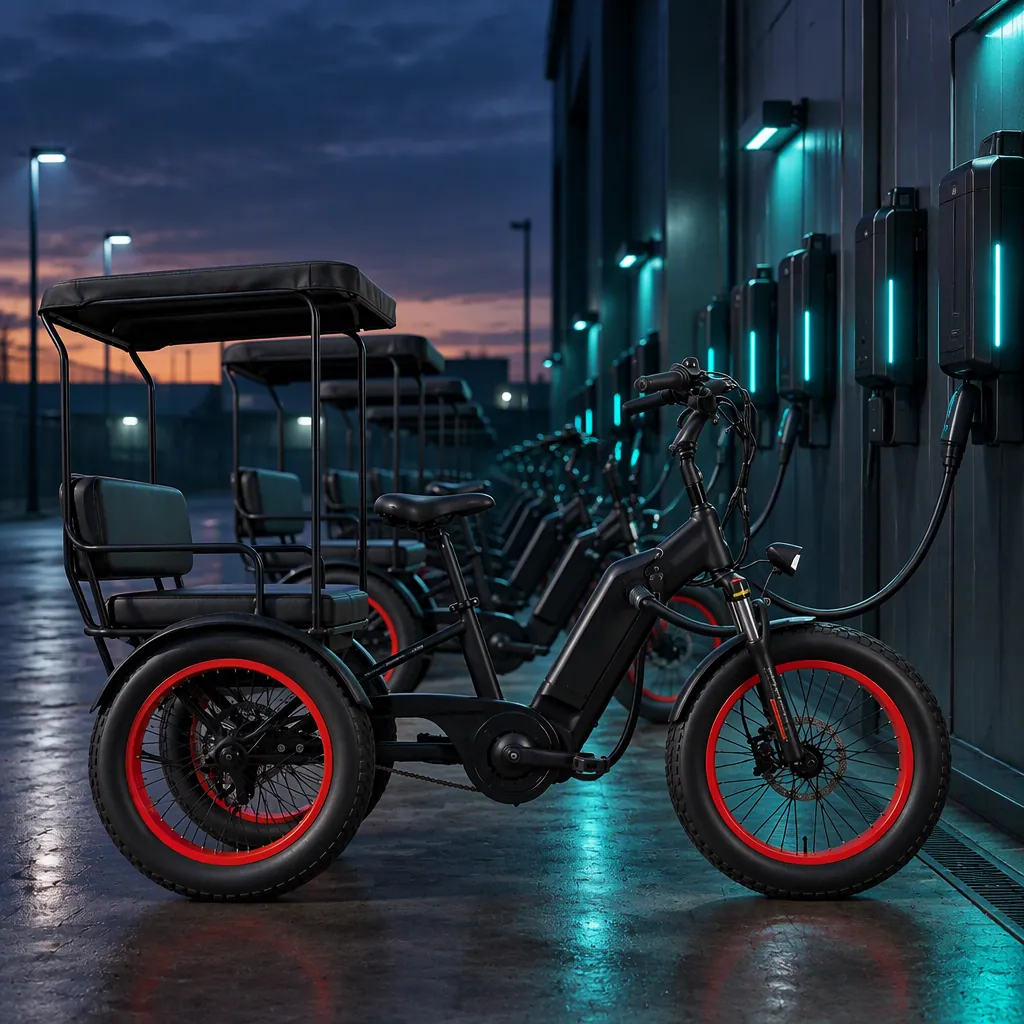
Why Charging Is a Fleet Decision, Not a Vehicle Decision
Buying one electric tricycle is a product decision. Buying ten is an electrical infrastructure decision, and the numbers that matter are different. A single unit charges wherever there is a socket. A fleet needs to know how many kilowatts the depot can supply, how many packs must be simultaneously on charge during the longest demand window, and what happens on the day one charger fails.
The reason this catches operators out is that the vehicle is purchased in one line item and the charging capacity is not. A 60V 32Ah pack on the platform we build draws roughly 5A on the standard charger, which is about 320W at the wall. Twenty units charging at once is 6.4 kW of continuous load on a circuit that may have been sized for workshop lighting and a kettle. That is a conversation with an electrician, not with a vehicle dealer, and it belongs in the purchase plan rather than in the first week of operation.
The second reason is availability. Charging time is the only part of a tricycle's day that is not productive. A pack that takes six hours on the standard charger cannot be rotated through three shifts at eight hours each unless something changes: faster charging, a second pack per vehicle, or a third fewer hours on the road. Those are the three levers, and every fleet charging plan is some combination of them.
The Power Math: How Much Depot Capacity You Need
The arithmetic is simpler than most operators expect, and it starts from the pack rather than from the charger.
Our cargo platform ships with either a 60V 32Ah NMC pack or a 72V 40Ah LFP pack, both swappable and both managed by a heavy-duty BMS. Nominal energy is approximately 1.9 kWh for the 60V pack and 2.9 kWh for the 72V pack. On the standard 5A charger, the 60V pack refills in about 6.4 hours and the 72V pack in about 8 hours, allowing for the CV tail of the charge curve and a little charger inefficiency.
| Item | 60V 32Ah NMC | 72V 40Ah LFP |
|---|---|---|
| Nominal energy | ~1.9 kWh | ~2.9 kWh |
| Refill time on standard 5A charger | ~6.4 h | ~8 h |
| Wall draw per vehicle on charge | ~320–350 W | ~420–450 W |
| Charge cycles to 80% capacity | ~800+ | ~2,000+ |
| Platform range at 200 kg payload | 50–80 km | 50–80 km |
Range is quoted the way the platform is actually tested: 50–80 km at 200 kg payload on flat ground. Heavier loads, hills and cold weather all reduce that figure, which is why a fleet plan should size the daily duty cycle from the worst route rather than the average one. If the hardest route consumes 70% of a pack, the plan needs to assume 70%, not 50%.
From there the depot figure falls out. Multiply the wall draw by the number of vehicles charging simultaneously. Ten units on 60V packs is a little over 3 kW; twenty is a little over 6 kW. Add the chargers' own standby load and a 20–30% headroom, and a twenty-vehicle fleet should be planning for something in the region of 8 kW of dedicated charging capacity rather than sharing a general-purpose ring main. That is the number to give an electrician before the vehicles arrive.
Charger Types: Standard 5A, Fast Charging, and the Connector Reality
Two charger paths matter for fleet operators, and the decision between them is about shift structure rather than about preference.
Standard 5A charging: the default for single-shift operations
The 5A charger is what ships as standard. It is slow, cheap, gentle on the pack and needs nothing more than a domestic-grade socket per vehicle. For a fleet running one shift a day with vehicles back at the depot by early evening, six to eight hours of overnight charging is exactly the right answer, and there is no operational reason to spend more.
The practical constraint is socket count, not charge speed. A twenty-vehicle fleet needs twenty charging points or a disciplined rotation schedule, and the cheapest way to get twenty points is a dedicated charging wall rather than trailing extension leads across a workshop floor.
Fast charging: for multi-shift and high-utilisation fleets
Where a vehicle must be returned to service within a shift, a higher-current charger cuts refill time substantially, at the cost of higher per-point infrastructure and a pack that must be specified to accept the current. This is where the pack choice and the charger choice become one decision. LFP chemistry tolerates higher charge rates and more cycles than NMC, which is why the 72V 40Ah LFP option is the one we recommend for fleets that expect to charge more than once a day or to keep vehicles in service for several years.
Connectors are a fleet-standardisation problem
Charging connectors vary between suppliers, and a fleet with mixed connector types cannot share chargers or move a pack between vehicles in an emergency. Whichever connector and voltage is chosen, it should be fixed across the whole fleet, specified in the purchase order, and held as a spare part with the lead time written down. Our after-sales programme covers the consumable and spare-part side of this in more detail in the guide to after-sales and spare parts planning.
Battery Swap: Turning Charging Time into a Shift Change
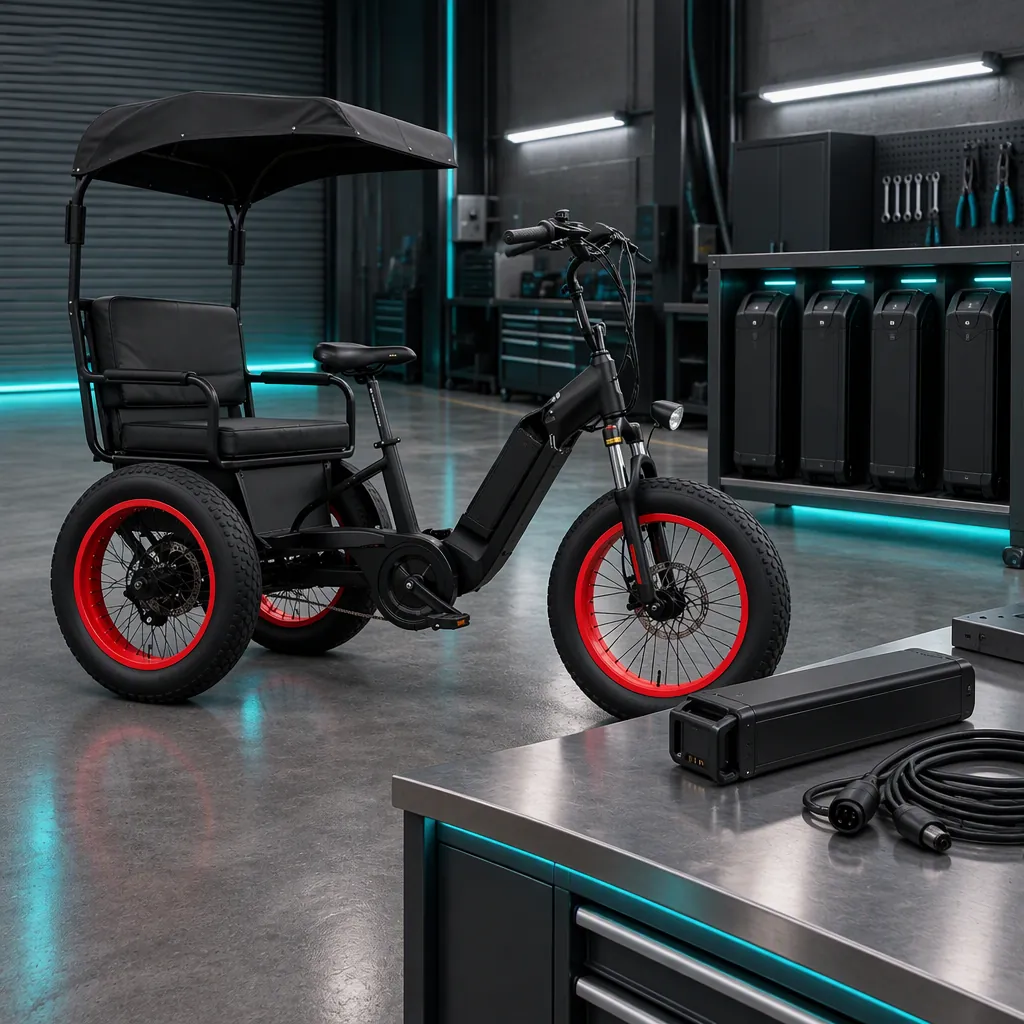
The fastest way to remove charging time from a vehicle's day is not to charge faster. It is to stop charging the vehicle at all and charge the packs instead. A swappable pack turns a six-hour wait into a two-minute task, and it decouples the number of vehicles from the number of charging points: ten vehicles can run on twelve packs and six chargers, because the pack, not the vehicle, is the unit being rotated.
Both our 60V 32Ah NMC and 72V 40Ah LFP packs are designed as swappable units with a slide-out mounting, which makes this the default fleet configuration for anyone running more than one shift. The requirements are modest but they are not optional:
- A fixed swap point. Packs should be exchanged at one station with a bench at working height, not in the yard. A 60V pack is heavy enough that lifting it from ground level is a manual-handling risk that will eventually cause an injury.
- A rack or cabinet, not a shelf. Packs on charge should sit in a dedicated rack with slots that hold each pack positively and keep terminals clear of metalwork. The rack should be away from walkways and from anything combustible.
- Charged and empty segregated. The single most common fleet error is mixing charged and discharged packs in the same stack. A simple colour-coded tag or a two-bay rack removes the failure mode entirely.
- Spare capacity of 10–20%. A fleet should hold at least one spare pack per ten vehicles so that a pack can be taken out of rotation for inspection without grounding a vehicle.
The economics are worth running explicitly. Adding a second pack to a vehicle typically costs less than adding a second vehicle, and it converts an eight-hour charging constraint into a two-minute labour task. Where the alternative is buying a larger fleet to cover the charging window, the swap route is usually the cheaper one.
Multi-Shift Rotation: The 4–4–4 Schedule
For three-shift operations the pattern that works with the packs we build is a 4–4–4 rotation: roughly four hours of running, four hours on charge, four hours as the reserve vehicle. Each vehicle in a pool of three covers one running slot while another charges and a third stays ready, so a three-vehicle pool keeps one vehicle in service continuously without ever needing fast charging.
The 4–4–4 pattern works because four hours of urban duty at moderate payload typically consumes less than half of a 60V 32Ah pack, which means each pack returns to the charger at a shallow depth of discharge. Shallow cycling is also the kindest regime for pack life, and it is the reason a well-run rotation fleet gets more service years out of a pack than a single-shift operation that runs the pack close to empty every day.
Two operational rules keep the schedule honest. First, the rotation is driven by pack state, not by the clock: a vehicle comes off the road when its pack reaches the agreed minimum, not when the driver happens to return. Second, the reserve vehicle is genuinely reserved. If the standby unit is dispatched for routine work, the pool has no answer on the day a pack trips its BMS.
Charging also has to respect temperature. Packs should be allowed to reach ambient before going on charge after a hard duty cycle, and a cold pack should not be charged hard in an unheated building. Our guide to winter operation and cold-weather handling covers the temperature side of the schedule in more detail, including the range derate that cold weather actually produces.
Energy Cost per Kilometer: The Number That Wins Budgets
The figure that survives a budget review is cost per kilometre, and for a cargo tricycle it is unusually favourable.
A 60V 32Ah pack holds about 1.9 kWh of usable energy and delivers the platform's tested 50–80 km at 200 kg payload. At a mid-range industrial electricity price of roughly $0.15 per kWh, and using the conservative end of the range, that works out at around $0.005 per kilometre in energy cost, before any allowance for charger losses. Even at a deliberately pessimistic 40 km per pack the figure stays under two cents per kilometre.
| Cost element | Electric cargo tricycle | Diesel light van (typical) |
|---|---|---|
| Energy cost per km | ~$0.005 | ~$0.12–0.15 |
| Drivetrain service items | Brake pads, tyres, bearings | Oil, filters, belts, injectors |
| Payload envelope | 300 kg (EU) / 500 kg (non-EU) | Depends on body |
| Access width requirement | Under 1 m footprint, cycle-lane legal | Vehicle-width lane |
The comparison that persuades finance is rarely the energy line on its own. It is the combination of energy cost, the absence of a combustion drivetrain service schedule, and the payload capability of the platform. The cargo box on our tricycle is a 150–500 L drop-side body with a 300 kg payload rating in the EU and 500 kg outside it, which puts a meaningful share of urban delivery and service work inside the vehicle's capability while keeping it small enough to use cycle infrastructure.
Fleets that need to justify the capital outlay across budget cycles should look at the financing options directly, which are set out in the guide to fleet financing and total cost of ownership.
Off-Grid and Solar Charging for Remote Operations
Not every fleet has a depot with a three-phase supply. Farms, remote work sites and event operations frequently have no reliable grid connection where the vehicles live, and the charging plan has to be built around a solar array and a battery buffer instead.
The arithmetic is manageable because the daily energy requirement is small. Ten vehicles on 60V packs, each consuming half a pack per day, need roughly 9–10 kWh of delivered energy. That is comfortably within what a modest array and a buffer bank can supply across a day, provided the array is sized for the worst month rather than the best one, and provided the buffer bank is separate from the vehicle packs so that a cloudy week does not strand the fleet.
Our platform supports a solar charging path that adds roughly 8–12 km of range per day from an on-vehicle panel, which is useful as a top-up for vehicles that park in the open but is not a substitute for depot charging at fleet scale. The practical configuration for a remote site is a fixed array feeding a stationary buffer bank, with the vehicle packs charged from the buffer overnight. Where operations genuinely have no grid at all, this is the configuration to specify at the quotation stage rather than to retrofit later.
The Fleet Charging SOP
Most charging failures are procedural rather than electrical. The standard operating procedure that prevents them is short enough to print and post at the charging wall.
- Charge at the same place, every time. Cables, chargers and packs stay in the depot. Charging equipment that travels with the vehicle gets damaged, lost or borrowed, and a fleet with missing cables has vehicles it cannot use.
- Inspect the cable and connector before connecting. A damaged connector is a fire risk and a pack-damage risk. Any cable showing exposed conductor, heat deformation or a loose fit comes out of service immediately and is replaced from the spare set.
- Never charge a swollen or damaged pack. A pack that has been dropped, immersed or visibly deformed should be quarantined away from the building and reported. This rule alone prevents the majority of serious battery incidents.
- Log pack and vehicle. A simple log matching pack ID to charge start, charge end and vehicle lets you spot a pack whose capacity is falling before it strands a route. Pack-level records are also what an OEM needs to support a warranty claim.
- Keep the charging area clear. No combustible storage, nothing stacked against the rack, and nothing stored under the charging wall. Charging areas should be ventilated and, where the building allows, separated from general storage.
The same discipline applies to the vehicles themselves. Brake condition, tyre pressure and drivetrain inspection all belong on the same daily checklist as the charging routine, and the consumable and inspection intervals are set out in our guide to scheduled maintenance for electric tricycle fleets.
Design a Charging-Ready Trike Fleet
Charging is where an electric fleet either works or becomes an expensive experiment. The vehicle spec is the easy part: both our 60V 32Ah NMC and 72V 40Ah LFP packs are swappable, the platform carries 300 kg in the EU and 500 kg outside it with a 150–500 L drop-side cargo body, and the tested range is 50–80 km at 200 kg payload. The depot plan is what turns those numbers into a working operation.
Before committing to a fleet order, it is worth verifying the real constraints on a factory sample: pack swap weight, actual charge time on the specified charger, and the connector standard for the whole fleet. Our OEM buying guide sets out the verification checklist that covers this step, and the platform specification for the cargo body and drivetrain is documented on the cargo tricycle platform page.
- Size the depot load first. Multiply the wall draw per vehicle by the number of vehicles charging simultaneously, add 20–30% headroom, and give that figure to an electrician before the order is placed.
- Choose the pack chemistry against the shift pattern. Single-shift operations are well served by the 60V 32Ah NMC pack on the standard 5A charger. Multi-shift fleets should specify the 72V 40Ah LFP pack for its higher cycle life and better tolerance of frequent charging.
- Decide swap strategy before vehicle count. A spare pack per ten vehicles is usually cheaper than an extra vehicle, and it removes the charging window from the operational day entirely.
- Fix one connector and one voltage across the fleet. Mixed standards break charger sharing and pack interchangeability, and they make emergency substitutions impossible.
- Verify on a factory sample. Test swap weight, charge time and connector fit before the fleet order is confirmed. The fleet terms we quote are a 50-unit minimum order with 15–30 days lead time, and first orders with custom bodywork typically run 30–45 days.
Sizing support for your duty cycle
Tell us your fleet size, shift pattern and depot electrical setup and we will size the pack configuration, charger count, swap rack and battery spares against your actual duty cycle. Fleets that plan the depot load, the pack chemistry and the swap routine together run the same number of vehicles harder, with fewer chargers, than fleets that treat charging as something to solve after the vehicles arrive.
Design a Charging-Ready Trike Fleet
Tell us your fleet size, shift pattern, and depot electrical setup. We will spec the pack configuration, charger count, swap racks, and battery spares so your fleet never waits on a charge.
