
An electric cargo tricycle that costs $1,300 FOB does not arrive as a $1,300 decision. Add freight, duties, inland delivery, a charging point, spare tyres and a driver’s first month of training, and a ten-unit fleet is a mid-five-figure commitment before a single parcel moves. That gap between the unit price and the programme cost is where fleet financing is won or lost — not in the interest rate.
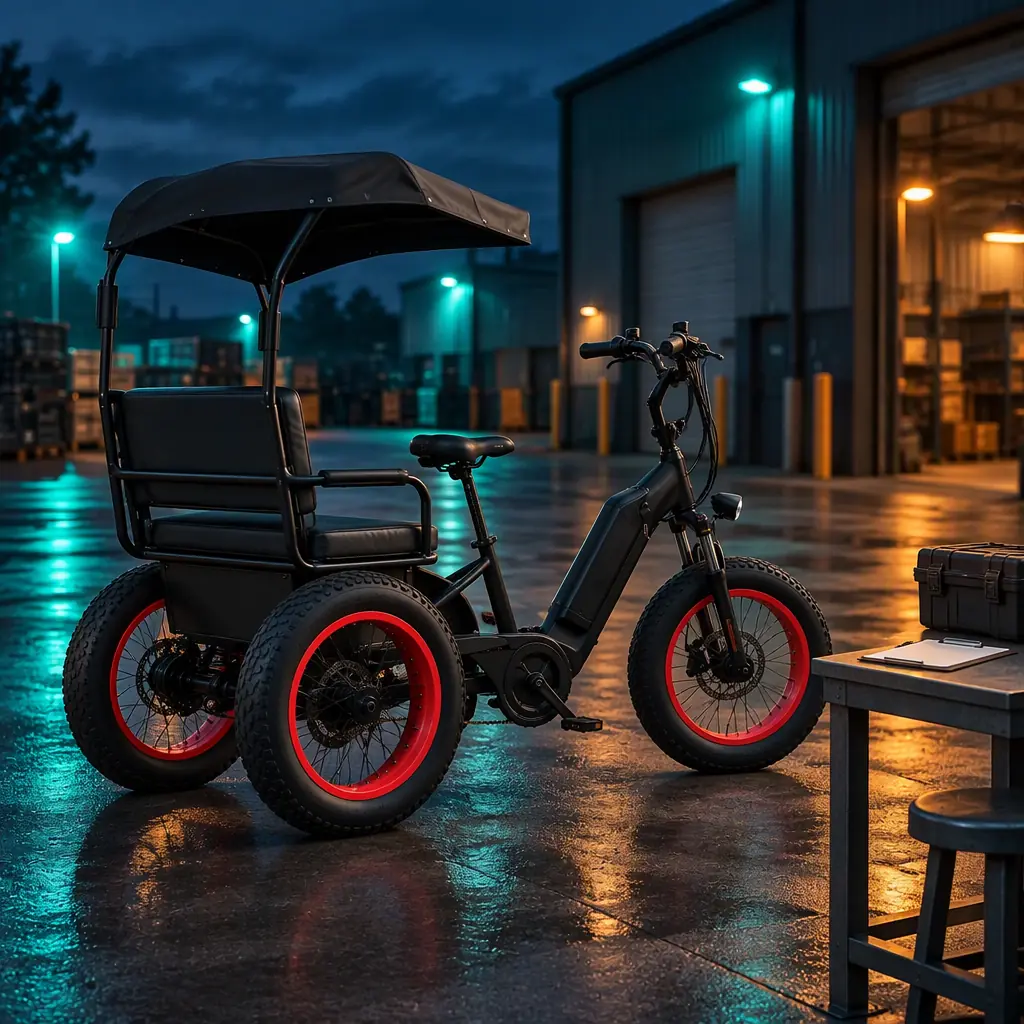
This guide works through the four funding structures importers actually use for tricycle fleets, the grant and incentive routes that change the arithmetic, and a worked total-cost-of-ownership model built on the specification data of the platform itself. Every number below is drawn from the platform specification, the factory quality gates and the export terms — the same documents your finance committee will ask for.
What You Are Actually Financing
The financing conversation starts with an accurate capital cost, and that means separating the vehicle from the programme. On a standard cargo e-tricycle platform the vehicle itself is a well-defined object: an 800W / 1000W / 1200W brushless hub motor with differential, 60V or 72V, a 60V 32Ah or 72V 40Ah lithium pack (LFP available) with a heavy-duty BMS, 50–80 km of range loaded at 200 kg on flat terrain, 25–35 km/h top speed, and 6–10 hours to full charge on a 5A charger. Payload is rated 300 kg in EU configuration and 500 kg outside the EU, with a cargo box of 150–500 L and drop-sides. Hydraulic disc brakes at the front pair with dual drum brakes and a parking brake at the rear. Unladen weight runs 150–220 kg before the box. That is a machine with a documented FOB band of roughly $1,250–$1,550 for the entry configuration, moving up through mid and high specifications.
Around that unit price sits the programme cost, and it is larger than most first-time importers budget for:
- Freight and duties — sea freight FCL or LCL, plus destination duty and customs brokerage on the full declared value of the shipment.
- Battery documentation — UN 38.3 transport test reports travel with the order; they are a cost of compliance, not an optional extra.
- Spare parts float — tyres in 3.00-12 front and 3.75-12 rear fitments, brake components, controllers and at least one spare pack per ten vehicles.
- Workshop and charging — a 230V charging point per berth on the standard 5A charger, plus basic tooling.
- Driver and tech training — the reverse gear, the three-speed selector and the load indicator are simple, but the driving envelope loaded at 500 kg is not intuitive.
Finance the programme, not the invoice. A structure sized on the FOB number alone will leave the fleet under-capitalised in month three, exactly when the first tyre replacements land.
Lease vs Equipment Loan vs Cash: The Decision Framework
There is no universally correct answer here, but there is a correct sequence of questions. Work through them in order and the structure usually selects itself.
| Question | If yes | If no |
|---|---|---|
| Is the fleet revenue-generating from week one? | Loan or lease — the asset services its own payment | Grant or phased cash purchase |
| Do you need the vehicles off the balance sheet? | Operating lease | Equipment loan |
| Is your operating market stable for 5+ years? | Loan — you capture the residual value | Lease — hand the residual risk back |
| Do you have fleet-managed maintenance already? | Lease with a service bundle | Loan and self-maintain |
| Is grant funding available in your jurisdiction? | Grant first, finance the balance | Pure commercial structure |
Cash purchase is the cheapest structure on paper and the most expensive in practice for a growing fleet, because it converts working capital into a depreciating asset and removes your buffer for the spares float. It makes sense for a pilot of two to four units where the goal is proving the route, not scaling it.
An equipment loan secured against the vehicles is the default structure for commercial fleets. You own the asset, you depreciate it, and you capture whatever residual value remains at the end. The critical underwriting question is not your credit score but the lender’s view of the asset’s value at term. Bring the specification sheet, the FOB band and the payload rating — a lender who understands the 300 kg EU / 500 kg non-EU distinction will size the advance more generously than one who files the tricycle alongside generic workshop equipment.
An operating lease moves the asset off your balance sheet and converts the purchase into an operating expense. The trade-off is that you pay for the residual-risk transfer every month. Leasing wins when your market horizon is shorter than the asset life, when you want certainty of monthly cost, or when your accounting treatment favours operating expense. It loses when you would have kept the vehicles anyway — you have paid for a risk you never took.
Grants, Subsidies and Public Funding Routes
Public-sector and regulated fleets have a funding layer that commercial buyers do not. Municipal and government procurement in many markets is explicitly structured to support electrification, and the tricycle platform is an unusually good fit because it replaces a much heavier vehicle per unit of work.
Three characteristics make an application stronger:
- Documented compliance. Tenders routinely demand ISO 9001 and ISO 14001 factory certificates, UN 38.3 battery transport reports, EN 15194 or UL 2849 compliance letters, and RoHS and REACH substance declarations, frequently subject to legalisation and apostille. A single missing document can disqualify the whole bid, so the document pack is assembled to the RFP schedule rather than requested after award.
- Measurable substitution. Grants reward displacement. A cargo tricycle carrying 300 kg on a delivery circuit replaces kilometres that would otherwise be driven by a van or pickup, and the fuel and maintenance delta is the number your application needs to state.
- Service continuity. Public fleet contracts typically run five to eight years with defined service-level agreements — documented repair-turnaround commitments, spare-parts availability for the contract duration, quarterly fleet health reports and annual safety inspections. A supplier who can map to that framework is a materially stronger grant partner than one who sells boxes.
When grant funding is available, sequence it first. Grant capital is the cheapest money in the structure and it reduces the principal that any commercial lender has to underwrite, which in turn improves the rate on the balance. See the government and municipal fleet guide for how the documentation pack is assembled for tender.
The Residual Value Question
Every lease or loan negotiation eventually arrives at the same number: what is this vehicle worth in four years? On a tricycle platform there are three defensible answers, and you should know which one your structure assumes.
Service life is long and cheap to extend. The platform is a steel tube chassis with heavy-duty e-coat and powder coat, an aluminium or steel cargo box with drop-sides, and an LCD display with speed, battery percentage, load indicator and reverse gear. The consumables are inexpensive and industry-standard: tyres in the 3.00-12 and 3.75-12 fitments, brake shoes and pads, controllers. A fleet that keeps a spares float and performs the scheduled inspections routinely runs a platform well past the term of a standard equipment loan.
Battery condition is the dominant variable. The pack is the single largest cost line and the one that sets residual value. An LFP pack specification, chosen for a hot-climate operating market, delivers more cycle life than a standard NMC configuration. Charging practice matters as much as chemistry: a fleet that charges on the 5A charger overnight and avoids deep discharge protects residual value in a way that a fleet running opportunistic top-ups does not. This is a maintenance policy that shows up directly on the balance sheet.
Regulatory classification is stable. The 25–35 km/h envelope with a governor settable to 25, 35 or 40 km/h keeps the platform in the light-vehicle class in most markets, and the platform is not a road-registered vehicle in the heavy sense. That stability makes the asset easier to re-market than a vehicle whose classification could be re-drafted. The same characteristic has a hard boundary: a non-road-registered platform cannot legally be used across public roads, so a fleet intended for public-road work needs the regulatory position confirmed before the finance is signed, not after.
A Worked TCO Model
The following model uses the documented platform specification. Substitute your own figures for freight and local labour; the structure of the arithmetic is what matters.
| Cost line | Basis | Note |
|---|---|---|
| Vehicle acquisition | $1,250–$1,550 FOB, entry configuration | Mid and high specifications sit above this band |
| Freight, duty and brokerage | Per shipment, FCL or LCL | Applies to full declared value |
| Charging energy | 60V 32Ah pack; 6–10 h on a 5A charger | Arithmetic below |
| Tyres and brake consumables | 3.00-12 front / 3.75-12 rear dual | Load-rated reinforced fitments |
| Scheduled maintenance labour | Per inspection interval | Use your local rate |
| Battery replacement provision | Per 72V 40Ah or 60V 32Ah pack | Set aside monthly, do not defer |
| Downtime cost | Per vehicle-day off route | The line most often omitted |
Charging energy is the easiest line to calculate and the easiest to get wrong. A 60V 32Ah pack holds 1.92 kWh of nominal energy; a 72V 40Ah pack holds 2.88 kWh. Multiply by your electricity tariff and by the number of charge cycles per year. A vehicle charged once daily for 300 operating days on a 1.92 kWh pack draws roughly 576 kWh per year before charging losses — a figure small enough to be a rounding error against the acquisition cost, which is precisely why electrification improves the operating ratio. The maintenance and energy delta versus a conventional vehicle is where the grant application and the finance case both land.
The line that most business cases omit is downtime. A tricycle off the route is not just an idle asset; it is work that either does not happen or gets pushed onto a more expensive vehicle. Spare-parts availability for the contract duration is therefore a financing-relevant term, not a logistics detail. If the OEM cannot commit to supplying 3.00-12 and 3.75-12 tyres and brake components on a defined lead time, price the downtime into your model before you sign. See the after-sales and spare-parts guide for what that commitment should look like on paper.
What to Demand From the Supplier Side
Financing structures inherit the quality of the order underneath them. A lender underwriting a fleet is underwriting the factory behind it, so the evidence you collect at the quoting stage is the same evidence your funder will want.
Quality gates, not marketing claims. Ask for the inspection regime: incoming material sampled to AQL 2.5 Level II before it reaches the line; lithium cells sorted with anything beyond 3 mΩ internal resistance or 0.02V open-circuit voltage rejected; frame tubing checked with ultrasonic thickness gauges and weld coupons tensile-tested per steel batch; motor stators tested for winding resistance and insulation breakdown at 500V DC. In-process torque verification on safety-critical fasteners — handlebar clamp bolts at 25 N·m, axle nuts at 40 N·m, brake caliper mounts at 18 N·m — logged to each unit’s quality passport. A supplier who repeats those numbers back to you is a supplier your lender can underwrite. The full regime is documented in the quality and compliance page.
Packaging that survives the voyage. Finance covers goods that arrive usable. The export packing standard is a 7-layer BC-flute master carton at 1,200 kPa minimum burst strength, stack-tested to five cartons high; 30 mm moulded closed-cell PE foam at 28 kg/m³ covering 85% of the frame surface; a 150 µm aluminium-laminate moisture barrier bag with a 50 g desiccant pack holding internal humidity below 40% RH; and a steel-reinforced 1,100 × 1,100 mm pallet rated to 1,200 kg. See the shipping and export page for the full specification.
Commercial terms that match the funding cycle. OEM orders start at 50 units per model with a 15–30 day standard lead time, extending to 30–45 days for a first custom-branded run, and pre-production samples ship before mass production. For a financed fleet the sample stage is not a formality — it is the physical evidence that de-risks the advance.
Ordering the Steps
- Specify the platform against the real duty. Payload rating, box volume and range determine which configuration you are financing; the 300 kg EU / 500 kg non-EU distinction and the 50–80 km loaded range at 200 kg are the two numbers to anchor on.
- Build the programme budget, not the unit budget. Add freight, duty, spares float, charging, training and a downtime provision.
- Sequence the capital. Grant and subsidy capital first where available, commercial finance on the balance, cash for the pilot tranche if you need proof before scaling.
- Select the structure against the residual question. Own the residual with a loan if your horizon is long; transfer it with a lease if it is not.
- Attach the supplier evidence to the finance pack. Quality gates, certification documents, packaging standard and spare-parts commitment all belong in the file your lender or grant body reviews. See the dealer and distributor guide for how a distribution agreement frames those commitments.
- Model the maintenance policy into the residual. Charging discipline and pack choice are balance-sheet decisions, not workshop preferences. See the battery pack guide.
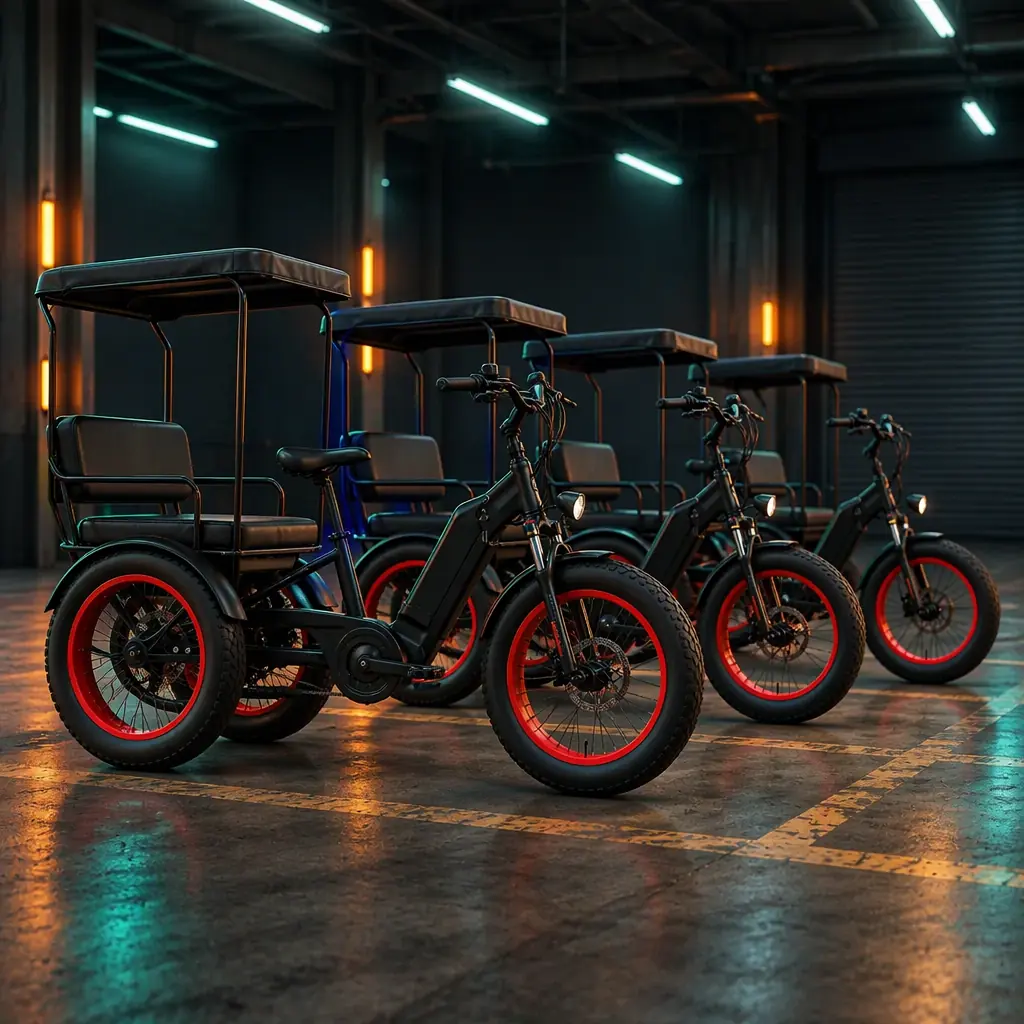
A tricycle fleet is a capital programme wearing the clothes of a vehicle purchase. The importers who get it right are the ones who finance the programme — the spares float, the charging berths, the training and the residual policy — and then negotiate the rate on top. Start with the platform specification and the compliance pack, build the budget upward from there, and bring your funder into the conversation with the factory evidence already in hand.
Build a Financed Fleet Plan
Tell us the fleet size, vehicle class, and your financing structure. We will prepare the spec sheet, landed-cost breakdown, and certification pack your lender or leasing partner will ask for.
