
A cargo tricycle at full payload is a heavy vehicle that stops on one front contact patch and two rear ones. The front wheel alone is expected to shed most of the kinetic energy, and the rear pair has to stay planted while it does. This is why brake architecture, not motor power, is the first specification a fleet buyer should interrogate on a cargo trike. A 1200W motor can get a loaded trike to 35 km/h without effort; it is the brake system that decides whether it comes back down safely, repeatedly, on the routes your drivers actually run.
This guide covers the brake architecture our cargo platform ships with, where each half of that system earns its cost, how to test stopping performance at full payload before you sign off a sample, and the specification checklist worth putting into an RFQ.
Why Brake Specs Matter More on a Trike Than a Bike
A two-wheel vehicle brakes in a straight line and leans into the load transfer. A delta cargo tricycle does not lean. It has a single steered front wheel and two driven rear wheels, and under braking the weight transfer runs forward onto that single front contact patch while the two rear wheels are still carrying the cargo box. The result is three specific problems a bicycle never has to solve.
- Front contact patch is the limiting factor. One wheel has to provide the majority of the deceleration force. If the front brake is undersized or grabby, the wheel locks early and the trike loses steering exactly when the driver needs it most.
- Rear wheels unload unevenly on cambered or broken surfaces. With a rigid rear axle, one rear wheel can lift slightly on a pothole edge. A rear brake that depends on perfect contact becomes inconsistent on exactly the farm tracks, kerbs and yard surfaces these vehicles work on.
- Gross weight amplifies everything. A trike configured to carry 300 kg (EU) or 500 kg (non-EU) of cargo, plus a 150–220 kg vehicle, is a very different braking problem from a 25 kg bicycle. Brake fade, heat build-up and pad wear all scale with that mass.
The practical conclusion: on a cargo trike you are not choosing a brake brand, you are choosing a brake architecture and then confirming it with test data at your real payload.
The Standard Architecture: Hydraulic Disc Front, Dual Drum Rear
Our cargo tricycle platform ships a split system as standard, and it is split for a physical reason rather than a cost reason.
| Position | System | Why it is specified here |
|---|---|---|
| Front (single wheel) | Hydraulic disc brake | Carries most of the braking force under forward weight transfer. Hydraulic actuation gives progressive, repeatable lever feel and self-adjusts as pads wear, which matters because the front brake does most of the work and wears fastest. |
| Rear (dual wheels) | Drum brakes, one per rear hub | Enclosed from dust, mud, grit and water. Provides stable, predictable retardation on the rear axle without the exposed rotor and caliper that debris-rich routes damage. Also acts as a mechanical hold. |
| Parking | Parking brake | A separate mechanical hold so a loaded trike does not roll on a slope with nobody aboard. This is a specification, not an accessory. |
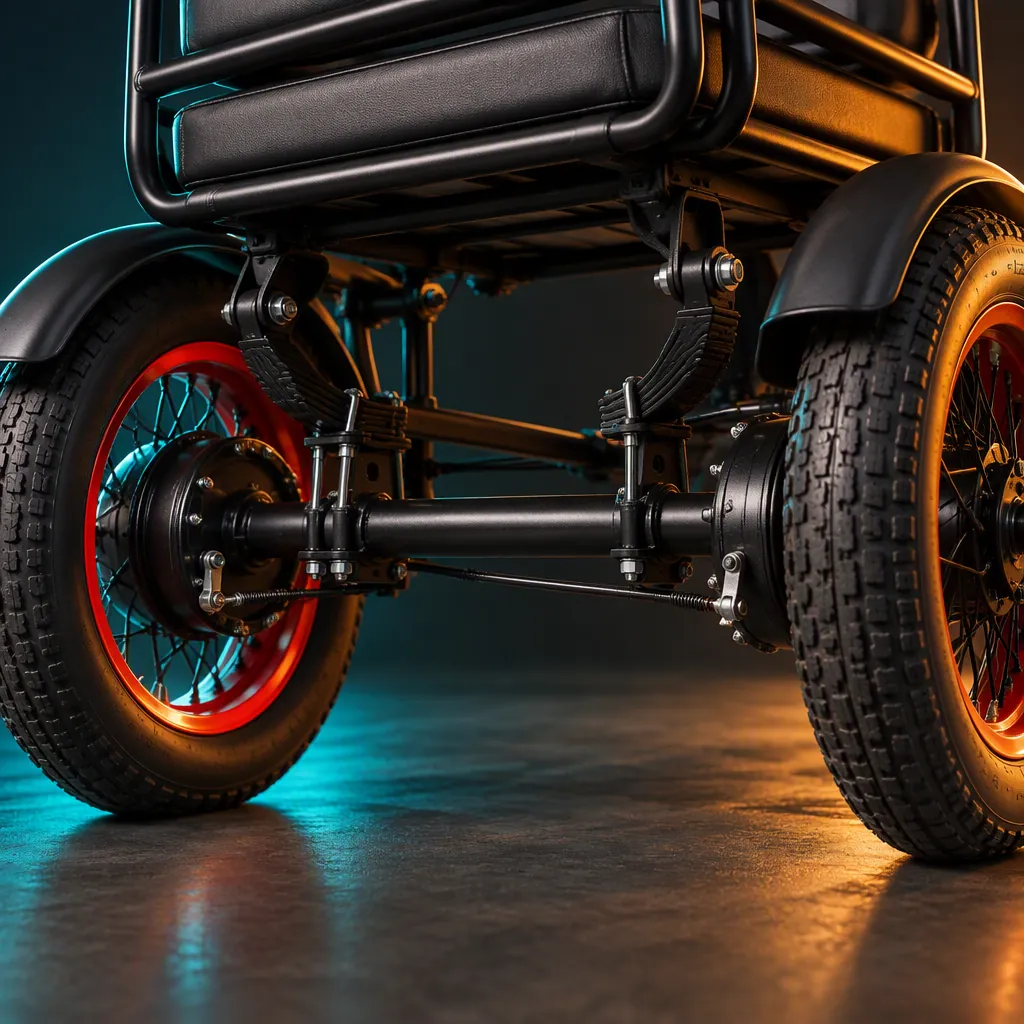
Note the asymmetry of workload. The front disc handles the dynamic braking, the rear drums handle durability and hold. A buyer who specifies a disc on every wheel is usually paying for exposed rotors that the duty cycle will destroy; a buyer who specifies drums everywhere is trading away front-wheel controllability that loaded braking genuinely needs.
Hydraulic Disc Brakes: Where They Earn Their Cost
The front hydraulic disc is doing the highest-energy work on the vehicle, so this is the one place where hydraulic actuation is not a luxury.
- Modulation under load. A cable-actuated brake loses feel as the cable stretches and the housing compresses. Hydraulic actuation transmits force through fluid, so lever effort stays consistent across the pad life and the driver can feather the brake instead of grabbing it. On a loaded trike with a single front contact patch, that modulation is what keeps the front wheel rotating.
- Self-adjustment. As pads wear, a hydraulic system takes up the slack automatically. On a fleet vehicle where the front brake may be the fastest-wearing component, that removes a recurring adjustment interval from the maintenance schedule. Wear items and their lead times are covered in our after-sales and spare parts guide.
- Heat capacity. A disc rotor is exposed to airflow and sheds heat well, which matters on descents and on routes with frequent loaded stops. The trade-off is exposure: rotors and calipers on the front wheel are vulnerable to impacts from kerbs, debris and loading-dock edges.
Where the front disc is not the answer is a duty cycle built on deep mud, sand or continuous grit. In those conditions an exposed rotor wears fast and a caliper can be contaminated. If your routes are genuinely abrasive, that is an argument for more braking authority at the rear rather than a larger front disc, and it is worth raising at specification time.
Drum Brakes: The Workhorse Under Payload
Drum brakes have a reputation for being the cheap option. On a cargo tricycle that reputation is misleading, because the drum's weaknesses are mostly irrelevant at these speeds while its strengths line up exactly with the duty cycle.
- Sealed against the environment. The friction surfaces live inside a drum, so dust, mud, grit and water do not sit on them the way they sit on a rotor. On farm tracks, construction sites, yards and winter-salting routes, that enclosure is the difference between consistent braking and unpredictable braking.
- Long service intervals. Because the friction surfaces are protected, shoe life on a rear drum is typically measured in much longer intervals than an exposed pad. For a fleet doing daily work in dirty conditions, the maintenance saving is real.
- Good hold, low drama. Drum brakes are well suited to being the rear, secondary, and parking-hold element. They do not need to shed the majority of the energy, so their known weakness under sustained heavy braking is not the constraint here.
- Speed range fits. The platform runs 25–35 km/h with a configurable governor. Drum performance characteristics that would be a limitation on a motorcycle at highway speeds are not the limiting factor at cargo-trike speeds.
The honest limitation: a drum brake is harder to inspect than a disc and does not modulate as finely. Both are acceptable on the rear axle, where the drums are sharing the work between two wheels and are not carrying the primary deceleration load.
Stopping Distance: What to Test at Full Payload
A brake specification on a quotation is not evidence. The only useful evidence is a measured stop, at your payload, on your surface, from your normal working speed. When you receive a pre-production sample, this is the test protocol worth running before you release mass production.
| Test | How to run it | What you are looking for |
|---|---|---|
| Dry loaded stop | Load the cargo box to rated payload, accelerate to governed top speed, apply both brakes firmly to a full stop. Repeat ten times. | Consistent distance across the ten runs. Distance that grows run over run means fade. |
| Wet loaded stop | Same run with the brakes and wheels wetted down, on a safe closed surface. | How much distance the wet condition adds, and whether the loss recovers after the first application. The sealed drum rear should be less affected than the exposed front disc. |
| Downhill repeat | Ten consecutive loaded stops on a descent, without a cooling interval. | This is the fade test. It is the single most revealing test for a cargo trike brake system and the one most often skipped. |
| Parking hold | Load to rated payload, park on the steepest slope of your intended route, leave the parking brake engaged. | Zero creep. If the trike moves, the parking brake is not a parking brake. |
| Single-wheel-lift behaviour | Loaded stop on a broken or cambered surface where one rear wheel unloads. | The trike should stay straight and predictable. This is where a mismatched rear system shows itself. |
Run these on the sample, not on a demo unit at the factory on smooth concrete. A brake system that stops well on a clean floor and badly on your yard is a system that was never tested against its duty cycle. If you want the wider pre-production checklist, our payload capacity guide covers how load rating interacts with the rest of the vehicle specification.
The Parking Brake: A Spec, Not an Afterthought
On a vehicle that carries several hundred kilograms for a living, a parking brake is a safety device rather than a convenience. A loaded trike parked on any kind of incline with only the service brake relied upon is a risk that shows up in exactly the moment nobody is watching: a driver unloading at a kerb, a yard with a slight slope, a site with loose surface.
Confirm three things in writing. First, that a parking brake is fitted as standard rather than offered as an option. Second, that it is mechanical and independent of the hydraulic service circuit, so a hydraulic fault cannot release it. Third, that it has been tested at rated payload on a slope, because a parking mechanism that holds an empty trike may not hold a loaded one.
Maintenance and Wear Items on a Working Trike
Brake wear is the most predictable maintenance cost on a cargo tricycle, and the specification you choose determines how often it recurs.
- Front pads wear fastest because the front brake does the most work. Expect these to be the first brake consumable.
- Rear shoes last considerably longer because they are enclosed and share the load across two wheels.
- Rotors and drums are long-life items but should be inspected for scoring, especially on abrasive duty cycles.
- Brake fluid and hoses on the hydraulic front circuit are the parts most often forgotten in a fleet maintenance schedule. Fluid condition matters, and hoses should be inspected for chafing.
When you place an order, ask for the brake consumables to be listed with part numbers and lead times alongside the rest of the spare parts list. A fleet that cannot re-order a brake pad is a fleet with a parked vehicle. Our maintenance guide covers how brake inspection fits into a scheduled service interval.
OEM Brake Spec Checklist for Buyers
Use this list when comparing quotations. It separates a real specification from a line item.
- Architecture stated explicitly. Front system named (hydraulic disc, rotor diameter), rear system named (drum, one per rear hub). A quotation that says only “front and rear brakes” has not specified anything.
- Rated to your gross weight. Braking authority should be stated against gross vehicle weight at your payload, not against an empty vehicle. Confirm the figure covers 300 kg (EU) or 500 kg (non-EU) rated capacity plus the 150–220 kg vehicle mass.
- Parking brake included as standard. Mechanical, independent of the hydraulic circuit, and tested at payload.
- Rotor and drum specifications in the quote. Sizes and material, so a later substitution to a smaller component is visible rather than silent.
- Tire and load rating matched to the brake spec. A brake system is only as good as the contact patch. The platform runs 3.00-12 front and 3.75-12 rear dual, load-rated and reinforced; the tire guide explains how load index interacts with braking.
- Test data supplied with the sample. Ask for measured loaded stopping distances, including a downhill repeat test. This is the deliverable that turns a claim into evidence.
- Consumables listed with part numbers and lead times. Pads, shoes, rotors and hoses should all appear on the spare parts list, with the service structure described in the after-sales and spare parts guide.
Brake components are also where certification risk hides: the brake system is part of the EN 15194 and UL 2849 scope, and the eMark type-approval process for higher-speed trikes includes specific brake tests. Our EU vs US certification guide maps which brake documentation you need for each market, and the safety features guide covers how braking interacts with the rest of the safety specification.
Spec a Brake System Built for Your Payload
Brake specification on a cargo tricycle is a systems decision: a hydraulic disc where the energy is highest, sealed drums where durability matters, a mechanical parking hold as standard, and measured stopping data before you commit to a production run. Get the architecture right up front and the duty cycle will not find the gap later.
Spec a Brake System Built for Your Payload
Tell us your gross weight, duty cycle, and terrain. We will spec the rotor sizes, caliper type, and drum brake rating with stopping-distance test data from the sample phase.
