
Most cargo e-tricycle buyers spend their first meeting on motor watts and battery amp-hours. The part that decides whether the vehicle still tracks straight after two seasons of kerbside loading is further back: the rear axle assembly and the differential inside it. On this platform the drive is an 800W / 1000W / 1200W brushless hub motor with an integrated differential running on 60V or 72V, and the whole assembly is engineered around a 300 kg (EU) / 500 kg (non-EU) rated load with box volumes from 150L to 500L.
This guide is written from the export engineering side of that assembly. It covers what the differential actually does on a three-wheeled vehicle, why the axle has to be treated as a system rather than a steel bar, what the real hardware looks like, how the drive copes with a full load, and exactly which numbers to pin down before you sign an OEM order for 50 units.
What a Differential Actually Does on a Cargo Tricycle
On a two-wheeled bicycle there is nothing to reconcile: one driven wheel, one path. A cargo tricycle drives two rear wheels from one motor, and those two wheels do not travel the same distance in a turn. The inner rear wheel follows a shorter arc than the outer one, so if the two were locked together on a solid shaft, one of them would have to slip. On wet paving, gravel or a warehouse floor that slip is exactly how a loaded trike skids its rear end.
The differential is the gear set that lets the rear wheels turn at different speeds while both receive drive. Three consequences matter to a buyer:
- Cornering without scrubbing. The inner wheel slows, the outer wheel speeds up, and the vehicle follows the steering line instead of pushing wide. On a trike with a 300–500 kg payload this is the difference between a clean turn into a loading bay and a two-point shuffle with a skid.
- Torque split across both rear wheels. Drive is not concentrated on one side. That matters on gravel yards, wet ramps and rammed-earth access roads where a single driven wheel would spin long before the vehicle was actually stuck.
- Less shock into the driveline. Because the wheels are no longer fighting each other, the loads arriving back through the half shafts and the motor are lower on every tight turn. That is a durability argument, not just a comfort one.
One honest limitation to plan around: an open differential always sends torque to the wheel with less grip. On a trike used mostly on sealed surfaces, yards and paved delivery routes this is a non-issue. If your route includes loose sand, deep mud or steep unsealed grades, say so at the enquiry stage, because that is a route characteristic that should drive the tyre choice and the payload planning rather than being assumed away.
The Rear Axle Is a System, Not a Bar
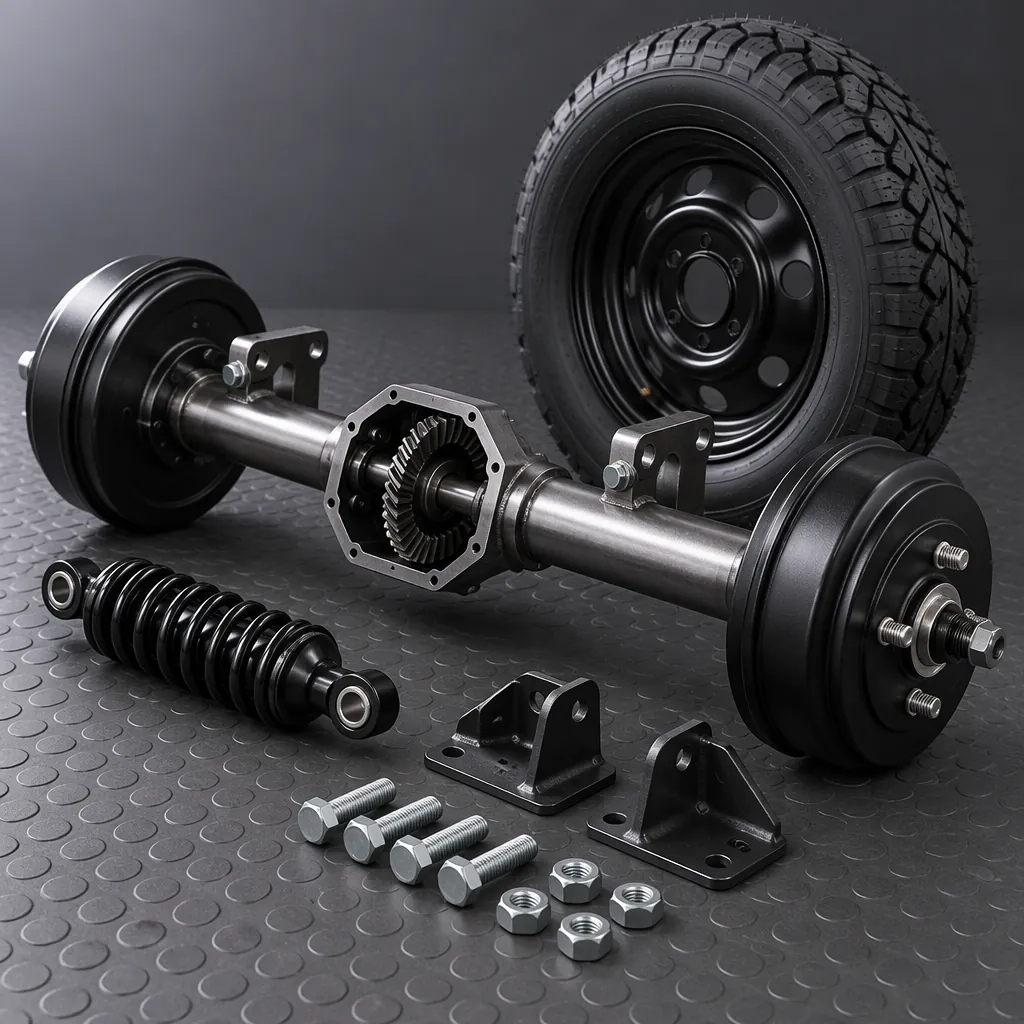
Buyers tend to picture the rear axle as a tube with wheels on the ends. On this platform it is a set of parts that all have to agree with each other, and the exploded layout above shows why. The assembly carries the differential housing in the middle, a tube out to each side, a brake drum at each end, spring mounts welded to the tubes, and dual load-rated wheels on 3.75-12 tyres — with 3.00-12 on the front.
| Axle assembly item | What it has to do on this platform |
|---|---|
| Differential housing | Houses the ring-and-pinion set that splits drive to the two half shafts while allowing a speed difference |
| Axle tubes | Carry the vertical load from the leaf-spring mounts out to the hubs; the load path runs through the tube, not the gear set |
| Leaf spring pack | The specified rear suspension on this cargo platform; it positions the axle and takes the payload directly |
| Dual drum brakes | Rear braking at each wheel, paired with the hydraulic disc on the front and a parking brake |
| Load-rated wheels | 3.75-12 rear, reinforced, dual fitment — the tyre sidewall is the last element in the vertical load path |
| Hub motor | Bolted into the same rear assembly as the differential, so motor choice and axle choice are one decision |
The practical point: if you change the motor rating, you have changed the axle. The three production configurations on this platform pair 800W / 60V, 1000W / 60V and 1200W / 72V with different box volumes and different kerb weights, and the rear assembly is specified to match. An axle chosen for a light 800W build is not automatically the right axle for a 1200W LFP build with a 500L box.
Hub Motor and Differential Are One Unit
On this cargo platform the motor is not a separate driveline feeding a gearbox. The brushless hub motor is specified with an integrated differential, and that single design decision shapes the rest of the vehicle. There is no exposed chain run to a rear axle, no prop shaft under the cargo box, and no separate final-drive oil level to check. The drive is enclosed at the rear axle.
That is worth stating plainly to a fleet buyer because it changes the maintenance story. The service points that remain are the ones you would expect on any three-wheeled work vehicle: brake adjustment and drum condition, tyre pressure and sidewall condition, wheel bearings, spring mounts and fasteners, and the wiring harness routing to the motor. The parts that are not on the daily checklist are the ones a chain-drive conversion would have added.
The motor side of the specification is where most of the OEM flexibility sits. Across the wider motor and controller range the platform family covers geared hub, direct-drive hub and mid-drive units from 250W to 1500W at 36–72V, with sine-wave FOC controllers, regenerative braking, and 80–92% peak efficiency in the working zone. For the cargo tricycle the relevant part of that range is the 500W–1500W band with differential axle controllers, and the high-torque winding that prioritises loaded starts over top speed — which is exactly the right trade for a trike that leaves a kerb with half a tonne on the deck.
How the Drive Carries a 300–500 kg Payload
The load rating on this platform is not a single number invented for a brochure. The published figures are 300 kg for EU-spec vehicles and 500 kg for non-EU markets, and the difference is a regulatory one: the EU L2e classification treats the cargo tricycle with a payload ceiling that includes the driver, while markets such as Southeast Asia, Africa and Latin America routinely specify the higher figure.
What the drive has to deliver against that rating:
- Loaded range. 50–60 km on the 800W build, 60–70 km on the 1000W build and 70–80 km on the 1200W LFP build — all quoted at 200 kg on flat terrain. Quote range at the payload you actually intend to run, not at the best-case figure.
- Starting torque, not top speed. Top speed sits at 25–35 km/h with a governed top end that can be set lower for site or municipal use. The engineering effort goes into the first two seconds of a loaded start, which is where a high-torque winding earns its cost.
- Kerb weight budget. The chassis alone runs 150–180 kg, 170–200 kg or 190–220 kg depending on configuration, before the box and the load. Trailer use, ramps and lift gates all need to be planned against the combined figure.
- Recharge turnaround. A 6–10 hour charge on the supplied 5A charger suits overnight depot charging. Two-shift operations need a second vehicle, a second pack or a larger charger, and that is a fleet arithmetic question rather than a drivetrain one.
Payload class is also where most specification errors start. If your routes mix a heavy first leg with a long empty return, size the vehicle for the heavy leg — the drive and the axle are rated for it, and running a 500 kg-rated platform at 200 kg costs you nothing but purchase price.
Turning, Reverse and the 3-Speed Gearbox
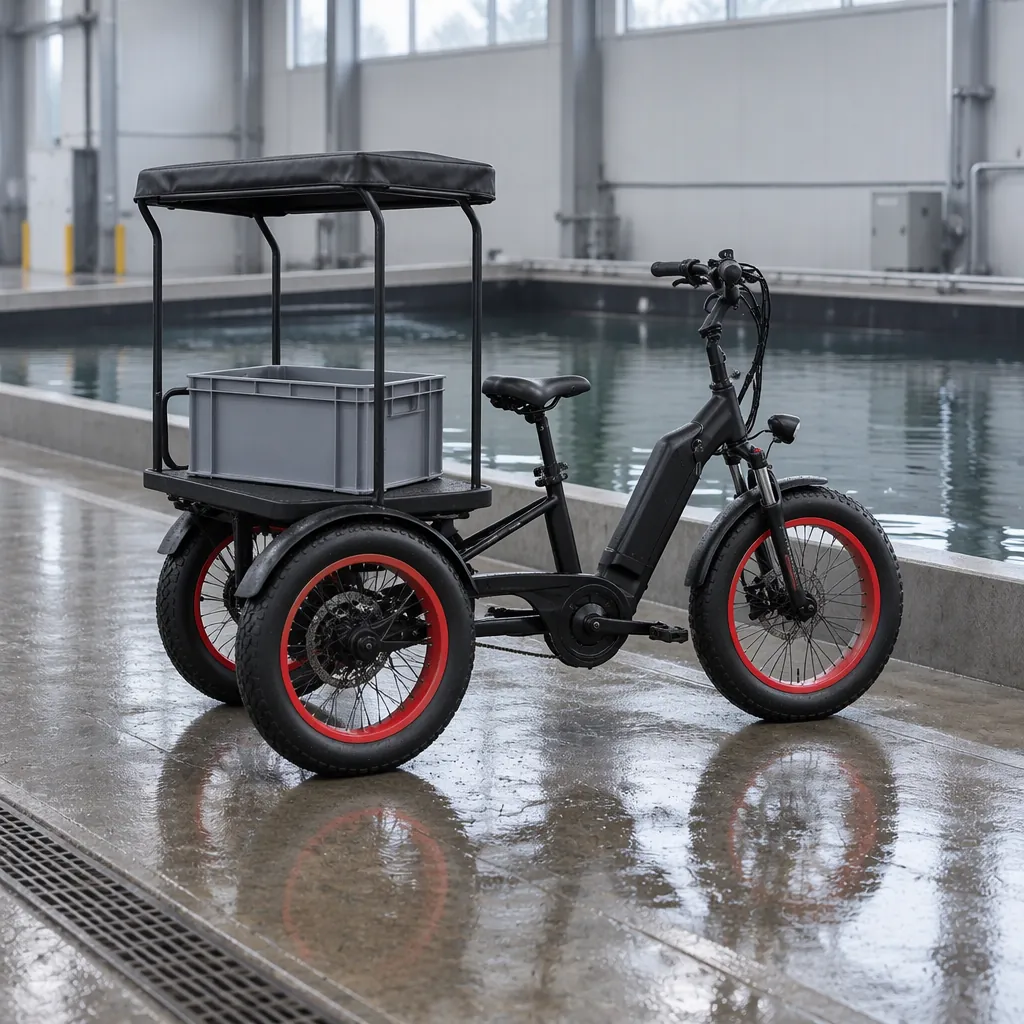
A loaded tricycle spends a surprising share of its life manoeuvring rather than travelling: backing out of a delivery bay, turning inside a warehouse aisle, repositioning at a market stall. Two controls decide whether that is easy or miserable — the forward / neutral / reverse selector with a 3-speed transmission, and the steering geometry that lets a long-wheelbase vehicle turn in a tight radius.
The selector is a genuine operational feature on a cargo trike, not a convenience. Reverse lets a single operator back a loaded vehicle to a kerb or a ramp without a second person spotting, and neutral allows the vehicle to be pushed or rolled by hand when positioning it for charging or loading. On a 300–500 kg platform that is a daily-use control, and the LCD shows the selected gear alongside speed, battery percentage and the load indicator.
The turning behaviour itself comes back to the differential. Three-wheeled vehicles with a locked rear axle fight their own steering on tight turns, because the rear wheels cannot resolve the difference in path length. With the differential in place the same turn is a single smooth movement, and the operator does not have to plan a wide arc into a narrow yard. For buyers comparing a tricycle against a small pickup: the tricycle's advantage in a tight yard is only real if the rear drive lets it actually turn.
What to Specify in an OEM Order
Orders on this platform start at 50 units per model, with a 15–30 day standard lead time and a further 10 days where a box customisation is involved. Because the vehicle is built to order, the specification conversation is the product. Six items decide what you receive:
- Motor and voltage. 800W / 60V, 1000W / 60V or 1200W / 72V, plus whether the pack is NMC or LFP. The 1200W build ships on 72V 40Ah LFP and is the configuration for hot-climate, high-utilisation routes; the lighter builds run 60V 32Ah.
- Rated load and the market it is registered in. EU-spec at 300 kg or non-EU at 500 kg, stated at the enquiry stage, because it drives the axle and tyre specification rather than the paperwork.
- Box and body configuration. 150–500L drop-side cargo box, optional insulated lining, hydraulic lift for loose material, or the flat-bed and enclosed variants used for utility fleets.
- Braking set. Hydraulic disc front, dual drum rear and a parking brake as standard — with the brake specification confirmed against the rated load rather than the base vehicle weight.
- Electrical and display. LCD with speed, battery percentage, load indicator and reverse gear; full LED lighting with an optional beacon for site and municipal work.
- Spare parts and documentation. State the tyre sizes (3.00-12 front, 3.75-12 rear) and the axle part numbers you want held as a spares kit. Consumables that cannot be re-sourced locally are the ones that strand a fleet.
Beyond those six, the platform supports OEM box engineering — dimensions, drop-side layout, lining, tie-down points and finish — and the motor side supports winding specification, cable exit position at the axle, connector type, magnet grade, controller programming for acceleration curve, regen strength and speed limit, and display pairing. If your operation has a specific duty cycle, the acceleration curve and the speed limit are the two firmware items worth specifying first.
Maintenance: The Axle Work Most Owners Forget
An integrated hub motor and differential is a sealed assembly, which is not the same thing as a maintenance-free one. The work that gets skipped is almost always visual inspection, because nothing on the vehicle complains until it fails:
- Fasteners at the spring mounts and axle brackets. Checked at the interval and re-torqued to the specified values. On a platform running at its rated load, a loose spring mount is the first sign of a load path problem.
- Drum brake condition and adjustment at both rear wheels. Rear braking on a loaded trike does real work; uneven drum wear shows up as a pull or a longer pedal before it shows up as a failure.
- Tyre condition and pressure, per axle. The rear pair carries the payload on 3.75-12 reinforced tyres. Mismatched pressure across the two rear wheels is one of the commonest causes of a trike that tracks badly.
- Wheel bearings and hub play. A bearing on its way out announces itself as a slight wander in a straight line long before it seizes.
- Harness routing to the motor. Look for chafing where the cable leaves the axle and runs to the frame. This is the one item that a visual check catches and a road test does not.
The structural warranty on the steel chassis and cargo box runs 24 months against manufacturing defects, and every unit passes a per-vehicle inspection covering weld integrity on the cargo subframe, torque verification on chassis fasteners, and a loaded road test with ballast to confirm brake balance and motor thermal behaviour. Ask for the inspection record for your batch — it is a better indicator of what the next two years look like than any specification table.
For the wider maintenance picture, our guide to electric tricycle maintenance covers the full inspection cycle, and the spare parts and after-sales guide explains how to build a spares kit around the components you cannot re-source locally.
Spec the Axle on Your Platform
The rear axle and differential are the least visible and most consequential part of a cargo tricycle specification. Get the motor rating, the rated load and the tyre specification into the same conversation and the rest of the vehicle follows: the payload capacity guide sets out how the load rating is derived, the tyre guide explains the load-index side of it, and the brake systems guide covers the stopping side against the same payload.
If you are choosing between voltage and motor configurations, our 60V vs 72V comparison and the motor power guide cover the trade-offs in duty-cycle terms rather than headline watts, and the suspension guide explains how the spring pack on this axle behaves loaded. For the drive unit itself, the motor controller guide covers the FOC controller side and the OEM program guide walks the full order from drawing to shipment. The vehicle specification itself sits on the cargo e-tricycle platform page, and the axle-level requirements are worth raising with the cargo and logistics team before the order is fixed.
Spec the Axle on Your Platform
Tell us your payload, route and grade, and we will send a dimensional drawing and axle/drivetrain spec for the cargo platform. So you can see the load path before you commit.
