
Farmers did not adopt electric tricycles because of a trend. They adopted them because a chore loop on 20–200 acres is a near-perfect fit for a 300–500 kg electric cargo platform that costs less than a set of pickup tires. Feed-store runs, mail routes, fence repairs, vet visits, gate checks and harvest shuttles are all short, slow, repetitive trips with light-to-medium loads — exactly the duty cycle a three-wheeled cargo trike is engineered for. This guide covers the payload arithmetic, the terrain requirements, the charging reality on a farm, cold-weather pack behaviour, and the exact spec sheet to order for rural property use.
What Farm Work a Tricycle Actually Does
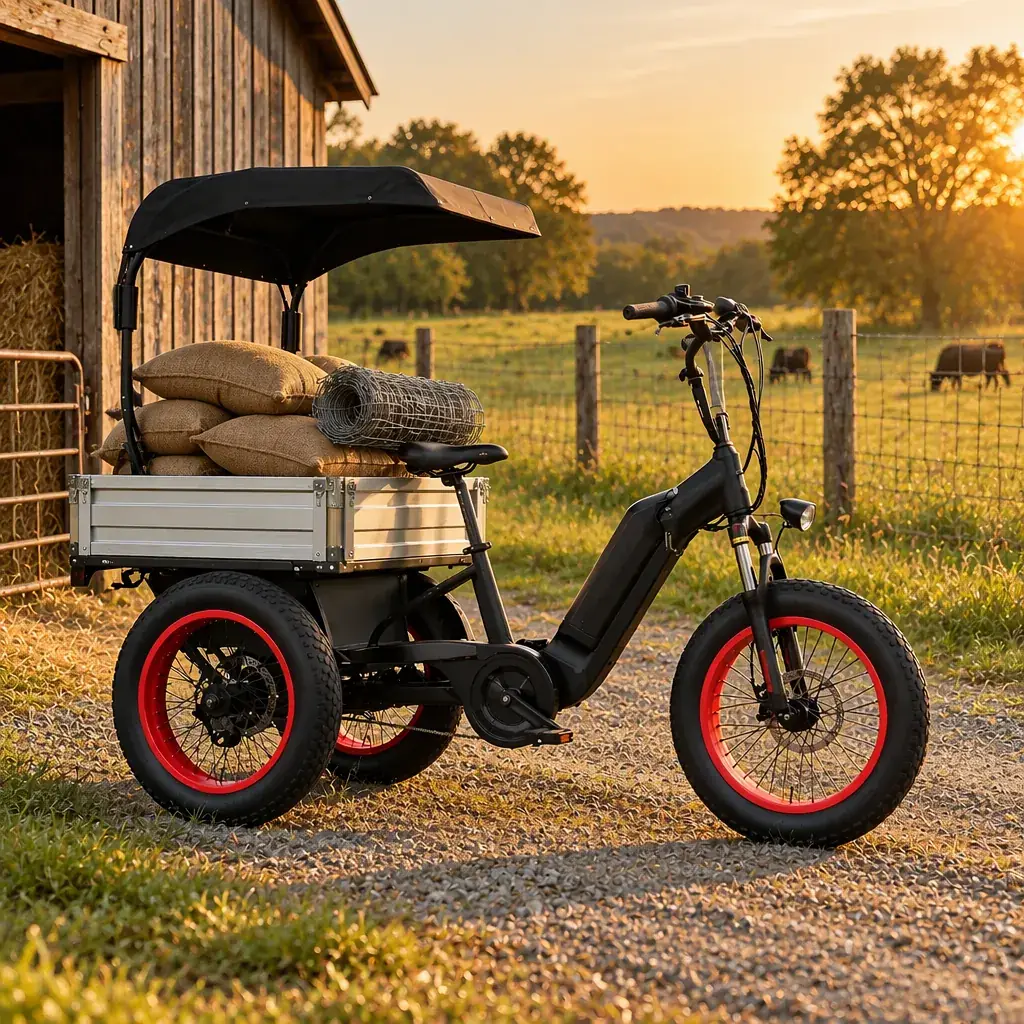
The rural chore list is dominated by trips under 10 km. The concrete jobs that fit a cargo tricycle:
- Feed and supply runs: 2–8 bags of feed (25–50 kg each), mineral blocks, salt licks and vet supplies from the co-op or feed store.
- Fencing and pasture work: posts, wire rolls, staples and tools shuttled between the shed and the fence line; the box keeps them off the ground and out of the truck bed.
- Mail, gates and inspections: the daily loop of checking gates, water troughs and perimeter that on many farms still happens on foot or in a full-size truck.
- Harvest and market shuttle: produce crates to the farm stand or market stall, 20–40 km round trips at 25–35 km/h.
- Equipment and tool movement: hand tools, welders, chainsaws and parts between outbuildings where a truck is overkill.
The US trend that put these vehicles on American farms is the same one that filled container ports with Chinese three-wheelers; the market background is in our analysis of the US three-wheeler boom. The platform itself — a steel tube chassis, leaf-spring rear suspension and a drop-side box — is the same one described in our platform overview.
Payload Math: Feed, Fencing and Harvest Loads
The payload rating is the first spec to check, because farm loads are dense. A 25 kg bag of feed is small but heavy; a fencing run adds 50 kg of posts and 30 kg of wire. The practical load bands:
| Load type | Typical weight | Fits a 300 kg trike? |
|---|---|---|
| Feed run (8 × 25 kg bags) | 200 kg | Yes |
| Fencing kit (posts + wire + tools) | 80–120 kg | Yes |
| Harvest crates (10 × 15 kg) | 150 kg | Yes |
| Water trough + pump parts | 40–60 kg | Yes |
| Hay bale (small square) | 18–27 kg each | Yes, stacked |
The cargo tricycle platform carries 300 kg (EU spec) or 500 kg (non-EU spec) in a 150–500 L drop-side box, which covers every load in the table with margin. Box volume matters as much as the rating: straw, empty crates and green waste cube out before they weigh out, which is why the three-way drop-side body that converts to a flatbed in seconds is the default farm configuration. The engineering behind load-rated frames, axles and brakes is covered in our payload capacity guide.
Terrain: Gradients, Gravel and Mud
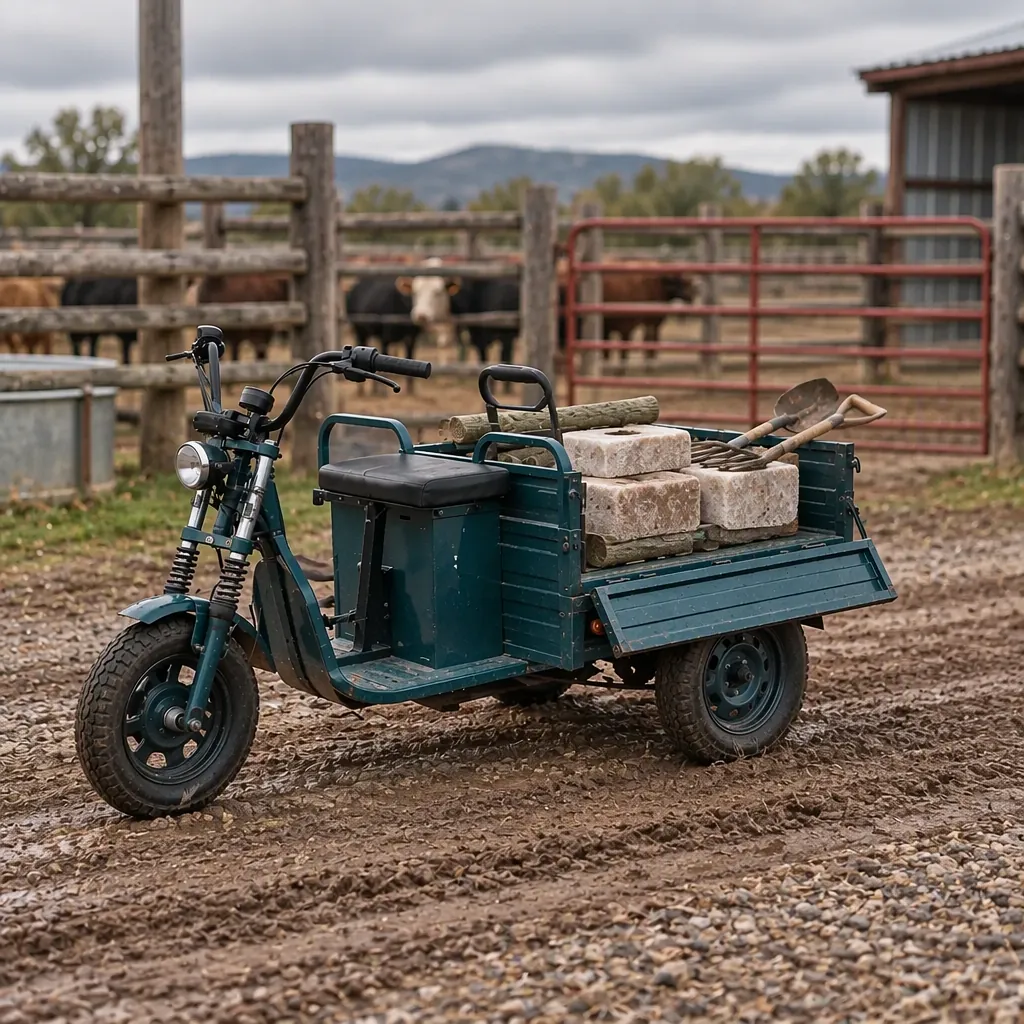
Farms are not paved. The terrain requirements, in order of importance:
- Gradient: a loaded trike should handle 8–10° sustained gradients. With 800W you get that on flat-to-rolling land; on hilly property order the 1200W motor, which holds speed on the same gradient with a full 300 kg load. The torque and power-band logic for choosing between classes is in our cargo trike motor power guide.
- Tires: the 3.00-12 front / 3.75-12 rear dual-wheel spec gives a wide contact patch on gravel. Ask for knobby or all-terrain tires for loose surfaces; the dual rear wheels are what keep a loaded trike stable on crowned gravel tracks.
- Ground clearance: 130–160 mm under the axle is enough for maintained farm tracks; rutted pasture needs more. The three-wheel delta layout (one front wheel, two rear) keeps the centre of gravity low, which matters more than clearance on uneven ground. Load-rated tire selection is covered in our tricycle tires guide.
- Reverse gear: non-negotiable on a farm. Backing out of a shed or turning around in a gate requires the forward / neutral / reverse selector that comes standard on the cargo platform.
- Suspension: reinforced leaf-spring rear suspension is what protects dense cargo and the rider on rutted tracks; the trade-offs are in our suspension guide.
Charging on the Farm: Outlet, Solar, Rotation
Charging infrastructure on a farm is a wall outlet. A 60V 32Ah pack takes 6–10 hours on the standard 5A charger; a 72V 40Ah LFP pack fits the same overnight window. Three practical patterns:
- Overnight outlet: plug in at the barn or garage; the pack charges while the farm sleeps. A dedicated 15A circuit handles one trike; two trikes on one circuit need a rotation or staggered timers.
- Solar pairing: the optional solar panel roof trickle-charges the auxiliary battery and extends daily range by 8–12 km, so a barn-roof array feeding the charger covers a trike's electricity entirely over a season.
- Swappable packs: order the swappable-battery configuration and keep a second pack charged; a 30-second swap beats a 6-hour wait during harvest season.
Range on the farm: 50–80 km per charge at 200 kg load on flat ground, which is two to three days of typical chore loops. Charger ratings and connector types are covered in our charger guide, and fleet-wide charging patterns in our fleet charging guide.
Cold Weather and Battery Care
Northern farms run year-round, and lithium packs need specific handling below 0°C:
- Charge indoors: lithium cells should not be charged below 0°C. The BMS low-temperature charge cutoff protects the pack; charging in an unheated barn in January will simply not start until the pack warms up. Bring the pack inside or use a heated storage box.
- Chemistry choice: LFP (the 72V 40Ah option) holds capacity better in cold than NMC and lasts more cycles, at the cost of slightly lower energy density. For a farm vehicle that lives outside, LFP is the lower-friction choice — it is also the chemistry we recommend for hot-climate operators where pack longevity under thermal stress matters more than energy density.
- Range in winter: expect 15–25% range loss in sub-zero riding; the 50–80 km rating assumes 20°C. Plan the daily loop accordingly.
The chemistry, BMS and pack-format trade-offs behind these recommendations are detailed in our battery pack guide and winter operations guide.
Trike vs ATV vs Pickup on the Farm
The honest comparison for rural property owners:
| Factor | E-cargo tricycle | ATV / UTV | Pickup truck |
|---|---|---|---|
| Purchase | USD 1,250–1,550 FOB | USD 6,000–15,000 | USD 38,000+ |
| Fuel / electricity / yr | USD 70–115 | USD 400–800 (gas) | USD 1,900–2,330 |
| Payload | 300–500 kg | 150–400 kg | 600–1,000 kg |
| License / registration | None (most states) | Varies (often none off-road) | Yes |
| Weather protection | None (open) / canopy optional | None (open) | Full cab |
| 5-year operating cost | ~USD 1,500–3,000 | ~USD 5,000–8,000 | ~USD 25,000+ |
The full purchase-and-operating spreadsheet, including the pickup comparison at 12,000 miles per year, is in our cargo trike vs pickup cost comparison. If a canopy is part of the plan, the retrofit and factory options are in our canopy guide.
Riding Rural Roads: Compliance
Farm trikes travel public roads between fields and the feed store. At 750W / 20 mph (Class 2) the cargo tricycle rides as an electric bicycle in most US states: no license, no registration, no insurance requirement. Rural state highways with 55 mph limits are the exception. Stay on local roads and farm-to-market routes where 25–35 km/h is the norm.
The platform is planned against CE marking, EN 15194 reference (where applicable for pedelec-assisted configurations), UN 38.3 battery transport testing, ECE R10 electromagnetic compatibility, and RoHS. Standard export documentation includes the UN 38.3 test report and certificate of origin, plus Form E for ASEAN destinations and Form A for African and least-developed-country destinations to support preferential tariff claims. State-by-state classification and the UL 2849 safety standard are covered in our certification guide and our dedicated e-tricycle legal guide.
Spec Sheet for Farm Use
Order a farm-spec cargo trike with these options:
| Component | Farm spec |
|---|---|
| Motor | 1200W brushless hub + differential (hill-climb gearing, full payload) |
| Battery | 72V 40Ah LFP, swappable, heavy-duty BMS with low-temperature charge cutoff |
| Payload / box | 500 kg (non-EU) / 300 kg (EU); 150–500 L three-way drop-side box, flatbed conversion |
| Chassis | Steel tube frame, heavy-duty e-coat + powder coat, leaf-spring rear suspension |
| Brakes | Hydraulic disc front + dual drum rear, parking brake |
| Tires | Knobby all-terrain; 3.00-12 front / 3.75-12 rear (dual), reinforced load-rated |
| Drive | Forward / neutral / reverse selector; LCD with speed, battery and load display |
| Extras | Full LED, optional beacon / hazard lights, parking brake, tow hitch, solar panel roof |
Every unit passes a per-vehicle inspection covering weld integrity on the cargo subframe, torque verification on all chassis fasteners, and a loaded road test with ballast to confirm brake balance and motor thermal behaviour. OEM orders start at 50 units per model with a 15–30 day standard lead time (30–45 days for a first custom-branded run), and pre-production samples ship before mass production.
For distributors and dealers adding farm trikes to their catalogue, the import route, container loads and landed-cost structure are in our China import guide, and OEM programme terms are in our OEM buying guide.
Spec a Farm Trike for Your Property or Channel
Tell us your terrain (gradient, gravel, acreage), typical loads, and target market. We will spec the motor class, battery chemistry, tires and box size, with incline and payload test data included in the sample phase.
