
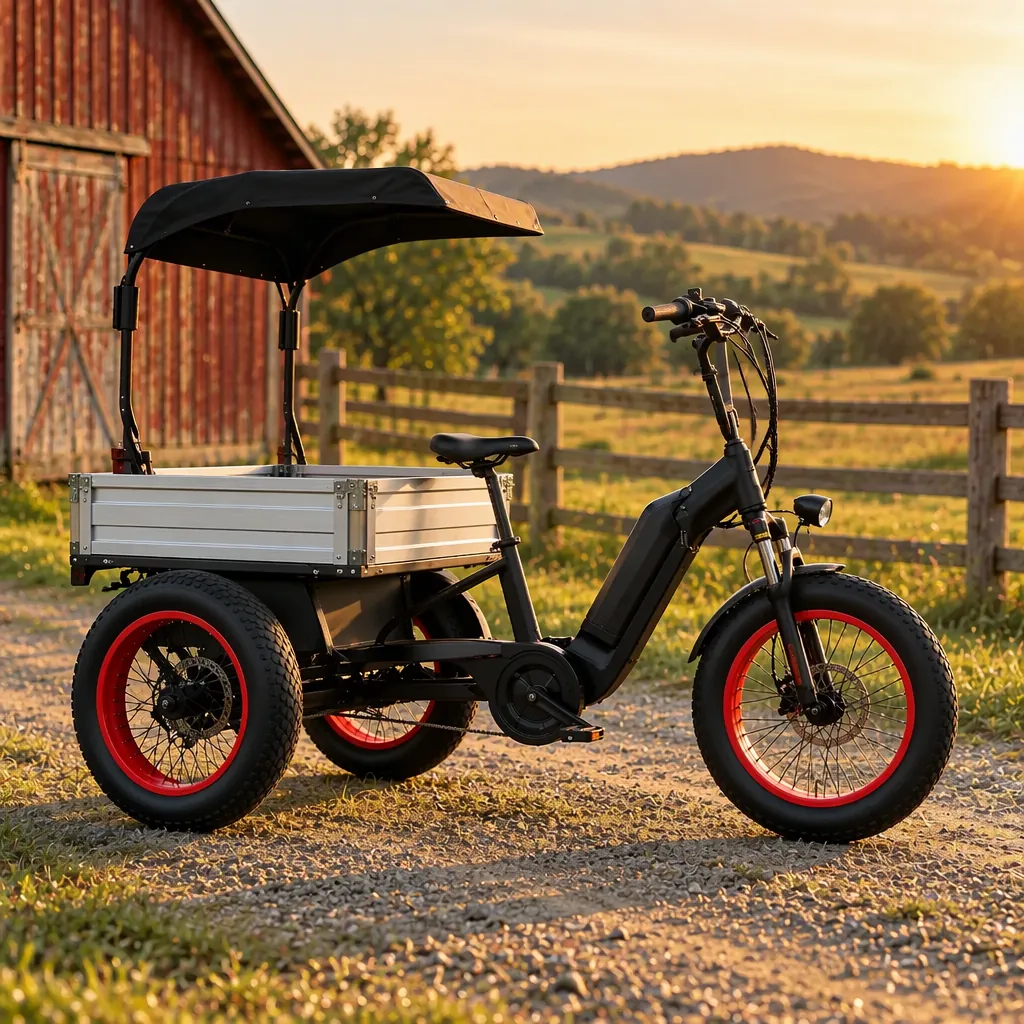
In 2023 a short video of a Chinese electric tricycle, what Americans now call the "three-wheeler" and what Chinese buyers casually call sanbengzi, rolled through a suburban American neighborhood and broke the internet. The clip showed something most Western viewers had never seen: a small, boxy three-wheeled electric vehicle hauling groceries, carrying a passenger, and costing less than a used golf cart. Within a year importers across the United States were booking container loads of cargo tricycles for farms, small towns, and rural delivery routes. This is not a novelty video trend. It is a structural change in what a practical utility vehicle costs. For importers and distributors the question is no longer whether the category works, but how to spec and certify it correctly. This guide breaks down why the three-wheeler caught on, what American buyers actually order, and how a first container is sourced. If you are sourcing rather than browsing, the short version is this: the Chinese tricycle category that American dealers are importing is a delta-layout cargo platform with one front wheel and two rear wheels, sold at $1,250 to $1,550 FOB for a 300 L drop-side box, at a minimum order of 50 units. A Chinese electric tricycle at that specification clears US low-speed rules in most states without a licence, which is the whole reason the category exists as a retail product rather than a farm curiosity. The section below records the origin story because it explains demand; the rest of the page is the buying work.
Where the 'Three-Wheeler' Boom Started, and What a Chinese Tricycle Importer Actually Sources
The boom traces back to a specific cultural moment rather than a marketing campaign: Chinese families sending Chinese electric tricycles as gifts to relatives in the United States. A Chinese son-in-law imported a small electric trike for his American father-in-law, and the videos of the older man proudly driving his new "three-wheeler" around his neighborhood spread across TikTok, YouTube, and Chinese social media. Millions of viewers saw a vehicle that was cheap, self-explanatory, useful immediately and cheap to maintain.
That origin story matters to a buyer for one reason. The vehicle in those videos is not a consumer gadget with a dealer network behind it. It is a Chinese tricycle built on the same delta-layout utility platform described on our cargo e-tricycle product page, and the importer who wants to sell the category has to buy it the way it is actually made: in container quantities, from a factory, with a certification file attached. A China utility tricycle ordered one unit at a time is a sample. A container is a business.
What a US importer is really buying, once the video is set aside, comes down to four decisions. The table below is the version of the category that shows up on a purchase order rather than in a social feed.
| Buying decision | What is actually being chosen | Where the number comes from |
|---|---|---|
| Platform layout | Delta geometry: one front wheel, two rear wheels, 300 L drop-side box as the default body | The cargo product page specification |
| Small electric tricycles OEM versus stock | Stock build ships in 15 to 30 days on a 50-unit MOQ; a custom box or motor adds 10 days of tooling and first-article time | Order terms quoted per programme |
| Legal class | 750 W and 20 mph ceiling keeps the unit inside the low-speed electric bicycle definition in most states, which is what makes a dealer sale possible at all | US state statute, per state |
| Certification file | UL 2849 for the electrical system plus UN 38.3 for the pack, supplied with the shipment rather than after it | Test reports issued per production lot |
The video trend created a search spike: "electric tricycle", "e-trike for adults", and "three wheel electric truck" queries grew steadily through 2024–2026 as dealers and importers scrambled to source supply. The demand is not a meme. It is a price-performance gap that the Western market had no product to fill, and it was filled by export-oriented Chinese production that most Western buyers had never previously had a reason to look at.
Small electric tricycles are where most first orders land, not because buyers want a small vehicle but because a small trike is what fits a 40HQ at a sensible unit cost while staying under the speed and power ceiling that keeps it dealer-sellable. The volume comparison in the next section is built around exactly that trade-off.
The Three Wheel E Scooter Market and the Electric 3 Wheeler Cargo Bike Market: How Big It Actually Is
Buyers searching the size of the three wheel e scooter market or the electric 3 wheeler cargo bike market are usually handed a number in the billions with no method behind it. Treat those figures with suspicion, because almost every published report merges two- and three-wheel volume, and two-wheel volume dwarfs three-wheel volume by an order of magnitude. A merged number tells a buyer nothing about the segment they are actually sourcing from. What can be measured, and what a distributor can act on, is import volume.
Why published market sizes do not survive contact with a purchase order
Three separate distortions sit inside a typical three wheel e-scooter market estimate. First, the two-wheel and three-wheel categories are aggregated, so a headline growth rate describes scooters that share no bill of materials with a cargo trike. Second, low-speed three-wheelers from every region are pooled, mixing 25 km/h postal units with 45 km/h passenger carriers that sit in different regulatory classes. Third, the figures are factory-gate revenue, not what a distributor pays landed. Working back from container density gives a number that survives all three distortions, because it is built from units that actually cleared customs.
A method a distributor can run without buying a report
The electric 3 wheeler cargo bike market can be sized bottom-up from what a 40HQ container carries. A standard cargo trike with a 300 L drop-side box loads 24 to 30 units per 40HQ once frames are nested and wheels are crated separately. Two-wheel e-scooters load at roughly 90 to 120 units per 40HQ. That gap is the reason a merged market figure cannot describe this category: at equal container counts, the trike segment represents a quarter of the unit volume but four to ten times the revenue per unit. For a buyer, the practical translation is simpler than any report. A single 40HQ of cargo trikes at $1,250 to $1,550 FOB is a $33,000 to $46,000 factory commitment, and a distributor who can model that against local resale price has all the market sizing they need.
| Segment | Units per 40HQ | FOB per unit | What drives demand |
|---|---|---|---|
| Cargo trike, 300 L drop-side | 24 to 30 | $1,250 to $1,550 | Farm, ranch, small-town utility hauling |
| Passenger trike, 2 to 4 seat | 18 to 24 | $1,250 to $1,480 | Resort shuttles, campus and terminal transfer |
| Enclosed cabin utility trike | 12 to 16 | Quoted per build | Year-round municipal and campus service |
| Two-wheel e-scooter (reference) | 90 to 120 | $280 to $650 | Urban commuting, last-mile delivery |
Read the table as a ratio, not a forecast. The cargo and passenger lines together are the three-wheel e-scooter market proper, and neither line has the unit churn of two-wheel scooters. A trike distributor sells fewer units at a higher ticket and earns on the spare-parts network and the repeat order, not on the first shipment. If what you need is the published market-size figure itself rather than the container arithmetic, the dedicated 2026 three-wheeler market breakdown works through the published estimates, their regional splits and the reasons they differ. This page stays on the question US importers actually ask, which is what moves through a container.
Three-Wheeler Price Math: $1,400 vs $35,000
The core driver of the boom is arithmetic. Compare the running economics of the two most common rural utility vehicles:
| Cost Item | Electric Cargo Tricycle | Entry Pickup Truck |
|---|---|---|
| Purchase price | $1,250–1,550 FOB | $35,000–45,000 |
| Energy per 100 km | $0.30–0.50 (grid charging) | $10–15 (gasoline) |
| Insurance per year | $0–150 (low-speed class in many states) | $1,200–2,000 |
| Licence requirement | None in most states when speed-limited | Driver's licence + registration |
| Maintenance, year one | ~$50 (brake shoes, tyre pressure) | $800–1,500 |
| Payload | 300 kg (EU) / 500 kg (non-EU) | 700–1,000 kg |
The trike does not replace a pickup for highway hauling. It replaces the second car for the majority of trips that are under 10 km: feed-store runs, market trips, fence and pump inspections, mail routes, and neighborhood errands. For those trips it is a fraction of the purchase price and essentially free to run. The battery and range engineering behind that cost picture is covered in our battery pack guide.
One pattern recurs in dealer feedback: the Chinese tricycle sells fastest where a buyer already owns land or premises, because the vehicle is judged as a tool rather than as transport. That is also why the same container often carries three body variants. A distributor ordering 50 units rarely orders 50 identical machines, because a farm account and a municipal account want different boxes on the same running gear.
Why Farms and Small Towns Are the Sweet Spot
The buyers who stayed after the viral moment were not city commuters. They were rural operators, and the pattern repeats across the United States and Canada:
- Small farms and homesteads: moving feed bags, tools, water containers, and produce between buildings. A 300–500 kg payload tricycle with a 150–500L drop-side box replaces the chore tractor for daily runs and costs less than a set of tractor tyres.
- Small-town households: one-car families where the second driver needs an independent vehicle for errands inside town limits. Speed-limited to 25–35 km/h, the trike is legal on most local roads without registration.
- Rural delivery and last-mile operators: mail, pharmacy, and food routes where a van is overkill. The operating-cost math for these routes is in our cargo delivery fleet guide.
- Retiree and accessibility buyers: the stability of three wheels, the low step-over, and the reverse gear make the trike the practical bridge between a mobility scooter and a car. That market is covered in our adaptive e-tricycle guide.
The common thread: these users need a vehicle that is cheap, durable, and simple. Exactly the design brief of the Chinese rural utility trike, engineered for village roads, farm work, and owner repair. The same duty-cycle logic applied to commercial grounds work is set out in our landscaping trike guide.
What American Buyers Actually Spec
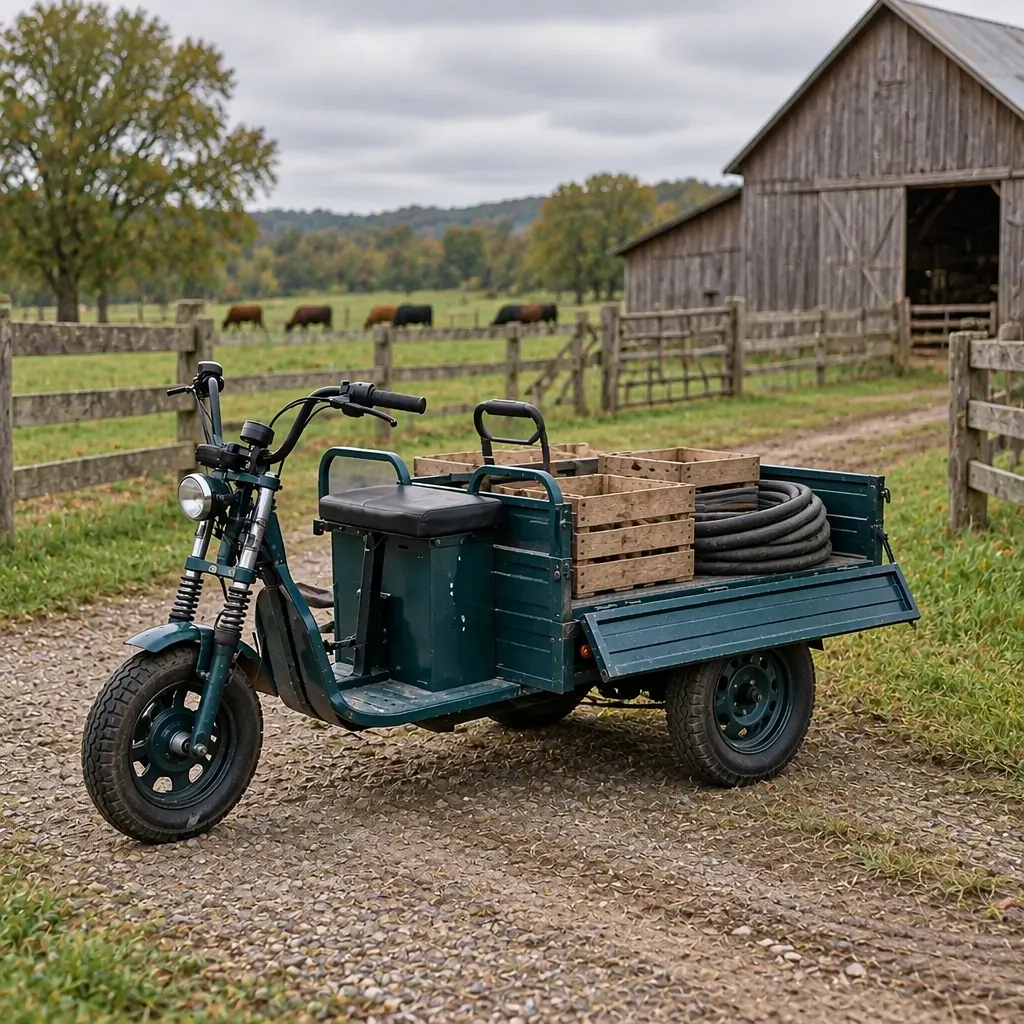
Importers who succeeded in the US boom did not import the cheapest possible trike. They imported the right spec. The configuration that survives the market:
- Motor: 800W is the entry point; 1000W and 1200W brushless hub motors with a differential are the volume sellers. The differential matters, because a solid rear axle drags the inside wheel in tight farmyard turns. The trade-off is explained in our hub vs mid-drive comparison.
- Battery: 60V 32Ah NMC for the standard build, 72V 40Ah LFP for the heavy-duty version. A range of 50–80 km loaded covers a full day of farm errands. Swappable packs are a differentiator for fleet users who cannot wait for charging.
- Payload and box: 300 kg for EU-classified units, 500 kg for the non-EU heavy build, with box volume from 150L to 500L. Drop-side boxes, whose sides fold down into a flat platform, are the single most requested US feature because they let the trike carry odd-shaped loads.
- Reverse gear: non-negotiable. Backing out of a barn or off a loading ramp with 500 kg on board without a reverse gear is a dealbreaker for rural buyers.
- Brakes: hydraulic disc at the front plus dual drum at the rear with a parking brake. Rural buyers test-stall the trike on a grade, and the parking brake is what gets sold. Our brake systems guide covers the component side.
- Wheels and tyres: 3.00-12 front and 3.75-12 twin rear tyres on steel rims. Wide, high-volume tyres are what make the trike survivable on gravel, pasture, and unpaved lanes rather than only on asphalt.
- Lighting: full LED with an optional beacon. Visibility on unlit rural roads is a safety and liability issue, so buyers spec the beacon for road use.
These requirements map directly onto the EMS-EBIKE cargo tricycle programme: 800W / 1000W / 1200W brushless hub with differential, 60V or 72V lithium with LFP available, 300 kg EU / 500 kg non-EU payload, 150–500L drop-side boxes, reverse gear, hydraulic disc front with dual drum rear and parking brake, and full LED. The configuration table and OEM options sit on our cargo e-tricycle page.
Legal Class: Why No Licence in Most States
A large part of the US appeal is that the trike sidesteps the vehicle-registration maze. Classification turns on speed and power:
- 750W / 20 mph (32 km/h) throttle units: treated as Class 2 e-bikes, or under state low-speed electric tricycle rules, in most states, meaning no licence, no registration, and no insurance requirement. This is the legal path that makes the category work.
- 1000W–1200W / 25–35 km/h units: many states place these under low-speed vehicle or neighbourhood electric vehicle rules, with local variation. Importers typically configure the controller for a 20 mph top speed to stay inside the no-licence class while keeping the larger motor for torque and hill climbing. The adjustable governor on the platform supports 25 / 35 / 40 km/h settings, so a single build can serve several markets.
- US certification: UL 2849 covers the electrical system for Class 2 products, while UN 38.3 covers transport of the lithium pack. The full comparison is in our EU vs US certification guide.
The takeaway for importers: spec the 20 mph controller limit, document the UL 2849 and UN 38.3 paperwork, and you have a no-licence utility vehicle in most states. That is precisely the pitch that sells the trike to rural first-time buyers who have never owned a motorcycle or a scooter. The full regulatory picture is also analysed in our e-tricycle laws guide.
The OEM Opportunity for Distributors
For distributors the boom is a margin story. Typical economics on the category:
- Landing cost: $1,250–1,550 FOB, and with freight and duty a standard 1000W unit lands at roughly $1,800–2,200 in the US.
- Street price: $2,800–4,500 for the standard build, and $4,500–6,500 for the 1200W heavy-duty version with the 500L box.
- Gross margin: 30–55%, with the heavy-duty version carrying the higher margin because there is less direct online competition at that price.
- Return rates: lower than e-bikes, because the buyer's use case (farm chores, errands) is concrete and the product is simpler to maintain.
The same buying discipline applies as to any OEM programme: factory audit, sample verification, certification documentation, and a spare-parts commitment. The negotiation structure, MOQ, lead time, and first-article sample process are the standard pattern covered in our OEM buying guide. Where a dealer is deciding whether the category merits a dedicated showroom presence at all, the same channel-economics reasoning as our dealer and distributor guide applies.
How to Source Your First Container Into the Three Wheel E Scooter Market
If you are entering the category, the practical path is short:
- Choose the spec: 1000W / 60V 32Ah / 300–500 kg payload / 300L drop-side box is the volume configuration that resells fastest in the US.
- Request a sample: one unit for a two-week farm test covering hill climb loaded, range with a full box, reverse-gear operation, and a brake stop from 32 km/h.
- Verify certification: UL 2849 for the electrical system, UN 38.3 for the pack, and confirmation of your state's classification for a 20 mph throttle trike.
- Plan the container: a 40-foot container fits roughly 60–80 cargo tricycles knocked down, or 40–50 assembled; FOB China with CIF options is standard. Loading detail is set out in our import guide.
- Build the service story: stock brake shoes, tyres, controllers, and a handful of packs. The rural buyer will not ship a trike back for a flat tyre, but he will buy the spare from you.
The three-wheeler is not a passing trend. It is the cheapest purpose-built utility vehicle on three wheels, and the importers who spec it correctly, certify it into the no-licence class, and support it with spares hold a durable, high-margin category that the Western market simply did not have five years ago. The commercial case for the wider electric three-wheeler segment is tracked in our market outlook.
Spec Your Three-Wheeler Container
Tell us your target market, payload needs, and box configuration. We will quote the 800W–1200W cargo tricycle line with UL 2849 documentation, sample lead times, and container pricing, FOB China.
