
A wildland fire crew does not run a delivery route. It runs a set of small, fixed work faces, each one a few hundred metres from the next, all of them reachable only by a track that was built for a pickup and a hand crew. Water, hose, fuel, tool caches and medical bags all have to move between those faces several times a shift, and none of it can wait for a flatbed. That is the gap an electric cargo tricycle actually fits, and it is a very different brief from the yard rounds and last-mile routes that most cargo-trike specifications are written for.
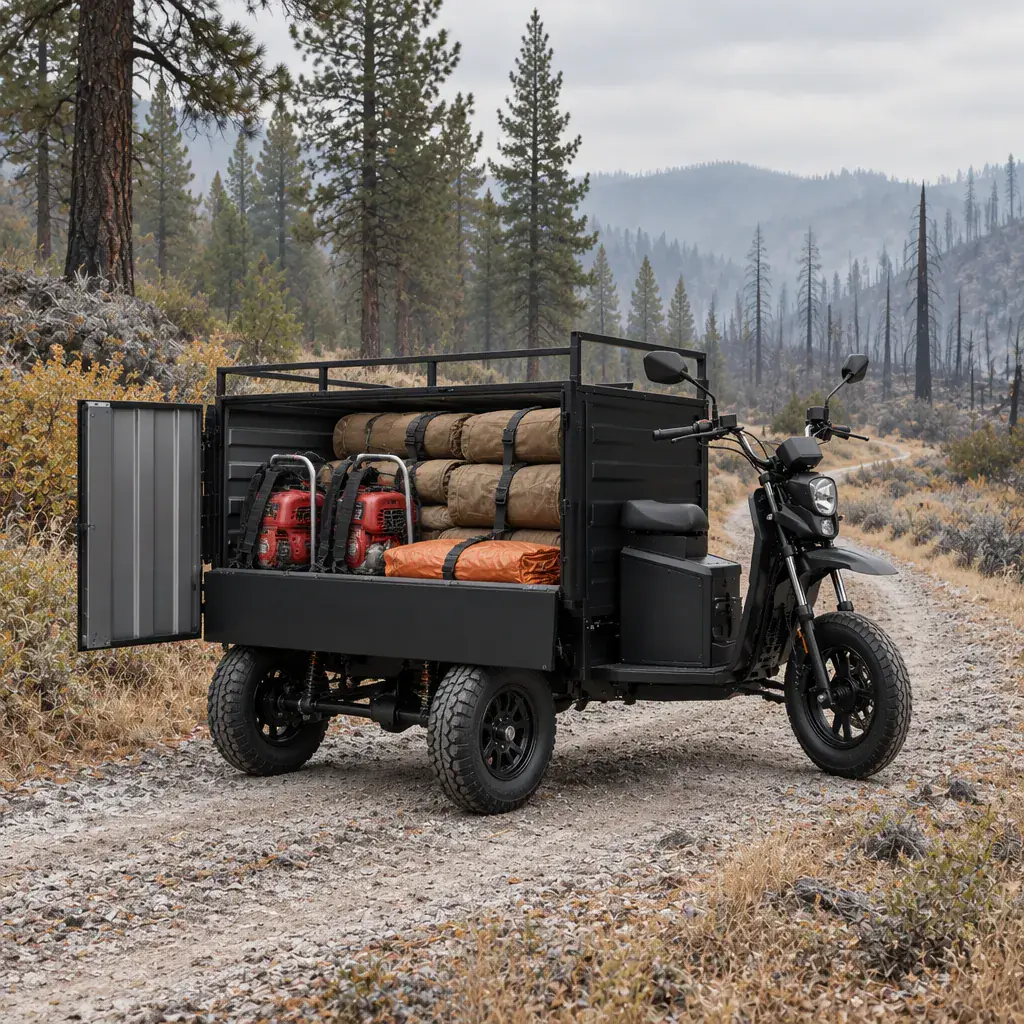
This guide is written for the operations and procurement people who have to justify the platform to a budget holder who has only ever seen a pickup on that track. It covers the four duties that share the word “support” on a fire line, the measurements that eliminate a platform before anyone discusses motor rating, and the three places where a standard cargo trike will not do the job at all.
What a fire-support round actually is
An incident support round is not a route with a start and an end. It is a loop, repeated many times a shift, between a staging point and the work faces. That changes what the vehicle has to be good at.
Four properties separate it from a delivery round. The loop is short but repeated, so the vehicle spends its time starting, stopping and turning rather than cruising. The surfaces are unsealed, cambered and often soft at the edges. The load changes shape through the shift as consumables are dropped at different faces. And the vehicle itself is a piece of regulated fire equipment once it is inside the operational area, which brings a set of constraints that a delivery fleet never faces.
Those four properties pull in opposite directions, and a specification that satisfies one will usually fail another. A bigger box carries more hose; it also raises the centre of gravity on exactly the cambered ground where stability matters most. A longer range comes from a bigger battery; that adds mass and reduces the payload headroom the crew needs. The stability trades in particular are covered in more depth in our tricycle stability guide, which sets out the four numbers that decide whether a loaded trike feels planted or nervous on a cross-slope.
Writing the spec means deciding which of those trades the site can live with, and it starts with measurement rather than with a catalogue.
Measure four things before anyone quotes a motor
Nearly every specification failure in this application comes from choosing a platform before the site has been measured. Four numbers eliminate most of the bad options in one afternoon, and none of them requires a test drive.
- The longest single leg between the staging point and the furthest work face, in minutes rather than kilometres. A fire access track can be 800 m long and take six minutes because it is narrow, rutted and needs a slow approach at every water bar.
- The number of work faces inside one shift, and how many times the loop is repeated. This is the number that decides whether one platform is enough, because a crew that resupplies four faces three times a shift makes twelve loading and unloading events, not one.
- The heaviest single item that has to be lifted on and off, not the average load. A full 30 m hose roll, a five-gallon fuel can and a rigid water tank are three entirely different handling problems even though their total mass is modest.
- The narrowest gap the vehicle must pass, taken at the tightest point on the track and not at the gate. Fallen timber, a culvert headwall and a line of boulders all narrow a track that looked open from the staging area.
Those four numbers set the payload target, the box volume, the turning envelope and the shift pattern. Anything quoted before them is a guess dressed up as a specification.
The payload arithmetic buyers get wrong
The standard platform figure is 300 kg for EU-market units and 500 kg for non-EU units, with a 150–500 L cargo box and a 50–80 km range measured at a 200 kg load on flat ground. Those are honest numbers for the platform. They are also the wrong numbers to plan a fire-support load against, because water and hose do not distribute the way cartons do. The full set of load limits, including how each one is derived, is in our cargo tricycle payload capacity guide.
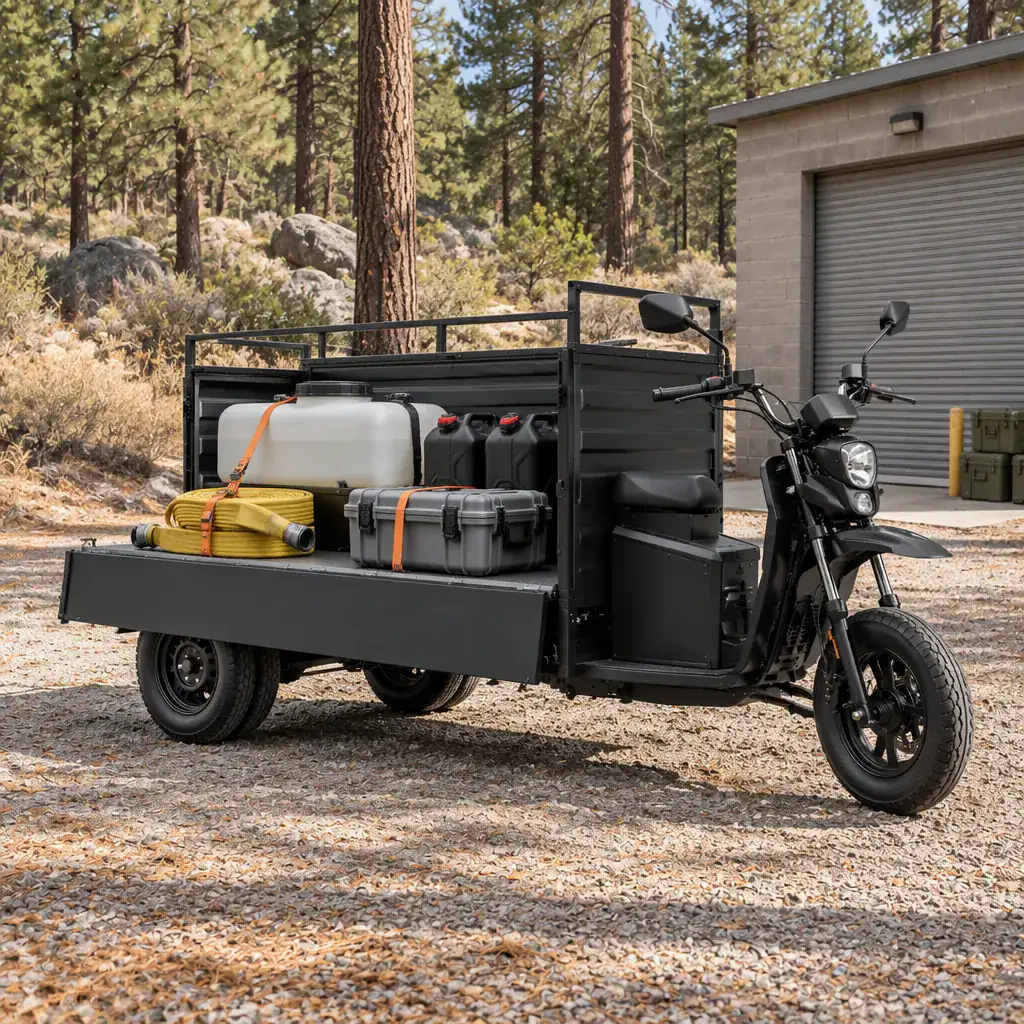
Water is the first trap. A litre weighs a kilogram, so a 150 L tank is 150 kg before you count the tank shell, the pump, the hose and the crew's own bags. Put a 150 L tank in a 300 kg-rated box and half the payload is gone at the start of the shift, with the heaviest item sitting at the front of the box where it does the most damage to the steering axle.
Hose is the second trap. A dry 30 m length of 38 mm hose is light, but a drained-wet roll is not, and crews rarely get to choose. Six wet rolls can add the better part of 100 kg in a volume that fills the box floor before anything else goes in, so the box volume runs out before the mass rating does. The practical answer is a load plan that separates dense items from bulky ones rather than a bigger box.
The third trap is the one that catches experienced buyers: the accessory electrical load. Radios, a crew-safety tracker, a rechargeable floodlight, a phone and a tablet charger, and in some configurations a small 12 V pump add up to a real continuous draw. On a platform whose own charging figures are 6–10 hours on a 5 A charger, that draw has to come out of the same energy budget, which is why a fire-support build needs a fused auxiliary circuit rather than a tap off the lighting loom. Our charger selection guide covers how charger amperage interacts with that budget.
| Load case on a fire-support round | Typical mass | Volume it takes | Where it must sit |
|---|---|---|---|
| Rigid water tank, 150 L, empty shell plus lid | 150 kg filled, 12–18 kg empty | About 170 L | Low, centred over the rear axle |
| Six drained-wet 30 m hose rolls, 38 mm | 90–120 kg | Fills 250–300 L of floor | Floor level, strapped in one layer |
| Two backpack pumps, dry | 12–16 kg | About 60 L | Rear, immediately reachable |
| Fuel and oil, two 20 L cans | About 40 kg | About 50 L | Rear corner, upright, vented |
| Crew personal gear and medical bag | 25–35 kg | About 120 L | Forward, accessible without unloading |
Read the table as a whole and the design decision is obvious. Mass and volume run out at almost the same point, which is exactly what the platform rating describes, but only if the tank is loaded low and the load is not biased forward. A build that puts the tank at the front and the hose behind it will be over the front axle limit with the box only half full.
Box form: drop-side, flatbed or fixed body
The three body options the platform ships with behave very differently on a fire line, and the choice matters more than the motor rating.
The three-way drop-side body is the right default. Hose, pumps and fuel all load and unload from the side, which means the crew does not have to climb into the box or reach over a tailgate at the end of a shift. That single property is worth more than any other body difference on this duty.
A fixed flatbed with stake sides is better when the load is mostly rigid containers and the crew wants to see the whole load at once. It is worse for anything loose, because nothing is contained and a cambered track will redistribute a load that is only tied at the corners.
An enclosed body is usually the wrong choice here. It shelters the load, but it also hides it, adds mass high up, and turns a two-minute side load into a walk-around every time something at the back of the box is needed. The exception is a build that also has to move medical or food supplies and needs a lockable, dust-proof compartment, in which case a small enclosed section bolted to the front of an open bed is a better compromise than a fully enclosed body.
Two small items are almost always left off the order and then retrofitted at cost: a rear step with a grab handle, and a set of tie-down rails along both side panels. Both are cheap at the factory and awkward afterwards.
Where the platform stops: grades, ground and rules
Honest specifications name their limits, and this platform has three that matter on a fire line.
The first is sustained gradient on loose ground. The differential and the 1000 W or 1200 W options give useful torque, but a loaded trike on a soft, loose 15% grade is limited by traction at the rear wheels, not by motor power, and no motor upgrade fixes that. The interaction between grade, motor and gearing is covered in our cargo tricycle motor power guide. If the track has a sustained loose climb, the answer is a different route or a lighter first load, not a bigger motor.
The second is ground clearance and wheel size. The platform runs 3.00-12 front and dual 3.75-12 rear tyres, a good compromise for unsealed tracks and field edges, but it is not a high-clearance off-road chassis. Deep ruts, rock steps and soft ash beds are outside its envelope. The load rating of those tyres and what the sidewall numbers actually mean is set out in our cargo tricycle tyres guide, and it is worth reading before anyone assumes a heavier-duty tyre solves a clearance problem.
The third is the one buyers underestimate: once the vehicle is working inside an operational area it may be treated as a piece of fire equipment rather than as a cargo vehicle, and that is a compliance question that belongs to the incident's own safety officer, not to the supplier. Nobody should accept a claim that a standard cargo tricycle holds a fire-service approval it does not hold. The platform's documentation package covers UN 38.3 for the battery and the per-order cell, BMS and test reports in the export file, and that is the honest limit of what a factory can certify.
Charging around a shift, not around a range figure
The published charging time is 6–10 hours on a 5 A charger, and that number decides the fleet size far more than the range figure does.
A fire shift commonly runs longer than the charging window, and the vehicle usually comes back to staging at the same time as everything else. If the platform cannot be on charge for most of a night, the second platform is not a luxury, it is what makes the first one usable. The arithmetic is simple: if the typical shift takes the pack below half, and the charger needs the better part of a full night to restore it, then a two-shift day needs two platforms regardless of how far either one can travel on paper.
Where a staging area has mains power, a second 5 A charger is usually a better purchase than a larger battery. A bigger pack extends the shift; it does not shorten the recharge, and the constraint on a repeated-loop duty is almost always the recharge. Our fleet charging guide works through the same arithmetic across a mixed fleet, and the charging dock station guide covers what changes when several vehicles share one point.
Where there is no mains power, the platform's solar option is worth roughly an extra 8–12 km of range per day, useful for keeping a pack topped up between shifts but not a substitute for a charger.
One charging detail specific to this application: crews should not leave a pack at a low state of charge across a rest day. LFP packs tolerate daily cycling well and are the sensible choice where the vehicle is charged every night, but long storage at low charge is a maintenance decision, not a warranty one, and it belongs in the unit's standing operating procedure. Our battery pack selection guide compares NMC and LFP cycle life for exactly this kind of nightly-charge duty.
What to put in the order
A fire-support build is a short list of well-chosen options rather than a long one. The platform's base configuration already carries what the duty needs: hydraulic disc front brake with dual drum rear and a parking brake, a steel tube chassis with e-coat and powder coat, full LED lighting with an optional beacon, an LCD with a load indicator, and a forward, neutral and reverse selector. The braking requirement on a cambered track is worth checking against our brake systems guide, because a parking brake that only holds on the flat is not adequate here.
The work-platform option set in our utility work tricycle guide maps closely onto this duty, so a buyer who is already familiar with that build can treat this article as the fire-specific delta rather than a separate specification.
- Body: three-way drop-side, aluminium sheet, with tie-down rails on both sides.
- Motor: 1000 W or 1200 W with differential, depending on the measured grade. Do not buy 1200 W to compensate for a route the platform should not be on.
- Battery: 60 V 32 Ah or 72 V 40 Ah, LFP where the vehicle is charged nightly and the climate is hot.
- Electrical: a fused auxiliary circuit with at least two outlets, sized for the accessory draw measured on the site.
- Access: rear step and grab handle, plus a beacon if the vehicle moves on or near a public road.
- Documents: UN 38.3 plus per-order cell, BMS and test reports in the export file, with the serial number traceable to the cell batch.
Order terms on this platform are 50 units per model as a minimum, 15–30 days as standard lead time, and 30–45 days for a first custom-branded run, with pre-production samples shipped before mass production. A single-unit trial is therefore not available through the standard programme, and a buyer who wants to prove the concept first should plan the pilot as a small batch inside a wider fleet programme rather than as a standalone order. Our in-plant and site logistics guide sets out how a staged rollout usually runs when a site is replacing a mixed vehicle fleet.
Proving it on your own track
The useful pilot is short and measures behaviour rather than specifications. Run one platform for four to six weeks on the real track with the real load and record four things weekly.
Record the actual number of loop repeats achieved per shift against the plan, because that is the number the platform either improves or does not. Record the time spent loading and unloading, since a side-loading body should cut it and a fixed box will not. Record the state of charge at the end of each shift, which tells you whether one platform or two is the honest answer. And record every location where the crew had to stop and carry something the last stretch by hand, because those points describe the true boundary of the platform and are the first thing to fix in the next build.
That last measurement is the one that changes the specification. A crew that consistently hand-carries the same item over the same 30 m of track is telling you the track, not the vehicle, is the limiting factor.
Where the platform pays back, and where it does not
The platform pays back where the loop is short, repeated and road-legal, and where the alternative is a second pickup that spends most of its day parked. It stops paying back in three specific situations, and it is worth naming them plainly.
It does not replace a vehicle that has to carry a full crew with tools to a distant face in one movement. It does not work on ground where clearance and traction, rather than payload, are the binding constraint. And it does not substitute for a proper water supply: a cargo trike moves water to where a crew is working, it does not deliver the volume a fire engine does.
What it does is remove the small, frequent, low-value trips that otherwise consume a pickup and two people for most of a shift, and on a long incident that is exactly where the hours go. Sites that already run this pattern of repeated short resupply loops have found the same arithmetic elsewhere: the quarry and mine site guide and the solar farm maintenance guide both describe sites broken into separated work faces rather than one continuous route, and both reach the same conclusion about where a small platform earns its place.
Frequently asked questions
Can a cargo tricycle carry enough water to be useful?
A 150 L tank is realistic inside a 300 kg-rated box and is enough for a hand crew working a small face away from the main supply. It is not a substitute for an engine or a tender, and the tank should be mounted low and centred rather than at the front of the box.
Is a cargo trike legal on a fire access track?
The vehicle's road classification and the incident's own access rules are two separate questions. The platform is a light electric cargo vehicle with its own market-dependent conformity, while access inside an operational area is decided by the incident safety officer. Neither answer can be assumed from the other.
How many platforms does a typical crew need?
Usually one per work-face cluster per shift, and almost always two if the incident runs two shifts. The deciding number is the state of charge at the end of a shift against the 6–10 hour recharge window, not the range figure.
What breaks first on this duty?
On unsealed, dusty and cambered ground the order is usually tyre wear at the rear pair, then the fasteners and brackets that carry the box, then the lighting and display connectors. The drivetrain is rarely the first failure, which is why buying the largest motor is usually the least useful upgrade. The scheduled inspection points are listed in our maintenance guide.
If you are specifying a support platform for a fire, forestry or emergency-response fleet, send us the four measurements from your own site and we will come back with a body form, an accessory circuit and a shift-based charging plan matched to the track you actually run. The most useful thing you can put in that message is the number of times the loop is repeated in a shift and the heaviest single item the crew lifts on and off, because those two figures remove more unsuitable options than any other pair, and they take about ten minutes to collect on site with no test drive and no specialist equipment.
Spec a Support Trike Around Your Own Track
Send us the four measurements from your fire access track and we will come back with a body form, an accessory circuit and a shift-based charging plan.
