
A used cooking oil round looks like any other collection route on paper: a list of stops, a container at each one, a fixed morning window. The vehicle that survives that route for five years is not the one with the biggest box. It is the one whose pump, hose, container mounts and washdown schedule were specified around a liquid that is heavier than water at collection temperature, turns near-solid when it cools, and carries a residue that will destroy a food-grade body panel from the inside out.
This guide works through the specification problems that decide whether a cargo e-tricycle is the right platform for a UCO round, and what to change on a standard trike to make it fit. The numbers below come from the same cargo platform the factory builds for other collection and cold-chain duties, so every parameter is quoted from a real configuration rather than a brochure ideal.
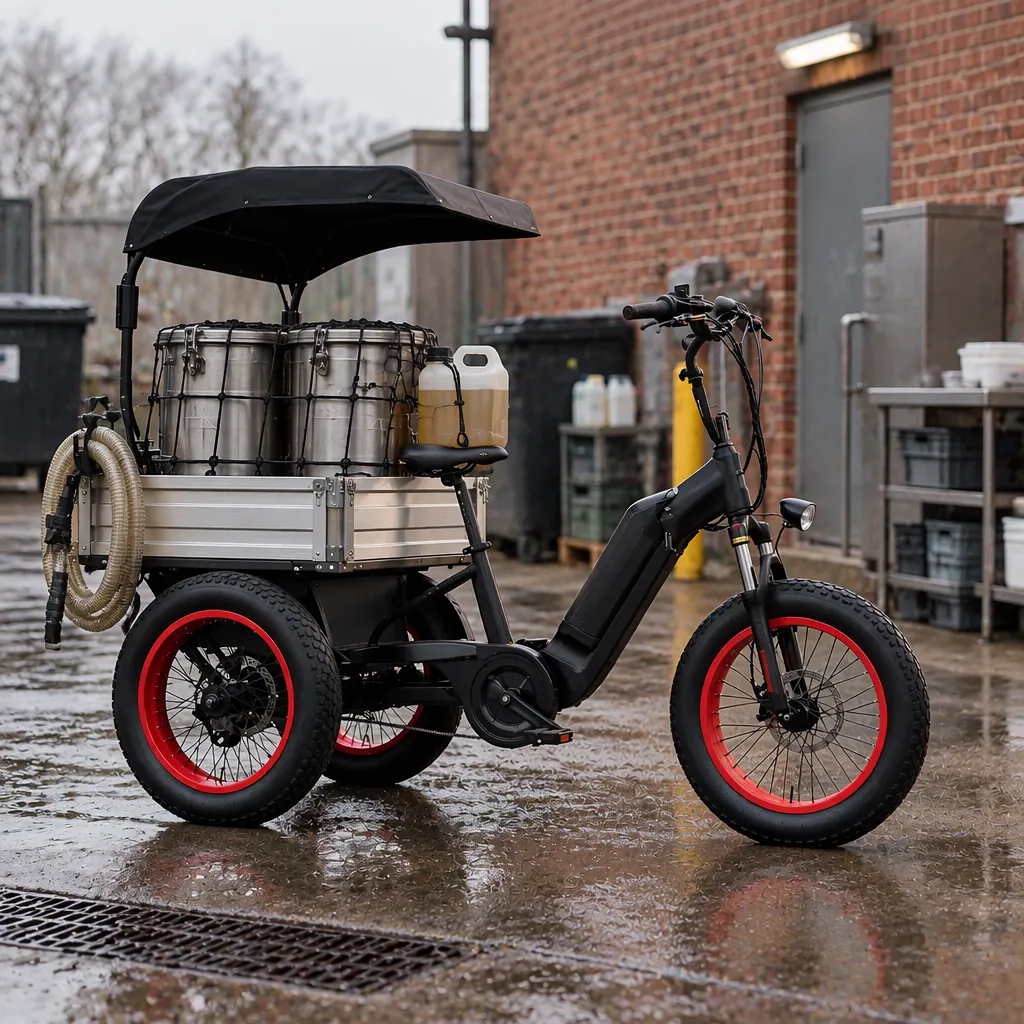
The density problem: 920 kg per cubic metre before you count the container
Most collection rounds are sized in litres, because that is how the kitchen reports it. Vehicles are sized in kilograms, because that is what the axle, tyres and brakes see. The gap between those two numbers is where over-specified and under-specified fleets both come from.
Used cooking oil at collection temperature sits in the 900 to 930 kg/m³ band, versus roughly 840 kg/m³ for the same volume of fresh rapeseed oil and 1,000 kg/m³ for water. Fresh oil is lighter than used oil because collection oil carries water, batter fines and absorbed moisture that raise its density over time. Plan on 920 kg/m³ and you will not be caught out.
Work through a common round: twelve restaurants, each handing over one 20-litre jug, gives 240 litres. That is 221 kg of oil. Add four 2BBL drums at 55 US gallons each, or 208 litres, and the oil alone reaches 412 kg before any container skin is counted.
| Container | Nominal volume | Oil weight at 920 kg/m³ | Container tare | Loaded weight |
|---|---|---|---|---|
| 20 L sealed jug | 20 L | 18 kg | 1 kg | 19 kg |
| 2BBL steel drum | 208 L | 191 kg | 20 kg | 211 kg |
| IBC tote (1000 L) | 1,000 L | 920 kg | 60 kg | 980 kg |
| Fixed 120 L tank on deck | 120 L | 110 kg | 14 kg | 124 kg |
The IBC row is the useful one. The underlying weight limits are worked through in detail in how payload capacity is actually set on a cargo tricycle. A single 1,000-litre tote exceeds the entire 500 kg non-EU payload rating of this cargo platform before the vehicle carries anything else, and exceeds the 300 kg EU rating almost three times over. That is not a reason to reject the platform. It is a reason to decide early that bulk tote collection belongs on a truck, and the trike round is built around drums and jugs picked up from kitchens that have no bulk storage.
Viscosity changes the pump, not just the hose
Oil at 40°C flows like a thin syrup. This is the same washdown-and-temperature problem that shapes a dairy collection round on a tricycle, where the liquid is heavier still. At 10°C it stops flowing through a 25 mm hose entirely, and at 5°C it sets into a paste that will block a diaphragm pump mid-stroke. A winter morning round collected in an unheated box is a different hydraulic problem from the same round in June.
Three practical consequences follow, and each one is a specification line rather than an operator habit:
- Suction lift is the binding constraint. A drum at ground level with the vehicle deck 700 mm above it forces the pump to lift roughly 0.7 m plus the hose friction. Self-priming diaphragm pumps rated for 2 m dry lift handle this; cheaper impeller pumps do not self-prime and will cavitate on every empty hose.
- Hose diameter sets transfer time. A 25 mm hose moves roughly 40 to 60 litres per minute with a small diaphragm pump. A 38 mm hose moves closer to 90 litres per minute. Across twelve stops the difference is 20 minutes of the round, every day.
- Insulation buys pumpability, not cold chain. A 30 mm insulated sandwich panel box slows cooling enough to keep oil above 15°C through a two-hour round in near-freezing weather. It does not heat the oil, and it should not be sold as a heating solution.
The platform supports insulated sandwich panel box construction alongside welded aluminium and galvanised steel bodies. For UCO duty the panel box earns its keep in winter and works against you in summer, because a sealed insulated body traps odour and heat. Many operators run a vented aluminium box with drum cradles and skip insulation entirely, accepting a shorter winter round instead.
Food-grade contact is a body material decision, not a liner you add later
Collected oil is a Category 3 animal by-product material in most EU jurisdictions, and it is a food-contact-adjacent material everywhere it is destined for biodiesel, soap or feed. Two separate compliance questions get confused constantly:
The vehicle is not the food contact surface. A cargo tricycle does not need a food-grade certificate to carry sealed drums of UCO. The drums do. What the vehicle needs is a body that can be washed down without corroding, and a deck that does not trap liquid.
Spill containment is the vehicle's real obligation. A drum that splits on the deck drains either onto the road or into a bunded deck. A flat steel deck with no lip drains onto the road. Specifying a 50 mm raised lip plus a drain plug on the deck is the cheapest insurance in the whole build, and it is a fabrication detail rather than a part number.
Material choice follows directly from the washdown schedule, and if the round also carries chilled product the insulated body detail in the cold-chain body guide applies to the same box. Aluminium sheet resists the fatty acids in UCO and the alkaline detergents used to cut them, and it saves weight on a deck that is already carrying drums. Galvanised steel survives impact from drum handling better and costs less, but the zinc layer is consumed faster under repeated caustic washdown, and a chipped edge becomes a corrosion site within one season. On a UCO round the aluminium body is the specification that pays back.
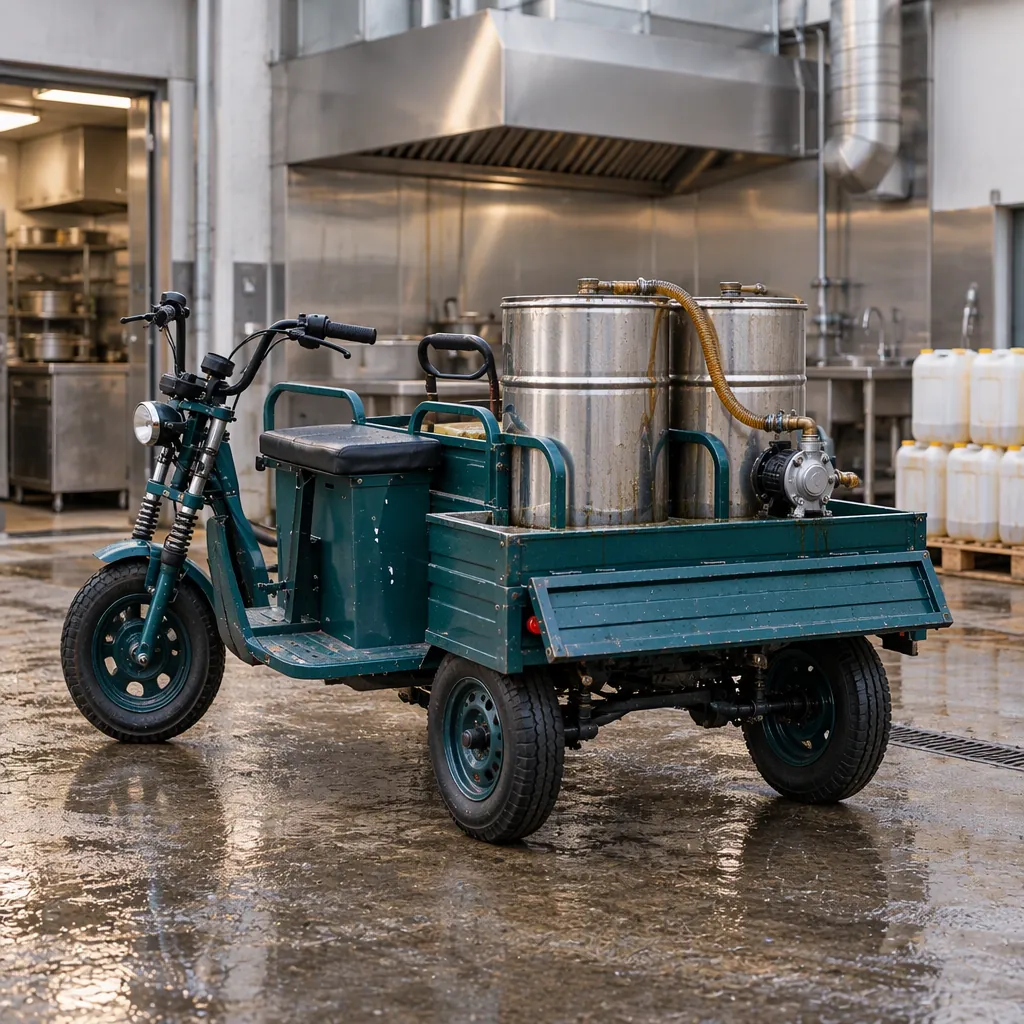
Route arithmetic: why 40 stops is not twice 20 stops
Collection rounds do not scale linearly, because the vehicle spends its time in three different states and only one of them is driving. A worked example from a 36-stop restaurant round across a 14 km circuit makes the split visible:
| Round segment | Time per stop | Stops | Total |
|---|---|---|---|
| Drive between stops (avg 390 m) | 1.6 min | 36 | 58 min |
| Position, open gate, approach drum | 2.5 min | 36 | 90 min |
| Pump transfer, 60 L average | 1.2 min | 36 | 43 min |
| Seal, log weight, load to deck | 1.9 min | 36 | 68 min |
| Depot decant and washdown | — | 1 | 35 min |
Total: roughly 4 hours 54 minutes, of which only 58 minutes is driving. That ratio is the single most useful number in UCO fleet planning, because it tells you the vehicle's top speed and range are almost irrelevant to throughput. What limits the round is the 2.5 minutes of positioning and the 1.2 minutes of pumping.
It also explains why a second vehicle rarely doubles capacity. Splitting 36 stops across two trikes means two depot decants at 35 minutes each, two warm-up cycles, and two operators driving overlapping circuits. The gain is real but closer to 70 percent than 100 percent until stop density per circuit is high enough that each vehicle runs a genuinely different geography.
Range is the constraint that rarely binds. At 50 to 80 km loaded on flat terrain with a 200 kg load, a 14 km circuit leaves enormous margin, and the round finishes well inside a single charge. The charging window is 6 to 10 hours on the supplied 5A charger, which fits a night-shift pattern comfortably. Where range does bind is density: a rural round with 25 km between the first and last stop and only eight collections pushes the daily distance past 60 km, at which point the 72V 40Ah pack and its thermal headroom become the specification that matters rather than the box volume.
Brakes, tyres and the parts that fail first on a wet deck
UCO rounds are hard on three components, and none of them is the motor.
Rear brakes. A thin film of oil on a drum brake lining drops friction sharply and unevenly, which shows up as a pull to one side under braking rather than a longer stopping distance. Dual drum rear brakes are the standard configuration on this platform, and they tolerate occasional contamination better than a single drum. Regular inspection of the rear linings after any spill is a maintenance line worth writing into the service schedule.
Tyres. The 3.00-12 front and 3.75-12 rear dual fitment is load-rated for the platform, but dual rear tyres hide a slow leak on the inner tyre until the outer one carries the whole side load. On a route that regularly runs near 300 kg, a weekly pressure check on all four rear tyre positions is cheaper than the axle damage that follows a run on a flat inner.
Deck fasteners. Repeated washdown loosens the bolts holding drum cradles and deck lip. The platform's per-vehicle inspection already verifies torque on chassis fasteners at build, but a UCO operator should re-torque deck hardware monthly. This is the failure that turns a two-drum load into a two-drum spill.
What the vehicle will not do, and where the round needs a truck
A cargo e-tricycle earns its place on UCO rounds where stops are close, volumes are drum-scale, and access is narrow. It stops earning its place in four specific situations, and a supplier who does not say so is selling a vehicle that will be resented inside a year.
| Situation | Why the trike stops working | What to use instead |
|---|---|---|
| Bulk IBC collection at a single site | 980 kg loaded against a 300–500 kg payload | Vacuum tanker or flatbed truck |
| Any stop reachable only by motorway | 25–35 km/h top speed; illegal and unsafe on 100 km/h roads | Van or truck |
| Round distance over 60 km daily | Range margin collapses; charging window no longer fits between shifts | Two trikes on split circuits, or a van |
| Oil stored below 5°C with no heated store | Product sets solid; pumping fails regardless of vehicle spec | Heated collection vessel or scheduled warm-weather-only pickup |
The reverse is equally worth stating. On a dense urban round under 15 km with 30-plus narrow-access stops, a trike replaces a light commercial van directly, and the payload capability of 300 to 500 kg covers a genuinely useful drum count. That is the same substitution logic the platform already serves on intra-urban distribution routes.
Specification checklist for a UCO collection build
This is the list of decisions that have to be made before a factory can quote, in the order that they affect cost. Each line is a real choice on the cargo platform, not an abstraction.
- Container format. Fixed 120 L deck tank, drum cradles for 2BBL, jug rack, or a mixed layout. The mixed layout is the most common UCO configuration and the hardest to fabricate.
- Body material. Aluminium for corrosion resistance under caustic washdown; galvanised steel for impact-heavy drum handling at lower cost.
- Deck containment. Raised lip height and drain plug position. Specify both explicitly or you will receive a flat deck.
- Pump mounting and power. Deck-mounted diaphragm pump drawing from the auxiliary battery, with a quick-release hose coupling. Confirm the pump's dry-lift rating against your worst-case drum position.
- Hose length and diameter. 25 mm for tight yards, 38 mm where transfer time dominates. Longer hose needs a reel, not a coil on the deck.
- Motor and gearing. 800W for flat urban rounds, up to 1200W with hill-climb gearing where loaded grades exceed roughly 8 percent.
- Battery chemistry. NMC for temperate markets; LFP is the recommended chemistry where daily temperatures stay high, because pack longevity under thermal stress matters more than energy density on a fixed route.
- Speed governor setting. 25, 35 or 40 km/h to match local regulation for the vehicle class.
Commercial terms on this platform: 50 units minimum order per model, 15 to 30 days standard lead time, plus 10 days where the box is customised, and pre-production samples before the mass-production run. First custom-branded runs typically extend to 30 to 45 days.
Weight logging: the record that settles disputes later
UCO is bought and sold by weight, and the difference between the kitchen's estimate and the depot's scale is where collection contracts get renegotiated. A vehicle that logs weight per stop resolves that argument at the point of collection rather than a week later.
The practical version does not need telemetry. A hanging scale on the deck rated to 300 kg, a printed stop sheet, and a photograph of the scale readout per drum gives the same evidentiary result for a few hundred dollars across a fleet. Where telemetry earns its cost is on multi-operator fleets, where the GPS tracker and geofencing option on this platform also confirms that each stop was actually serviced rather than skipped and back-filled at the depot.
What neither approach fixes is a round where the same kitchen reports wildly different volumes week to week. That is usually a container story rather than a vehicle story: drums swapped between shifts, oil poured into the wrong bin, or a competitor collecting the high-volume accounts on alternate weeks. Settling the collection schedule before specifying a second vehicle is almost always the cheaper decision.
Where to start
Three numbers decide the whole specification, and all three are already inside your existing operation. The total litres collected per week, which sets how many vehicles the round needs. The largest single container at any stop, which decides whether the trike round is viable at all or whether bulk collection needs a truck. The longest distance between the first and last stop on the circuit, which decides pack size and whether a single charge covers the day.
Send those three figures with a description of your current containers and washdown practice, and the specification conversation becomes concrete: container layout, body material, pump rating, deck containment and motor gearing follow directly from them. Anything quoted before those numbers are known is an estimate, not a specification.
One more number is worth tracking after the first month: the ratio between litres collected and litres delivered to the depot. A round that collects 1,400 litres and delivers 1,280 has a spill, an evaporation or a documentation problem somewhere in it, and the cause is almost always a container that was not sealed before the vehicle moved rather than a defect in the vehicle itself. Operators who log both figures from the first week find that discrepancy early, while it is still a process fix. Operators who only log deliveries discover it at the annual reconciliation, when it has become a contract dispute.
The same discipline applies to the washdown record. A deck that is washed at the end of every round and inspected monthly for fastener torque and rear brake lining condition will outlast one that is washed when someone remembers. Neither habit costs anything to start, and both decide whether a five-year vehicle actually reaches five years on a working UCO route.
Send Us Your Litres, Your Biggest Container and Your Circuit Length
Those three numbers decide container layout, body material, pump rating and pack size. Share them with a description of your current containers and washdown practice, and an export engineer will come back with a concrete UCO build specification rather than a brochure range.
