
A butcher and a fishmonger share a problem that neither a courier nor a grocery round has: the product has already been through the slaughterhouse or the auction floor, and it now has to leave a licensed premises and arrive at another licensed premises still inside its temperature band. That single constraint reshapes the vehicle. It is not a route-planning exercise with a fridge bolted on top. It is a cold loop, and the arithmetic that matters is minutes between door openings, measured on trays that weigh more than they look.
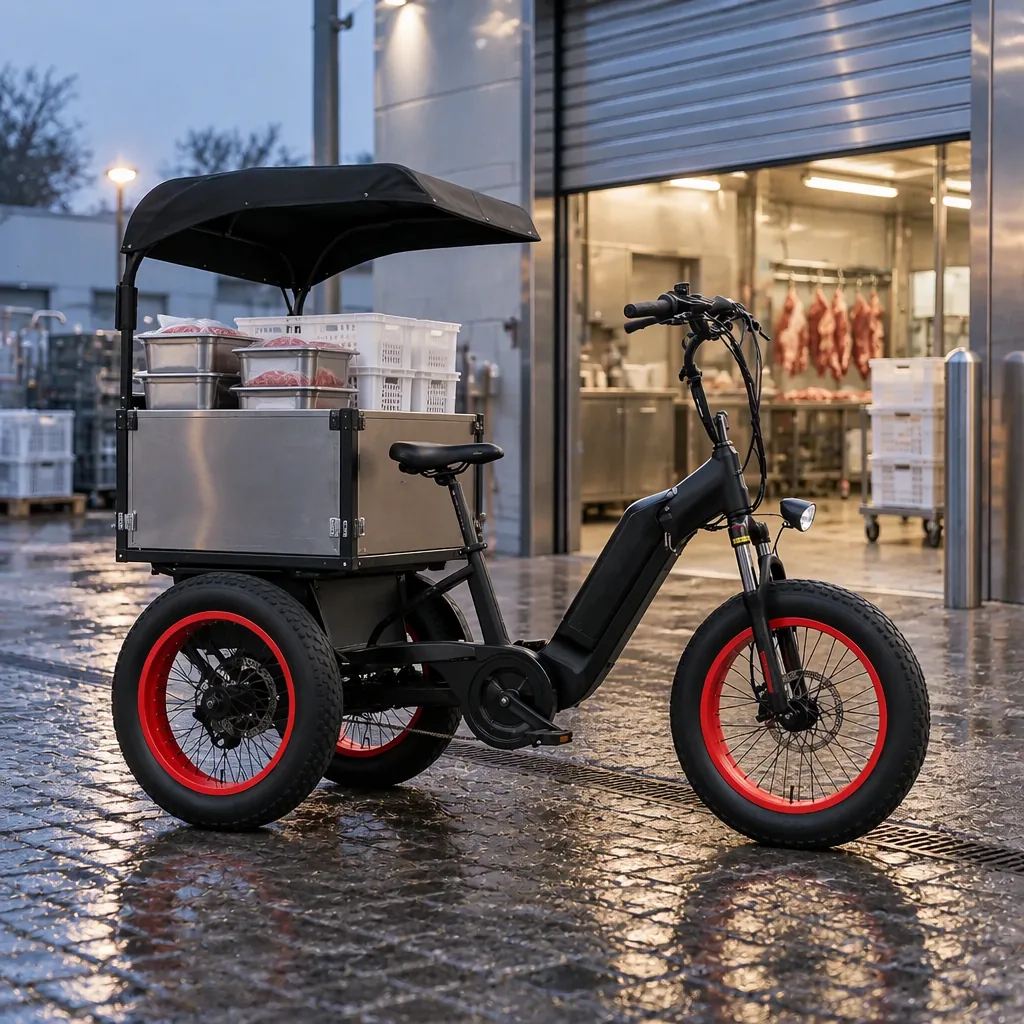
This guide is written for the shop owner or the small wholesale operator who is done carrying gas bottles and is now deciding whether a cargo tricycle can run the loop properly. It covers the four measurements that eliminate platforms before power is even discussed, the hold-time arithmetic that decides how many boxes you can carry per run, the washdown specification that quietly determines whether the chassis survives three winters, and the charging maths that sets how many vehicles a two-premises business actually needs. Every number below comes from the EMS cargo tricycle platform specification, not from a generic guideline.
Why a cold loop is not a delivery route
A parcel round tolerates time. A meat round does not, because the product is already chilled and the clock only runs one way. Within the EU cold-chain framework that most fresh meat and fish distribution is audited against, chilled fresh meat is normally held at or below 4 °C and fresh fish on flake ice at or below 2 °C. That is the product leaving the shop. The vehicle is not meant to chill it further. The vehicle is meant to buy enough minutes to prevent a rise.
That distinction is what separates a cold loop from a grocery round. Grocery delivery assumes each stop is short and the product is dry. Butchery assumes each stop involves a delivery note, a signature, a handover into someone else's chiller, and often a returns crate coming back. The door is open longer and it is open more often. Three stops on a short high-street loop can occupy as much of the run as twelve parcel drops.
The second thing that separates them is weight per unit volume. A grocery crate holds bulky low-density goods. A stainless meat tray is heavy for its footprint. A two-metre stainless tray of vacuum-packed primals can run to 25–30 kg. Stack several and the vehicle's total payload is used up long before the cargo volume is, which inverts the way most buyers think about box size. The specification that fails first on this duty is almost never the box. It is the axle pair.
The four measurements that eliminate platforms before power matters
Before a motor rating or a battery size is worth discussing, four physical facts will already have decided which platforms are viable. Get them first. They cost one hour with a tape measure and they save a mistaken order.
- Shop door width and clear opening height. A licensed butchery often has a wide delivery door and a narrow customer entrance, and your vehicle has to fit whichever one you will actually use. Measure the clear opening, not the frame.
- Loading bay threshold and approach slope. A drop kerb or a ramped loading apron is fine up to roughly 8 percent of gradient. Beyond that, the platform needs a higher motor rating rather than more battery, because the limiting factor is climbing torque at walking pace.
- Aisle width inside the chilled area. Most shop chillers and preparation areas give somewhere between 1.6 and 1.9 metres between benches and shelving. A cargo tricycle of the EMS platform envelope passes that. Below roughly 1.4 metres, stop trying to fit the trike and use a hand trolley for the last few metres.
- Tail-lift or dock height at the other end. If the receiving kitchen or restaurant has a raised dock at 800 mm or above, the trike is loaded from a folding ramp, not by lifting trays overhead. That changes the loading time estimate and, in turn, the whole circuit arithmetic.
Write those four numbers down before reading any product page. If any one of them fails, the trike programme is the wrong programme for that premises, and no amount of specification will fix it.
The four circuits a butcher or fishmonger actually runs
Shop operations do not run one delivery round. They run four distinct circuits, and each one stresses the vehicle differently. Sizing a fleet around the wrong one is the single most common procurement error in this trade.
Circuit 1: preparation bench to the van or the street
This is porterage inside or immediately outside the premises. Tray trolleys have historically done this work, and in tight yards the trike does not replace them. It replaces the second van run. The relevant number is the weight moved per loading event, not distance. A trike parked at the rear door with drop-sides open can be loaded tray by tray straight from the bench.
Circuit 2: shop to customer premises
The real cold loop. Shop to restaurant, shop to two or three domestic customers, shop to a market stall. Distances are usually 2–8 km per leg with 4–10 stops. The dominant stress is frequency of door opening, and the dominant cost is the minutes lost at each handover.
Circuit 3: wholesale pickup to shop
For a fishmonger this is often the morning run that matters most: the market or the port to the shop, arriving before the counter is dressed. Loads are heavier and single-drop. Range and payload dominate; stop frequency is irrelevant. A 200 kg loaded run of 20–40 km on the flat fits comfortably inside the platform's 50–80 km loaded range figure.
Circuit 4: waste, returns and washdown between runs
Bones, trim, packaging, returns crates and the washdown of the box. This circuit is the one buyers forget and the one that destroys vehicles. It is covered separately below because it is a materials specification, not an operational one.
Hold-time arithmetic: how many boxes per run
Insulated box performance is quoted as a hold time under a stated ambient, and the honest number always comes with an assumption about door openings. The EMS insulated cold-chain box is specified for a 2–8 °C hold with a four-hour claim. Treat four hours as an empty-box figure in still air, and budget a real-world allowance of roughly one-third of that lost to door openings on a multi-stop loop.
That gives a working rule: a chilled cargo box on this platform keeps a genuinely usable hold for about 2.5 hours of active multi-stop work in summer ambient. A single-drop wholesale run of 40 minutes uses almost none of it. A ten-stop high-street loop with 6–8 minute handovers will consume the entire allowance in a single pass.
Three practical consequences follow. First, pre-chill the box before loading, ideally by parking under cover in the shade rather than in direct afternoon sun, because an empty box that starts at 12 °C has already spent a quarter of its allowance before a single tray goes in. Second, keep the drop-sides closed between stops even where the opening is 30 seconds, because the loss per opening is disproportionate on a small box. Third, and most importantly: if your loop cannot be closed inside 2.5 hours, the answer is not a bigger box. The answer is a second vehicle or a shorter loop, because a larger box has a proportionally larger door opening and often no better hold.
Payload and axle load: the number that actually limits you
The EMS cargo platform carries 300 kg payload in the EU configuration and 500 kg in the non-EU configuration. Those are engineering limits set by the chassis rail and the rear axle set, not marketing figures, and the loaded range of 50–80 km is quoted at 200 kg on flat terrain. Read those two figures together and the design intent becomes clear: the vehicle is engineered around a 200 kg typical load, with headroom above it.
For butchery work, that headroom gets used. Calculate tray weight honestly. A stainless tray of vacuum-packed primals at 25 kg, six trays, plus two 10 kg fish boxes on ice, plus a driver of 85 kg, is already 285 kg before the box and its insulation are counted. That is inside the EU rating with almost nothing to spare.
The distribution matters as much as the total. The platform runs a single front wheel and a reinforced dual rear wheel pair on a steel tube chassis with leaf-spring rear suspension. Load carried behind the rear axle line transfers weight off the front wheel on gradients, which is where braking and steering both degrade. The practical rule: heavy trays go forward in the box, over the rear axle rather than behind it, and never stacked above the box side rails where the centre of gravity rises on a vehicle that already leans into corners.
Tyres are specified at 3.00-12 front and 3.75-12 rear in a dual arrangement, load-rated. These are not scooter tyres and they should not be substituted with a lighter commercial tyre to save money, because the rear pair is carrying the majority of a load that is often at the top of the rating.
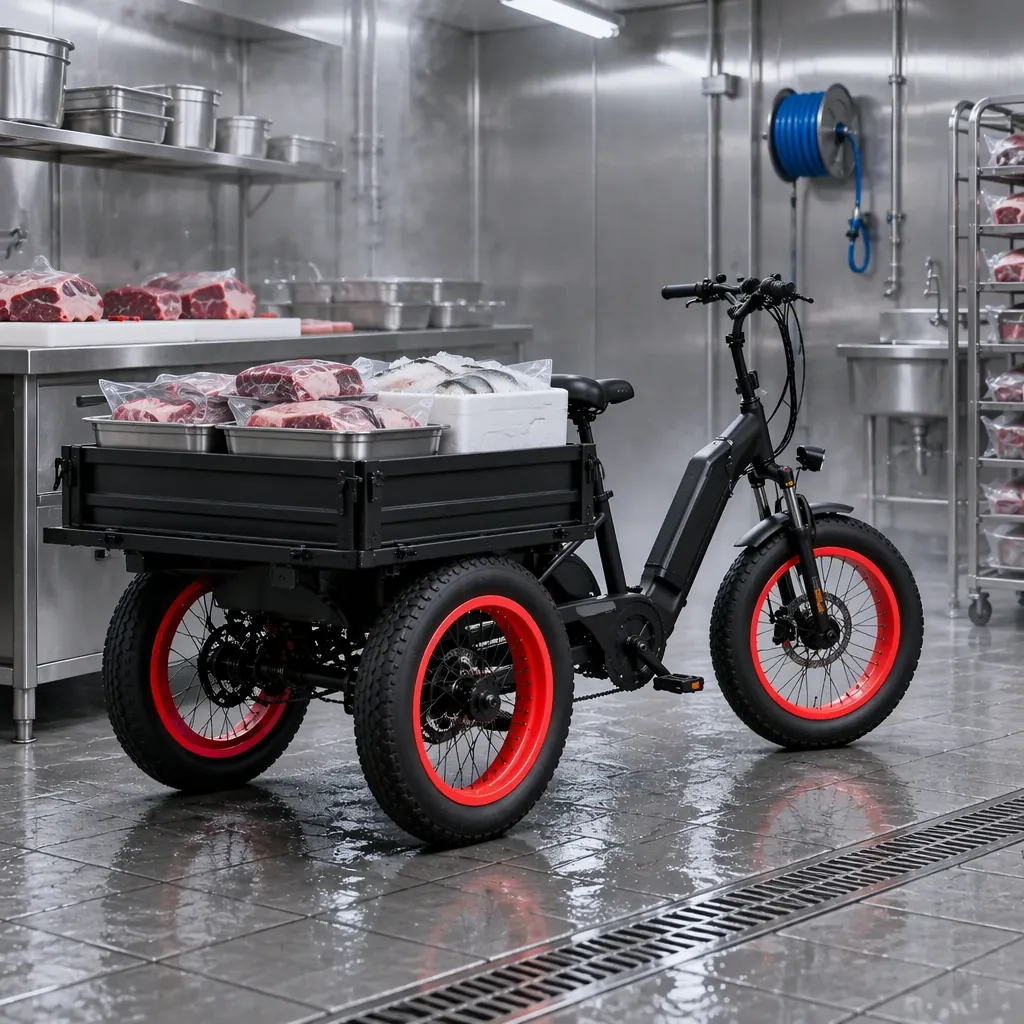
Washdown grade: the specification that decides service life
No other food-adjacent duty washes its vehicle as hard as butchery. Hoses, food-safe detergents, and if you are audited, a documented sanitation schedule that includes the vehicle. The chassis is steel tube with a heavy-duty e-coat plus powder coat, described as rust resistant. Rust resistant is not the same as sealed, and the distinction is where money gets lost.
The items that fail first in a washdown environment are predictable and worth specifying explicitly in the purchase order:
- Chassis welds and the areas around the axle mounts. These are where coating coverage is thinnest from the factory. Ask for them to be checked and touched up as part of pre-delivery, and inspect them yourself every quarter.
- Drop-side hinges and latches. Not part of the painted structure on most builds, and the first place rust becomes visible.
- Electrical connectors to lights and the LCD display. The controller carries an IP65 rating and the warranty covers water ingress, which tells you ingress has been a real-world failure mode. Route-check the loom for any point where it sits below the box floor line.
- Leaf springs. They collect organic debris between the leaves, and organic debris plus moisture is the fastest corrosion mechanism on the whole vehicle. Include them in the washdown routine, not just the box.
The box lining choice follows from this. An insulated lining is right for the chilled product. An aluminium or steel drop-side box is easier to hose out and dry and is the better choice if your loop mixes chilled deliveries with collections of unpackaged product. Expect to replace hinge hardware before you replace anything else.
Charging arithmetic that decides how many vehicles you need
The platform charges in 6–10 hours on a 5 A charger, across both the 60V 32Ah NMC and 72V 40Ah LFP packs. That single figure does more to determine fleet size in this trade than range does, because butchery working hours are unforgiving.
Take a fishmonger running a morning wholesale pickup and an afternoon shop-to-restaurant loop. Both circuits fit inside a 50–80 km loaded range with margin. But the vehicle returns at roughly 15:00 and needs to be full again by 04:30. That is a 13-hour window, so one vehicle on one 5 A charger is comfortable, assuming the charger is at the shop and someone is there to plug it in. No problem.
Now take the same business running two loops and a third evening round. The vehicle comes back at 18:00 and goes out at 20:00. A 5 A charger returns somewhere between 20 and 35 percent of the pack in two hours. That is enough for a short loop, not for a full one. The options are a second charger, a higher-current charger, or a second vehicle. For most operators the honest answer is the second vehicle, because it also covers breakdown and service downtime, which no charging arrangement can.
Two specification points worth raising with the supplier. An LFP pack on the heavy-duty 1200W/72V configuration is the better choice where the vehicle is charged twice a day every day, because the cycle life advantage compounds. And if the shop has three-phase power at the yard, ask what AC input the higher-current charger requires before you assume a domestic socket will carry it.
The specification table for butchery and fish duty
This is the platform configuration that fits the four circuits above. All figures are from the EMS cargo e-tricycle specification.
| Item | Specification | Why it matters on this duty |
|---|---|---|
| Payload | 300 kg (EU) / 500 kg (non-EU) | Dense tray loads use payload before volume; the EU figure is a genuine ceiling for a full loop plus driver |
| Box volume | 150–500 L, drop-sides, optional insulated lining | Drop-sides let you load trays from the bench; insulated lining is required for the chilled loop |
| Motor | 800W / 1000W / 1200W hub with differential, 60V or 72V | The differential matters on wet cobbles and ramped aprons; 1200W is the choice for the loaded wholesale run |
| Battery | 60V 32Ah NMC / 72V 40Ah LFP | LFP for twice-daily charging; NMC is adequate for a single overnight charge |
| Range | 50–80 km loaded at 200 kg, flat | Relevant to Circuit 3; circuits 1, 2 and 4 are minutes-limited, not range-limited |
| Brakes | Hydraulic disc front, dual drum rear, parking brake | The parking brake is not optional on a sloped loading apron with a live load |
| Tyres | 3.00-12 front, 3.75-12 rear dual, load rated | Rear pair carries the load; do not substitute a lighter commercial tyre |
| Charging | 6–10 hours on 5 A | Determines whether one vehicle or two covers a two-loop day |
| Frame | Steel tube, e-coat plus powder coat | Rust resistant, not sealed; washdown routine is the real protection |
| Speed | 25–35 km/h, governor configurable | Set below 25 km/h for high-street loops where pedestrians share the surface |
| FOB range | $1,250–$2,250 across the three configurations | Light 800W at the low end through the 1200W LFP heavy-duty |
| MOQ | 50 units | Programme order level; sample first, then volume |
| Lead time | 15–30 days standard, 30–45 days for first-order custom | Box lining and livery are the usual custom items |
Compliance and documentation across the cold chain
Two separate compliance questions run in parallel here and buyers regularly conflate them. The first is vehicle compliance: which standards the trike itself is built and documented against. The second is food chain compliance: what your local authority expects of the vehicle as a food transport container.
On the vehicle side, the relevant reference set for this class is CE marking for the EU market, EN 15194 for pedal-assist cycles, UN 38.3 for lithium battery transport, and ECE R100 for high-voltage battery safety, alongside IP54 or better weather rating. Ask for the documentation package per market at quoting stage rather than at shipping, because it determines whether the vehicle can be registered and insured as a commercial vehicle in your jurisdiction.
On the food side, there is no single international certificate, and anyone who tells you there is should be treated with caution. What actually matters is that you can demonstrate to your inspecting authority that the vehicle is cleanable, that it holds temperature, and that you have a written cleaning schedule for it. A vehicle with a smooth washable box lining, a floor drain, and a documented washdown routine satisfies that in practice. A vehicle with an open timber flatbed does not, regardless of what the vehicle's own compliance paperwork says.
This is also where the trike's legal classification matters operationally. In most US states and in the EU, a low-speed electric cargo tricycle in this class sits outside the licensing regime that applies to a light commercial van, which is a large part of the cost argument. Verify the position for your own jurisdiction before ordering, and note that the classification often changes abruptly above 25 km/h.
Order terms, samples and the first month
The EMS programme runs at 50 unit MOQ with 15–30 day lead times and 30–45 days on a first order that involves customisation, with the light 800W configuration at the bottom of the FOB band and the 1200W LFP heavy-duty at the top. For a single shop, MOQ is clearly not the entry point. The route in is either a sample order through a distributor, or a joint order with neighbouring businesses on the same industrial estate, which is more common in this trade than it sounds.
Before committing a fleet, run one vehicle for a full month on the circuit that hurts most. For most butcheries that is Circuit 2, and for most fishmongers it is Circuit 3. Log four numbers daily: minutes per loop, tray count and weight per loop, state of charge on return, and any day the vehicle was unavailable. Those four columns will tell you within three weeks whether you need one vehicle or two, and they will tell you in a way no supplier conversation can.
Finally, confirm spare parts availability for the wear items specific to this duty before you order: box hinges and latches, drop-side hardware, brake pads, and the rear tyre pair in 3.75-12. A cold loop that stops because a hinge failed is a food waste event, not just a maintenance event.
Where this fits in the wider operation
The cold loop above is one of several food-adjacent circuits on this platform. If your operation also runs retail or wholesale food distribution at larger scale, the cold storage distribution guide covers the freezer-store end of the same problem, and the cold chain guide sets out the temperature-gate framework that both build on.
Where the vehicle is doing multi-drop work across a neighbourhood rather than a fixed loop, the market hall circuit guide and the grocery delivery guide cover the routing and box-configuration decisions in more depth. If you are comparing the trike against a refrigerated van on cost rather than on temperature, the tricycle versus pickup comparison runs that arithmetic directly.
On the engineering side, the difference between a vehicle that survives washdown and one that does not comes down to a small number of components. The brake systems guide and the tyre selection guide both deal with the parts that fail first on a loaded, wet, high-frequency duty cycle. And if you are specifying a custom box lining or livery for a shop identity, the private label programme guide sets out what is and is not practical at volume.
Start with the four measurements and then run one vehicle for a full month on whichever circuit hurts most in your own operation. Everything else in this guide, from the motor rating to the number of vehicles you buy, follows from what those four weeks record rather than from what any specification sheet claims. Get the cold loop right and the trike becomes the cheapest vehicle on the estate; get the loop wrong and no amount of battery capacity will rescue it.
Spec a trike that survives the cold loop
Tell us the four measurements of your loop — door width, apron gradient, chiller aisle and receiving dock height — and we will come back with a platform recommendation and a quote.
