
Most cargo tricycle specifications are written in kilograms and litres of box volume. A dairy collection round breaks both numbers at once. Milk weighs about 1.03 kg per litre, so a modest-looking load of forty 40-litre churns is more than 1.6 tonnes of product, and the trip is not one drop but eight or twelve stops on farm lanes with grades, gates and a washdown bay at each end. Buyers who spec a collection vehicle from a parcel-delivery template discover the mismatch in the first month: the platform is right, the body and the duty cycle are wrong.
This guide works through the four decisions that actually determine whether an electric tricycle can serve a milk collection round: how much product the round moves and in what container, what food-contact and washdown discipline the body has to survive, what the farm-lane terrain does to grade and range calculations, and whether the round should be built around churns at all or around a bulk transfer. It is written for the dairy, the cooperative and the collection contractor sizing a first fleet or replacing a light van, not for a buyer who wants a general cargo trike.

Start With Weight Per Litre, Not Box Volume
Liquid dairy is the densest routine payload a cargo tricycle is asked to carry. Water-based drinks sit near 1.0 kg per litre; whole milk sits around 1.03, and cream considerably higher. That single number reshapes the whole specification, because the box volume that a general cargo trike is sold on becomes irrelevant long before the weight limit is reached.
Work the arithmetic backwards from the churn, not forwards from the box. A standard stainless churn holds 40 litres, so a full churn is roughly 41 kg of product before the container itself. Four churns already exceed 160 kg. The platform figures published for the heavy-duty cargo configuration are 300 kg payload in the EU and 500 kg outside it, measured over a 150 to 500 litre box and a 50 to 80 km range at 200 kg on flat ground. That means a realistic churn load on a 300 kg-rated build is six to seven churns, not the fifteen or twenty the box would physically swallow. The full method for reconciling a nominal payload figure with what a body can actually be loaded to is set out in our cargo tricycle payload and capacity guide, and it is worth reading before you accept any headline number.
Two consequences follow. First, the round has to be planned in churns per trip rather than litres per day, and a farm producing more than the churn ceiling becomes a second trip or a second vehicle. Second, because the load is dense and stacks in a small footprint, the vehicle is almost always weight-limited rather than volume-limited, which is the opposite of the parcel and bakery duty cycles that most cargo trike literature describes.
| Container | Product weight when full | Notes for a collection round |
|---|---|---|
| 40 L stainless churn | ~41 kg plus container | Industry-standard size; hand-liftable when full, dominant on small and mid-size farms |
| 20 L churn or can | ~21 kg plus container | Lighter handling, roughly doubles the stop count for the same volume |
| 50 L churn | ~52 kg plus container | Faster loading but needs two-person handling or a lift aid |
| Bulk transfer hose | Zero container weight | Product moves straight from farm tank to vehicle tank; changes the platform class entirely |
The Tanker-or-Churn Decision Comes Before the Vehicle
Before choosing a motor or a box, a collection operation has to choose its transfer method, because the two options produce completely different vehicles. Churn collection is a multi-stop pick-up round: the vehicle visits each farm, takes the churns that were filled overnight, and leaves empty ones. Bulk collection is a single-visit transfer: the vehicle carries a tank, couples to the farm's bulk tank outlet, and pumps the whole morning's production in one operation.
The churn route is the lower-capital choice and the one a cargo tricycle suits. It needs no pump, no tank cleaning-in-place, and no driver trained in bulk transfer hygiene. Its cost is labour: every litre is lifted twice, once onto the vehicle and once off, and at 41 kg per full churn that limits the round to what one person can handle across a shift. The bulk route removes the lifting and cuts the stop time, but it moves the vehicle into a different specification band: a tank body, a pump or vacuum system, washdown ports, and a payload that usually exceeds what a tricycle platform carries.
The practical dividing line is farm size and access. Smallholdings with a few dozen animals and gate widths under two metres are churn territory. Larger units with a bulk tank, a concrete apron and vehicle access are bulk territory, and a tricycle is the wrong tool there regardless of how capable the platform is. A cooperative running mixed routes often ends up with both: churns on a tricycle for the small-farm loop, and a tanker for the larger units, which is a fleet decision rather than a vehicle decision.
Food-Contact and Washdown Change the Body, Not the Chassis
Dairy collection is a food-contact operation, and that constrains the body far more than the drivetrain. The box a parcel round uses is a closed steel or aluminium shell with drop-sides and a painted interior. If your operation already runs a washable body on another duty, the body logic in our waste collection tricycle guide is the closest transferable precedent, because that round is also built around a body that has to be cleaned at the end of every shift. The box a milk round needs is a washable, drainable tray with no pockets where milk residue can sit, because residue sours, and sour residue is what an inspection finds.
Three body details do most of the work. The floor should be a single stainless or coated-aluminium sheet with the corners radiused rather than square, so a hose and brush can clear it in one pass. The box should drain: a low point with a plugged outlet, or a floor that slopes to the tailgate, so wash water leaves instead of pooling under the churns. And the structure should tolerate daily wetting, which in practice rules out untreated mild-steel fixings and bare steel joints where water sits.
The vehicle-level coating already covers the chassis side: a steel tube chassis with heavy-duty e-coat and powder coat, which is the specification to hold on to for a wet-duty round. What the buyer has to specify separately is the body interior and the fittings, because a standard painted cargo box will lose its finish around churn feet within a season of daily washdown.
Two operational habits follow from the same requirement. First, loaded churns should ride on a removable tray or a lined floor rather than directly on the painted deck, so the deck is not abraded and the tray can be lifted out for cleaning. Second, the washdown bay at the collection point is part of the route: it needs to be on the loop, not at the depot, because a vehicle that collects eight farms and then drives forty kilometres before washing has carried residue for the whole return leg.
Grade, Range and the Farm-Lane Reality
Published range figures assume flat ground and a 200 kg load. A milk round breaks both assumptions in the same direction. Farm lanes are unpaved, often cambered, and frequently climb between the yard and the road, and the load is heavier than the reference figure for most of the return trip. The grade and traction behaviour of this platform on working land is described more broadly in our farm and ranch tricycle guide.
Take the platform numbers literally and then discount them. The range quoted is 50 to 80 km loaded at 200 kg on flat terrain, with the 800W build at the low end and the 1200W 72V 40Ah LFP build at the high end. A churn round that climbs 8 per cent farm tracks and returns fully loaded should be planned at the low end of its own band, not the middle. The habit that works is to measure one real circuit, not to extrapolate: drive the actual loop with a representative load once, record the distance and the state of charge on return, and size the round from that number.
Suspension matters more on this duty than the spec sheet suggests. A dense, rigid load of stainless churns on an unsprung bed over washboard farm track transfers every bump into the floor fixings and the churn bases, which is where leaks start. Sprung suspension on the platform, plus a bed that spreads the load across the axle pair rather than concentrating it at the tailgate, keeps the churns seated and the body intact; our cargo tricycle suspension guide covers how much of that load actually reaches the churn bases over washboard track. Tyre specification matters too: the platform uses 3.00-12 front and 3.75-12 dual rear load-rated tyres, and on a loose or muddy farm apron the rear pair does the traction work, so a worn rear set shows up first as wheelspin on the yard rather than as a handling complaint. Load-rated tyre selection for this kind of duty is covered in our cargo tricycle tyres guide.
Braking is the other side of the same calculation. The platform carries hydraulic disc front with dual drum rear and a parking brake, which is the right architecture for a loaded descent to a farm gate. A parking brake is not optional on this duty: an operator who leaves the vehicle on a sloped apron while carrying churns into a parlour needs the brake to hold the vehicle, and it also protects the drivetrain from being left in gear under load as the only restraint.
Charging Arithmetic for a Fixed Morning Round
A milk round has a fixed schedule, which makes charging simpler than it is for a delivery fleet. Collection happens in a defined morning window, the vehicle returns to the depot or processing site, and it charges overnight. The platform figure of 6 to 10 hours on a 5A charger suits exactly that pattern, provided the round fits inside the vehicle's measured range with margin.
The arithmetic that matters is churns per charge, not kilometres per charge. If the measured circuit supports a certain number of churns at the dense load, then the round size is that number times the collection frequency, and the charging window only has to cover one round per day. Where a dairy wants two rounds per day, the constraint is the recharge time: a second round inside the same day generally needs either a faster charger or a battery swap, because the 5A charger will not restore the pack between rounds. The heavier build with the 72V 40Ah LFP pack is the one to look at for daily deep cycling, since LFP tolerates full cycles better than an NMC pack over a fleet's service life.
Cold weather belongs in this section rather than in a separate winter planning exercise. Dairy collection runs early, and a pack that is cold at the start of a morning round delivers less than its rated capacity. The mitigation that costs nothing is to charge in a sheltered space and to start the round with a warm pack rather than parking the vehicle outside overnight. The wider cold-weather duty picture, including how range falls and what to derate, is in our electric tricycle winter guide.
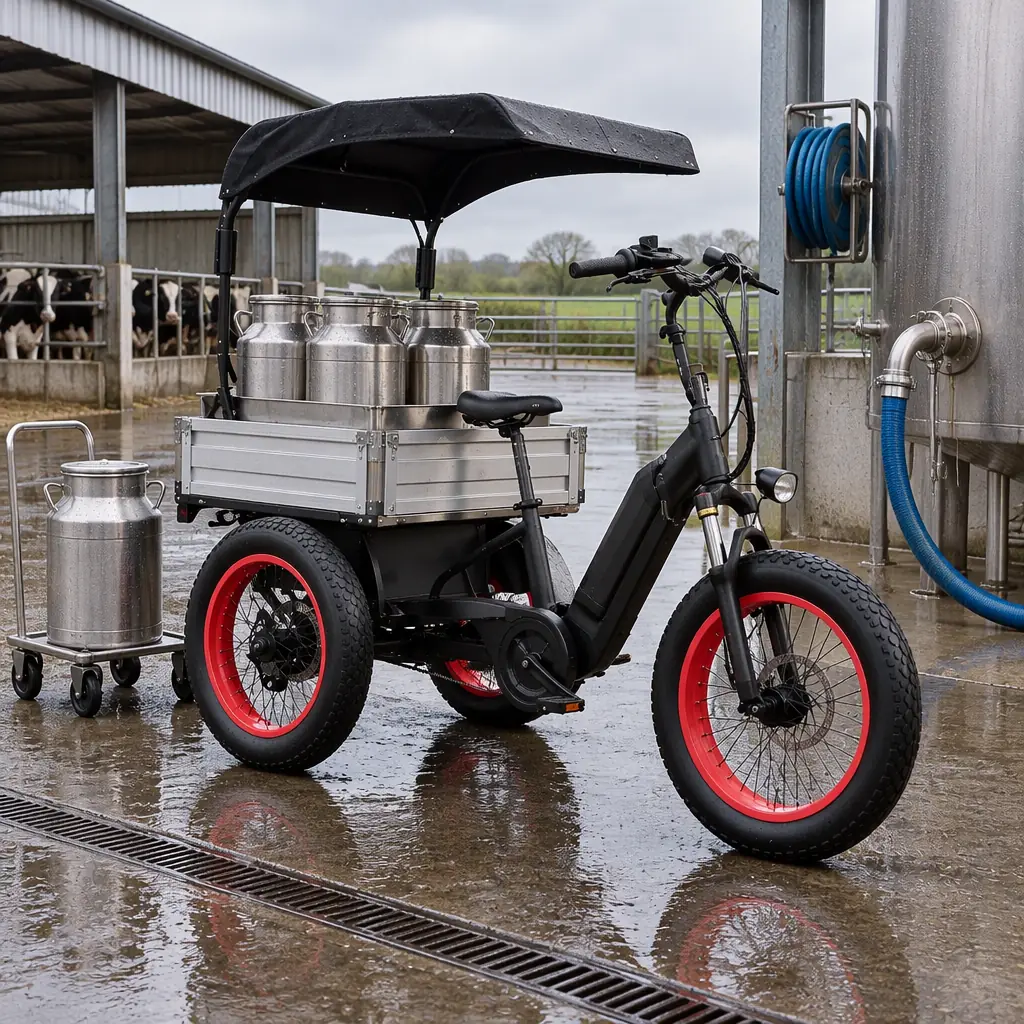
The Body Options That Fit a Milk Round
Three box configurations cover almost every churn round, and the choice is driven by how the churns are loaded rather than by capacity.
- Open drop-side aluminium box. The default. Side gates fold down so churns are lifted across a low edge instead of over a fixed wall, which matters at 41 kg per full churn. Fastest to load, easiest to hose out, and the configuration to choose when the round is churns and nothing else.
- Insulated sandwich-panel box. Adds a temperature buffer for a round where the gap between collection and processing is long, or where ambient temperature is high. Heavier and slower to clean, so it earns its place only when the round genuinely needs held temperature rather than short transit time.
- Flatbed with a removable churn tray. The most flexible option: the tray and churns come off and the bed returns to general farm use. Suited to a dairy that runs one vehicle for collection and a second job later in the day, at the cost of strapping discipline every time the tray is re-fitted.
What does not work is a fully enclosed body with no drain path. Churns go in wet, condensation collects, and a sealed box becomes the hardest thing on site to clean. If an enclosed body is required for weather protection, specify the drain first and the door second.
Specification Table for a Collection Platform
The figures below are the platform specification as published for the heavy-duty cargo build, which is the configuration a churn round should be priced against. Payload is the engineering limit of the chassis rail and axle set, not a marketing number, and it is stated separately for the EU and non-EU markets.
| Item | Specification | What it means on a milk round |
|---|---|---|
| Motor | 800W / 1000W / 1200W brushless hub with differential, 60V or 72V | Graded farm lanes favour the mid or heavy build; the differential matters on tight yard turns |
| Battery | 60V 32Ah or 72V 40Ah lithium, LFP available, heavy-duty BMS | LFP for daily deep cycling on two-round operations |
| Range | 50 to 80 km loaded at 200 kg, flat terrain | Discount to the low end for grades and dense loads; measure the real circuit |
| Top speed | 25 to 35 km/h | Farm-lane legs run well below this; the figure matters on the road transfer |
| Charging | 6 to 10 hours on a 5A charger | Fits one overnight round; two rounds a day needs a faster charger or a swap |
| Payload | 300 kg (EU) / 500 kg (non-EU), box volume 150 to 500 L | Roughly six to seven full 40 L churns on the EU-rated build |
| Brakes | Hydraulic disc front, dual drum rear, parking brake | Loaded descent control plus a hold on sloped aprons |
| Tyres | 3.00-12 front, 3.75-12 dual rear, load-rated | Rear pair carries the dense load and provides yard traction |
| Frame | Steel tube, e-coat and powder coat | The coating specification to hold for daily wet duty |
| Box | Aluminium or steel, drop-sides, optional insulated lining | Specify a radiused washable floor and a drain for food contact |
| Controls | LCD with speed, battery, load indicator; forward / neutral / reverse | Reverse is used constantly in farm yards and parlour approaches |
Ordering Terms and the Pilot Month
Production terms follow the general OEM pattern for this platform: MOQ of 50 units, 15 to 30 days lead time, and a longer window for a first order with body customisation such as a washable tray or a specific drain arrangement. If this is your first import, the documentation and container-loading sequence is covered step by step in our first container tricycle shipment guide. Those terms are the reason a first dairy fleet should not be ordered as a full replacement of an existing van route.
The approach that de-risks the purchase is a pilot month on the hardest circuit. Put two or three vehicles on the route with the longest farm lanes, the most stops and the tightest washdown discipline, and run them for a full collection cycle before committing the rest of the fleet. What the pilot measures is not whether the vehicle moves the milk but the four things the specification cannot tell you: how many churns the circuit actually supports across a shift, how long washdown takes at each end, whether the loaded return leg on the steepest grade leaves enough charge margin, and whether the drivers accept the loading height at 41 kg per churn over a full morning.
That measured data is also what makes the second order cheap. A dairy that knows its circuit carries a churn count, a washdown duration and a grade profile into the next negotiation, instead of re-deriving them from a spec sheet that was written for flat ground and 200 kg.
Where a Tricycle Stops Being the Right Answer
It is worth being explicit about the boundary, because a dairy that buys the wrong tool once rarely buys twice. A cargo tricycle fits a churn round on small and mid-size units with farm-lane access, a circuit inside the measured range, and a collection window that fits one shift. It stops fitting when the round needs a bulk tank and pump, when a single farm's morning production exceeds the churn ceiling and the answer is a tanker rather than a second trip, when the circuit runs beyond the measured range even at the heavy build, or when the washdown discipline cannot be met at either end of the route.
Inside those limits the platform is well matched to the work: dense loads, short stops, mud and grades, a fixed schedule and a strong case for an electric drivetrain on cost per litre collected. The specification work is not in choosing a motor. It is in counting churns, measuring a circuit, and specifying a body that a hose can clean.
Send us your churn count and your farm lanes
Tell us how many farms are on the loop, how many churns each one fills, the steepest grade on the circuit and whether your washdown point sits on the route or at the depot. We will come back with a platform configuration, a body drawing and an FOB range for the pilot quantity, not a generic catalogue spec.
