
Public library systems have been running mobile stops for a century, and almost all of them were designed around a van. The economics of that van no longer hold in most of the places where the service matters most: a 7.5-tonne vehicle that does two runs a week, costs more per stop than the stock it carries, and needs a driver with a heavy-goods licence for a route that never exceeds 18 km/h.
This guide is written for the people who have to re-spec that route: library service managers, county fleet officers, and the procurement staff who get handed a capital request and told to make it defensible. It covers where an electric tricycle actually fits a library brief, the four measurements that eliminate most candidate vehicles before price is even discussed, how the load behaves differently from a parcel route, and what to write into the order so the first unit survives its first winter.
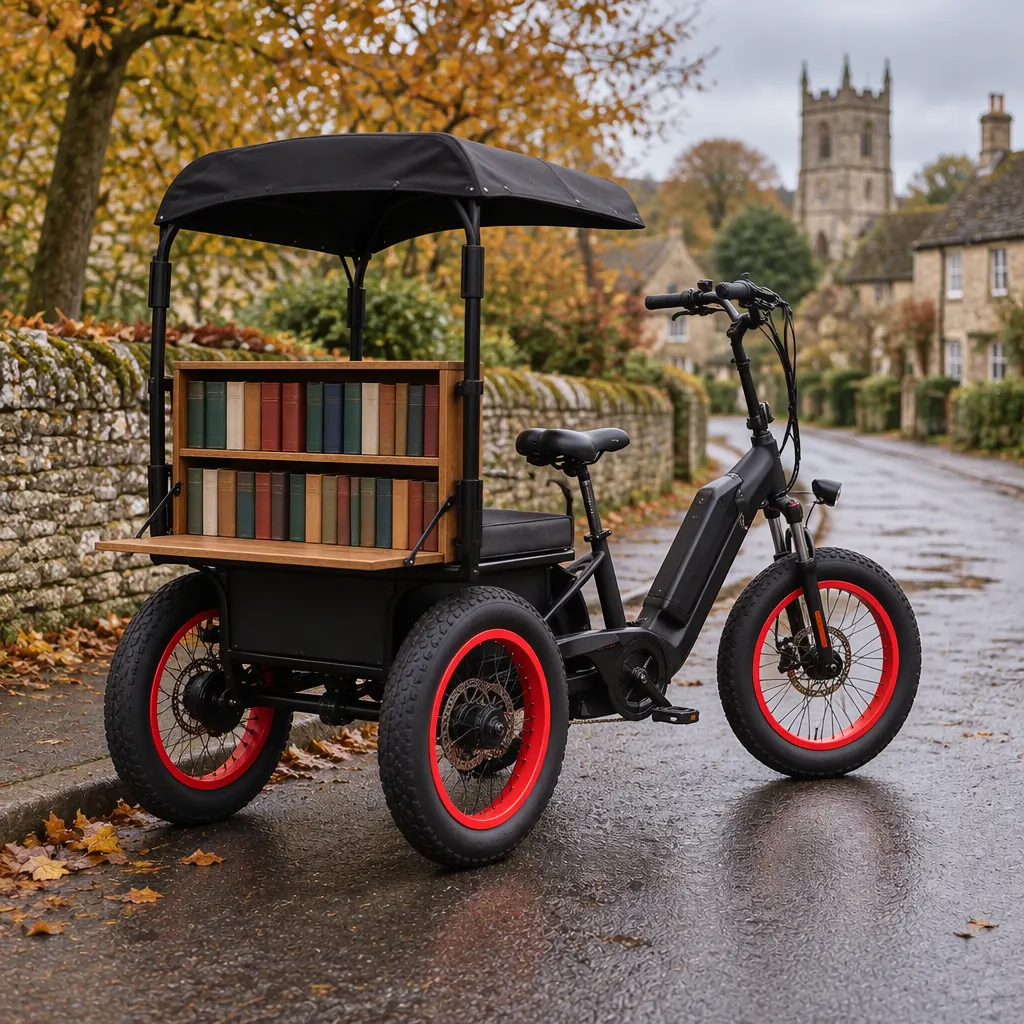
What a Mobile Library Stop Actually Demands From a Vehicle
A delivery route and a library stop look similar on paper and behave nothing alike in the field. A parcel trike leaves a depot full and returns empty, on a linear route, with a driver who loads it. A library stop leaves the depot full, stays full all day, and returns full, because the stock rotates rather than depletes. That single difference drives most of the specification decisions that follow.
| Duty attribute | Parcel / delivery route | Mobile library stop |
|---|---|---|
| Stops per shift | 40–120 | 3–6 |
| Dwell time per stop | 2–5 minutes | 35–75 minutes |
| Load at end of shift | Near zero | Within 5–10% of start |
| Loading done by | Driver, at depot | Second staff member, at the kerb |
| Public access | None | Continuous, from the right-hand side |
| Failure consequence | Late parcel | Cancelled session for a scheduled community |
| Typical daily distance | 40–90 km | 8–25 km |
Read the distance row and the payload row together and the platform question answers itself. A mobile library does not need range. It needs load, dwell comfort, and a body that can be opened and closed a hundred times a year without the hinges going first.
Why a Van Route Does Not Transfer to a Trike
The instinct when downsizing is to shrink the van: fewer shelves, same layout, smaller footprint. That fails because the constraint that made the van work, the side door and the flat floor at loading-bay height, is exactly what the trike does not have. A van loads horizontally from a dock or a kerb-height tail lift. A passenger-platform tricycle loads vertically, by hand, over a drop-side or through a rear gate at roughly 600–700 mm.
That changes the labour model, not just the vehicle. If the stock has to be lifted over a side panel, the second staff member on the stop becomes mandatory rather than optional, and any stock box above about 12 kg needs a two-person lift or a ramp. Where the service already runs with a single driver and volunteers, the trike conversion is a staffing decision as much as a procurement one, and it should be costed that way from the start.
The upside is real. A tricycle routes through pedestrian precincts, market squares, park paths, and housing-estate courtyards that a 7.5-tonne van cannot enter at all. In many European markets a 25 km/h pedal-assisted or low-speed electric tricycle is treated closer to a bicycle than a goods vehicle, which is what makes those stops legally possible in the first place. Confirm the local classification before the order, not after.
Four Measurements That Eliminate Most Candidates
Before comparing motors or battery chemistry, measure four things on the actual route. Each of these disqualifies vehicles outright, and doing them in this order saves weeks of supplier correspondence.
1. The narrowest point on the stop approach
Measure gates, bollard gaps, covered walkways, and the space between a parked car and a kerb at the busiest stop of the week. A passenger-platform tricycle with a fabric canopy runs a body width in the region of 1.0–1.2 m, but the canopy frame, mirror stalks, and open drop-side panels add to that when in use. If the narrowest approach is under 1.2 m, the route is a hand-cart or trolley route, not a vehicle route, and no amount of specification work changes it.
2. The kerb and ramp geometry at each stop
Library stops are frequently on a footway with a 100–150 mm kerb and no dropped section. A loaded tricycle crossing that edge puts a shock load through the front wheel and the front fork that a parcel route never produces, because parcel routes stop at the kerb face and hand over. Record the kerb height at every stop, then decide which stops need a portable ramp before the vehicle is chosen.
3. The gradient of any access path that is not a road
Park paths, cemetery lanes, and estate service roads routinely sit between 8% and 14%. The vehicle needs to climb those loaded, from a standstill, several times a day. On the cargo platform the 800W and 1000W 60V configurations are rated for 300 kg with 50–80 km of range at 200 kg on flat ground; sustained gradients shorten that materially and heat the hub. If more than a third of the route includes a climb above 8%, specify up a motor tier rather than up a battery size.
4. The overnight parking point and its power
A mobile library returns to a library building, a depot, or a staff car park. Charging time on the cargo platform is 6–10 hours on a 5A charger; the passenger platform is listed at 6–8 hours. That fits one overnight charge comfortably and does not fit two shifts on one battery. Confirm there is a usable socket where the vehicle actually parks, and that whoever holds the key is also the person who plugs it in. A vehicle that charges in a locked compound nobody can access at 7am is a vehicle that misses its first stop.
Choosing Between the Passenger and Cargo Platforms
Two platforms in the range can carry a library stop, and the choice is not about which is newer. It is about whether the session happens inside the vehicle or beside it.
| Attribute | Passenger tricycle | Cargo tricycle |
|---|---|---|
| Motor | 500W or 800W hub, 60V, rear differential | 800W / 1000W / 1200W hub with differential, 60V or 72V |
| Battery | 60V 20Ah, 60V 32Ah, or 32Ah LFP | 60V 32Ah NMC or 72V 40Ah LFP |
| Rated load | 250–300 kg including driver and passengers | 300 kg (EU) / 500 kg (non-EU) |
| Body volume | Rear bench area, 2–3 seats | 150–500 L drop-side box |
| Range, loaded | 40–60 km | 50–80 km at 200 kg on flat ground |
| Session model | Readers board and browse inside | Readers browse at an open side panel |
| Canopy | Fabric with roll-up sides, or hard-top with windshield | Optional canopy, primarily weather protection for the load |
| Typical FOB | $850–1,480 | $1,250–2,250 |
The passenger platform suits the traditional model: a bench, a canopy, and readers sitting inside the vehicle for a 45-minute session. It is the closer replacement for a small mobile library van and it is the cheaper of the two. Its limitation is volume. Once the stock requirement passes roughly 90–120 kg of books and periodicals together with the shelving that holds them, the bench area stops being enough and the session moves outside.
The cargo platform suits the open-panel model: the vehicle arrives, the drop-sides come down on the pavement side, and the shelves are reachable from outside. That format handles considerably more stock, it works better where accessibility for older readers matters, and it doubles as an equipment carrier for a pop-up service point that hands out forms, tablets, or seed-library kits rather than books. It costs more and it needs a second person for the set-up, but it is the more flexible brief.
The Load That Does Not Leave: Weight, Volume, and Restraint
Library stock is one of the densest loads a small commercial vehicle carries, and it is the load most often under-specified. A shelf-metre of hardbacks weighs in the region of 60–90 kg. A single plastic tote of picture books is light; the same tote filled with hardbacks is not, and the two look identical when a volunteer is carrying them.
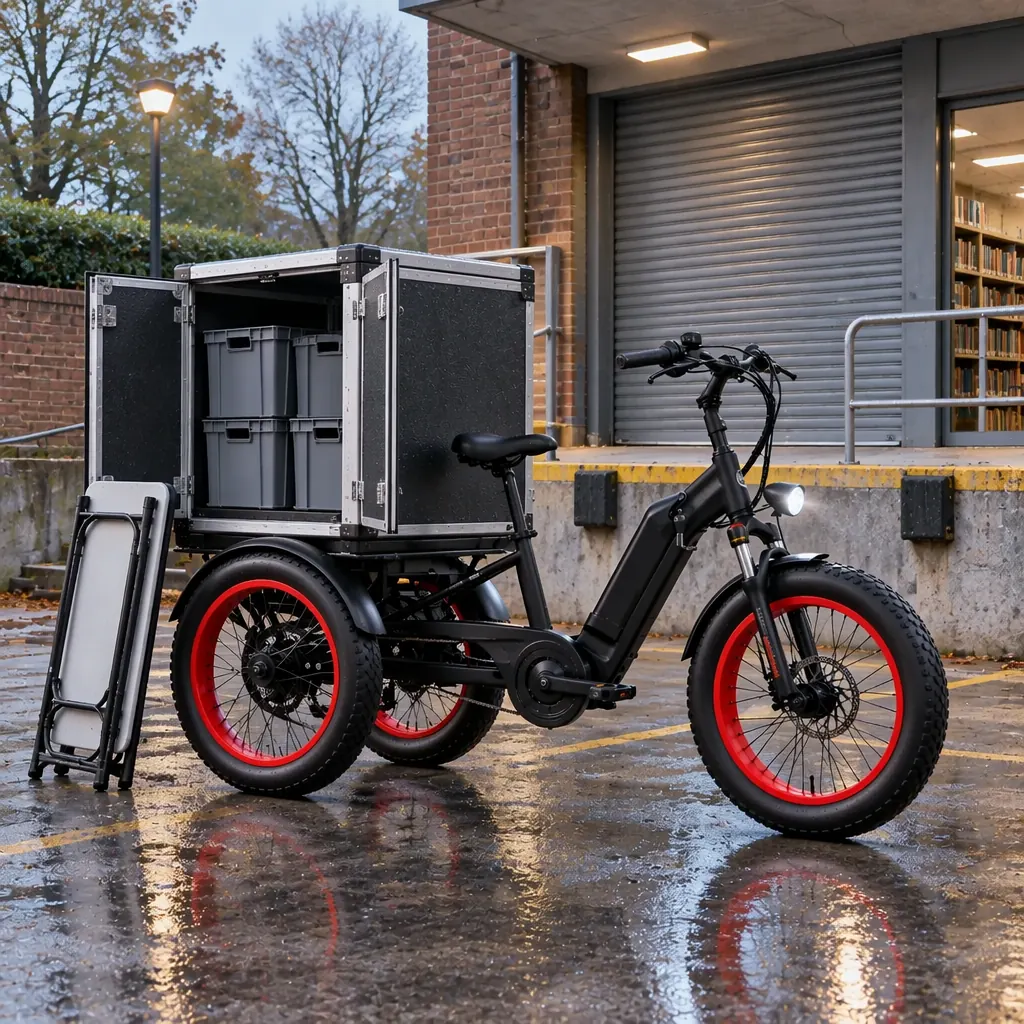
On the cargo platform, the 300 kg (EU) / 500 kg (non-EU) rating is a total vehicle figure, not a cargo figure. Deduct the driver, any second staff member, the shelving itself, and the tool kit, and the practical stock allowance on the EU-rated unit lands near 180–220 kg. On the passenger platform, the 250–300 kg figure expressly includes the driver and two or three passengers, so a session with four readers aboard and 120 kg of stock in the rear is close to the limit before anyone has sat down.
Three rules follow from that arithmetic, and they are worth writing into the vehicle brief rather than leaving to the supplier:
- Specify stock in kilograms per stop, not shelf-metres. Shelf-metres vary with trim size and binding, and they cannot be added up against a vehicle rating.
- Specify the shelving as a fixed, bolted structure. Free-standing shelf units become projectiles in a low-speed incident, and a trike's brake performance, hydraulic disc front with dual drum rear and a parking brake, is good enough to move loose loads.
- Specify restraint for the totes, not just the shelves. Two cam straps per shelf bay and a lip on every shelf edge is the minimum, and it should appear as a line item so it is not quietly dropped in negotiation.
Dwell Comfort Is a Specification, Not a Fit-Out Detail
A 60-minute stop in a fabric canopy at 6 degrees Celsius is a real operating condition, and it is where cheap conversions show. Three items decide whether staff and readers use the vehicle as intended.
Canopy closure. A fabric canopy with roll-up sides is adequate for summer and marginal in shoulder season. If the route runs year-round, specify a hard-top with a windshield, or accept that the stop becomes an outdoor session and plan the stock presentation for an open drop-side instead. Mixing the two models within one fleet is common and generally sensible: hard-top on the winter circuit, open drop-side on the summer one.
Floor and step height. Readers of retirement age board a vehicle step, and a 350 mm first step is the figure that accessibility-focused platforms in this range are designed around. Ask for the step height in the quotation. Where the figure comes back above 400 mm, add a portable step rather than accept the boarding point as supplied.
Lighting and power. A dusk stop needs interior light and, increasingly, a charging point for a tablet-based returns system. Both exist as dealer-fit options on the passenger platform, including USB charging on the rear armrest, and both are cheaper specified with the vehicle than retrofitted.
Sizing the Fleet: A Worked Circuit
Most library systems ask for a fleet size before they have walked the route. The arithmetic is simple enough to do on one page, and it prevents both under-buying and the over-specified single vehicle.
Take a plausible English county circuit: nine stops across four days, average dwell 55 minutes, average inter-stop distance 2.4 km, deepest point 11 km from base. Total route distance per day is 22 km, well inside the 40–60 km loaded range of the passenger platform, and inside the 50–80 km figure of the cargo platform. Range is not the constraint.
The constraint is the working day. Nine stops at 55 minutes is 8.25 hours of dwell before travel and set-up are counted. That is a full shift for one vehicle and one staff member, with no slack for a late finish or a second session at a busy stop. Two configurations work: reduce to seven stops per day with an eight-hour shift, or run two vehicles with different circuits, winter and summer, and let each carry a smaller stock allowance. The second is the more durable answer where the service is expected to grow, and it is also the answer that the charging arithmetic supports, because each vehicle charges overnight on its own 5A charger without competing for a single socket.
Add one more figure to the calculation: the reload. If the route returns to base mid-day, the reload takes 25–40 minutes with two people and a trolley, and it must be inside the shift. Circuits designed around a mid-day reload routinely fail in month two because the reload time was never costed.
Charging Without Building a Depot
The overnight-charge model is what makes a small library fleet practical, and it depends on three things being true at once.
- The parking point has a standard socket that is not shared with a building's heating or kitchen load. A 5A charger on a 60V 32Ah pack draws roughly 400–450 W, which is modest, but a shared circuit that trips at 6am is still a missed stop.
- The key holder and the charger user are the same person, or the handover is written down. This sounds trivial and is the single most common cause of a flat pack in small public-sector fleets.
- The vehicle is charged to full, not part-charged "because the route is short". Repeated partial charging on an NMC pack in a cold depot is the fastest route to a shortened pack life, and the annual service budget will show it in year three.
Where LFP is specified, charging is more forgiving of partial cycles and of ambient temperatures above 40 degrees Celsius, which matters for services in southern Europe, the Middle East, or anywhere the vehicle parks in direct sun. It costs more per unit and it is the right answer for a fleet that will run eight years rather than three.
Weather, Fabric, and the Corrosion Calendar
A mobile library is a wet-climate vehicle by definition, and it sits idle more than it drives. That combination attacks specific parts in a predictable order: canopy frame joints, shelf fixings, the lower edge of any steel panel, hinge pins, and the connector block under the floor where the lighting loom runs.
The frame on both platforms is steel tube with an e-coat plus powder coat finish, which is the finish to insist on rather than a paint-only alternative. Beyond that, four habits extend the life of the vehicle by years and cost almost nothing:
- Rinse the underside and wheel arches with fresh water after any salted-road week, not after every trip. Salt sits in the same places and the rinse is the same job either way.
- Keep the canopy rolled down when parked, not rolled up. Water sitting in a folded fabric panel is what rots the stitching and the frame joint behind it.
- Check the shelf fixings at the annual service rather than at the five-year inspection. A shelf that has worked loose for two years has already damaged the floor panel.
- Store the vehicle under cover where possible, and where not possible, park it with the canopy side away from the prevailing weather.
Certification and the Paperwork a Library Service Will Be Asked For
Public-sector procurement asks for documents a private buyer never mentions, and they should be requested with the quotation rather than after the award. The passenger platform ships with CE marking planning under the Low Voltage Directive and electromagnetic compatibility for the motor controller, RoHS documentation covering the wiring harness, lighting, and dashboard electronics, and UN 38.3 test reports for the battery pack covering the T.1 to T.8 sequences including altitude simulation, thermal cycling, vibration, shock, and overcharge.
Three further documents are worth asking for explicitly:
- The route classification position in writing. Whether the vehicle is treated as a bicycle, a low-speed electric vehicle, or a goods vehicle determines which stops are legal, and the answer varies by jurisdiction. A supplier that will put its reading in writing is a supplier worth shortlisting.
- The battery transport documentation as a complete file. Lithium packs move under UN 3480 Class 9 dangerous goods rules, and the MSDS plus the UN 38.3 test summary need to travel with the shipment. A library service that has never imported a vehicle will be asked for these by its freight forwarder.
- The warranty split by component. Motor, controller, and battery usually carry different terms from frame and finish, and the public-sector expectation of a multi-year period needs to be mapped onto those terms rather than assumed across the whole vehicle.
What to Put in the Order
The order terms below are the ones that change outcomes rather than the ones that look impressive on a quotation. Minimum order quantity on both platforms is 50 units per model, standard lead time is 15–30 days, and a first custom-branded run is 30–45 days with pre-production samples shipping before mass production.
| Line item | What to specify | Why it matters on a library route |
|---|---|---|
| Platform | Passenger 800W, or cargo 800W/1000W, per session model | Bench-inside vs open-panel decides the whole fit-out |
| Battery | 60V 32Ah, LFP where ambient exceeds 40°C | Overnight charge fits; LFP survives hot depots |
| Canopy | Hard-top with windshield for year-round circuits | Dwell comfort decides whether readers board |
| Shelving | Bolted, with edge lips and two cam straps per bay | Loose shelves are the most common conversion failure |
| Step height | Stated in the quotation, in millimetres | Boarding point for older readers |
| Lighting | LED work lights plus interior light | Dusk stops and winter afternoons |
| Governor | Speed limited to the local classification figure | Keeps the route legal in pedestrian areas |
| Spares | Tyres in 3.00-12 and 3.50-12 or 3.75-12, plus a controller | Odd tyre sizes are the classic six-week stoppage |
| Documents | CE, RoHS, UN 38.3, MSDS, warranty split | Required by public-sector procurement |
Two clauses are worth pressing on harder than the rest. First, ask for the tyre specification to be guaranteed available for the life of the vehicle, because a mobile library that stops for six weeks waiting on a 3.50-12 rear tyre has failed its community more visibly than a van ever would. Second, ask for a sample unit before the fleet order and run it on the real winter circuit for a month, loaded, with the real staff. The four things to record are stops completed per shift, range remaining at the end of the shift, any stock shift that required re-strapping mid-route, and whether the staff want to keep using it. That last one is not a soft measure; it decides whether the fleet gets used or parked.
Where a Tricycle Is the Wrong Answer
Three briefs should stay on a van or move to a different format, and saying so early saves a failed pilot.
- Any route where the stock requirement exceeds roughly 250 kg per circuit. The vehicle can carry it in theory on the non-EU 500 kg rating, but the loading and unloading labour at each stop becomes the bottleneck.
- Any service area where the vehicle must travel sustained distances above 35 km between stops on a daily basis. The platform is built for circuits, not for trunk runs.
- Any stop where the readers expect to browse a full collection rather than a curated selection. That is a building, not a vehicle, and no amount of specification closes the gap.
For everything else, a two-vehicle tricycle circuit generally delivers more scheduled stops per pound of capital than a single van, because it removes the licence requirement, the depot, and the fuel line at the same time. The specification work above is what turns that from a claim into a defensible business case.
The practical sequence for a library service evaluating this brief is short. Walk the circuit once with a tape measure and the four figures above written down, then ask two suppliers for the same three documents: the route classification position in writing, the tyre and controller availability commitment, and a sample unit on a one-month trial basis. Compare the returned quotations against the stop count each configuration can actually complete in a shift rather than against unit price, because on a circuit of this shape the labour saved per scheduled stop is worth more over eight years than any difference in the purchase order. Where the arithmetic points to two vehicles instead of one, buy two; a library stop that is cancelled because the single vehicle is charging has a cost that never appears in the capital request, and it is the figure a committee will remember.
Specify a library circuit, not just a vehicle
Send us your stop count, stock weight per circuit, kerb geometry and the climate the route runs in. We will come back with a platform recommendation, the shelving and canopy options that fit, and the compliance document list your procurement team will ask for.
