
An event caterer does not run a delivery round. The route changes every day, the serving point is rarely at road level, and the whole operation has to be set up, served and struck inside a window the client has already published to guests. That single difference — a fixed service window at an unfamiliar site — is what separates a catering trike specification from a bakery round or a vending cart.
This guide works through the six numbers that decide the platform before you look at a single accessory: site access, set-up distance, holding temperature, service-window power draw, the load between two venues, and the share of the day the vehicle is actually moving. Every figure below is drawn from the cargo and passenger tricycle platforms we build and export, not from a generic wish list.
Why an Event Service Round Is Not a Delivery Route
The food-delivery and bakery articles on this site deal with recurring rounds: same streets, same stops, same start time. An event operation inverts nearly every one of those assumptions. Before specifying anything, it is worth writing down the five differences, because each one pushes a different part of the platform.
| Dimension | Delivery / bakery round | Event and venue service |
|---|---|---|
| Route | Fixed, learned, repeated daily | New site most days |
| Time pressure | Spread across a 3–4 hour round | Concentrated into a published service window |
| Ground surface | Road and pavement | Gravel, grass, temporary trackway, terrace stone |
| Loading height | At the vehicle, at street level | Often carried 20–80 m to a service point |
| Power availability | Return to base between rounds | Whatever a generator or venue socket provides |
The practical consequence: an event trike is judged on set-up and strike time and on holding capability, not on maximum daily range. A platform that carries 300 kg for 50 km is over-specified on range and under-specified on how quickly a crew can turn it around.
Site Access: Measure Three Things Before You Choose a Platform
The most common costly mistake is ordering a vehicle that cannot reach the service point. Three measurements eliminate the problem, and all three should be taken at the venue, not estimated from a map.
- Gate and doorway width. A cargo tricycle with a 150–500 L box and dual rear wheels is a wide vehicle. If the service route passes any gate, corridor or marquee opening narrower than about 1.6 m, the trike stops outside and everything is hand-carried from there — which changes the labour maths entirely.
- Threshold and kerb height. Venues are full of 40–120 mm lips: terrace steps, marquee floor edges, gravel-to-paving joins. A loaded trike crosses these slowly and should never be driven at an angle that lifts a rear wheel.
- Gradient on the service lane. Our platform is rated for 25–35 km/h and 50–80 km loaded at 200 kg on flat terrain. Sustained gradients above roughly 8% should be treated as a reason to step up the motor specification rather than to add battery capacity.
If the answers rule out vehicle access, the honest conclusion is that the site wants a hand truck at the final 30 m — and that is a planning decision, not a failure. What matters is discovering it before the order, not on the first event day.
Set-Up Distance and the Trolley Decision
Set-up distance is the number most often left out of a specification, and it drives straight into payload. A trike that parks 15 m from the service point is a different machine from one parked 80 m away, because at 80 m the crew makes many more trips and the vehicle's own box becomes a staging container rather than a delivery container.
The arithmetic is simple and worth doing on paper. If a full service load is 180 kg and a crew member can carry 25 kg per trip, a 15 m carry is a handful of short trips; an 80 m carry at the same 25 kg is the same trip count but a very different time and fatigue cost. Above roughly 40–50 m, a coupling trolley or a second run staged from the box is almost always the right answer, and the trike specification should then reserve capacity for the trolley itself.
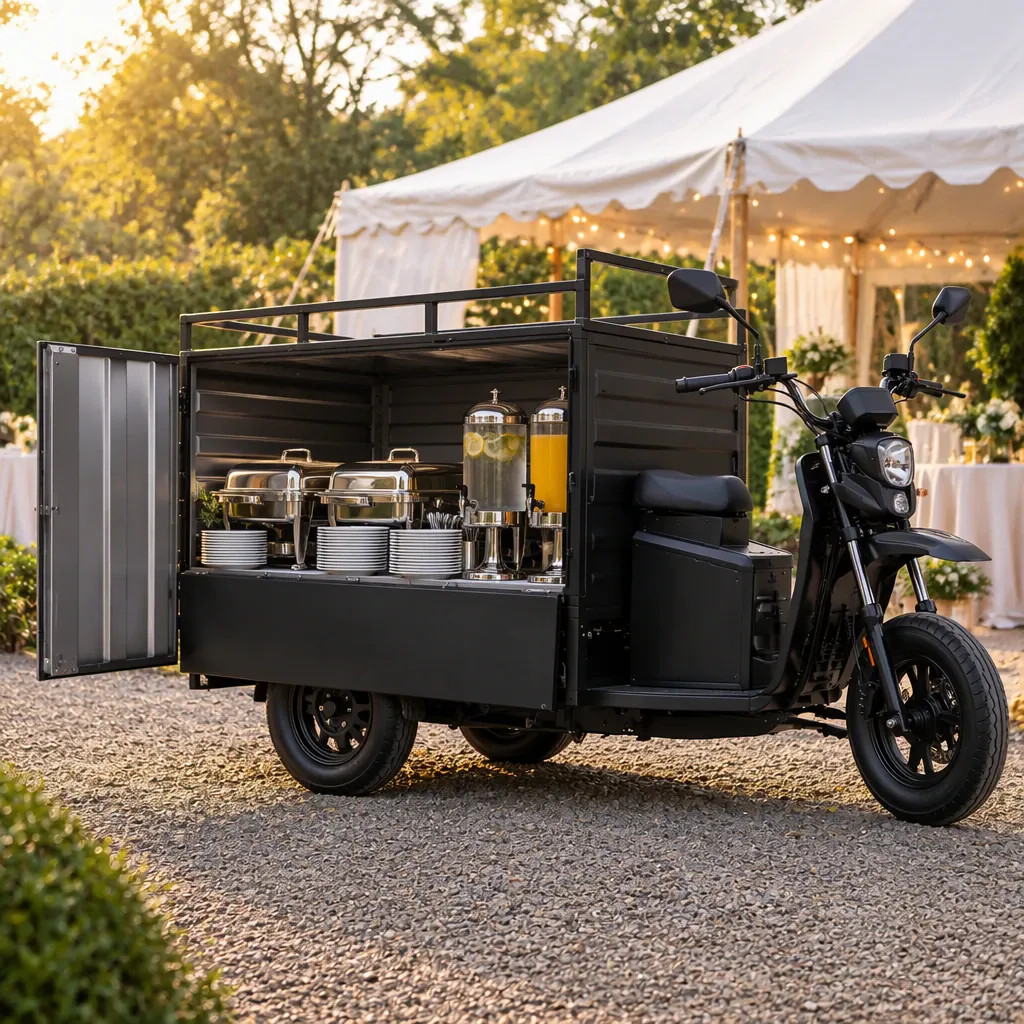
Note the box choice that follows. A drop-side aluminium or steel box of 150–500 L lets the crew work from three sides at the service point, whereas a plain box forces everything over one lip. For events, the drop-side configuration earns its cost.
Hot and Cold: Holding Loads on One Vehicle
Event menus are usually mixed — something hot, something cold, and beverages. A single trike can carry all three, but only if the box is planned around temperature zones rather than treated as one volume. Our cargo platform offers aluminium or steel boxes with optional insulated lining, and that option is the one to take for catering.
- Hot holding. Chafing dishes and insulated carriers occupy volume for their mass, so hot items are usually the space driver, not the weight driver.
- Cold holding. Cold items are the opposite: dense, heavy and compact. Beverage dispensers and produce crates are where the payload figure actually gets consumed.
- Separation. Hot above cold is wrong. Plan side-by-side zones with a divider, and load cold last so it is taken out first — that ordering alone recovers several minutes per service.
Payload figures to design against: the cargo platform is rated 300 kg in the EU and 500 kg outside the EU, with a vehicle weight of 150–220 kg. A realistic event load — two chafing dishes, two dispensers, plates, and a case of dry goods — comfortably fits inside that envelope, which means the limiting factor is almost always volume and access, not mass.
Service-Window Power Draw and Charging
This is the calculation that most often gets skipped, and it is the one that decides whether a second battery or a second vehicle is needed.
The platform charges from 6 to 10 hours on a standard 5 A charger. That is fine for a single-shift operation charged overnight at base. It is not enough to recharge a depleted pack between a morning and an evening function on the same day — a two-event day inside a 10-hour window cannot be covered by charging alone.
Three workable answers exist, and the choice is commercial rather than technical:
- Charge only at base and treat two-event days as two vehicles. Simplest, and usually correct if the site has a secure base and the events are geographically separate.
- Swap a second pack. Carrying a spare battery converts charging time into a shift change, which is the same logic our fleet charging material applies to multi-shift operations.
- Opportunity-charge at the venue. Only viable where the site provides a socket the crew can reach during set-up, and it should never be assumed — ask, in writing, before quoting for it.
Separately, note that a catering trike running lights, a display and any powered holding equipment during the service window draws down the pack while stationary. Size the pack for the shift including the static draw, not just for the distance ridden to the site.
A Worked Load and Turnaround Arithmetic
Putting the pieces together for a typical mid-size event service, the specification logic reads as follows. Assume a single function, 120 guests, one hot course and a cold beverage service, service point 35 m from the parking position.
| Input | Value | Specification consequence |
|---|---|---|
| Service point distance | 35 m | Coupling trolley justified; box must open on three sides |
| Total load | ~170–200 kg | Inside 300 kg EU rating with margin |
| Box volume needed | 250–400 L | Mid or heavy box; drop-sides essential |
| Temperature zones | 2 (hot, cold) | Insulated lining option; divider |
| Day structure | One function | Overnight 5 A charge suffices |
| Ground | Gravel + terrace stone | Load-rated 3.00-12 front / 3.75-12 rear dual tyres |
The point of writing this out is that the arithmetic points to the mid or heavy platform configuration, not the light one — and it reaches that conclusion from volume, access and temperature, not from the weight figure alone. Weight is usually the least binding constraint in catering work.
Where the Platform Pays Back, and Where It Does Not
Be explicit about both, because a trike is not universally the right answer.
- Pays back where the service point is reachable by vehicle, the load is under the rating, and the alternative is a van that must be parked far away and hand-loaded anyway. In those cases the trike removes a vehicle from the site, removes parking cost, and works from the service point directly.
- Pays back where venues are close together and a same-day double service is realistic, because one operator and one vehicle cover what two van runs would.
- Does not pay back where the crew must carry everything more than roughly 80 m regardless of vehicle, or where a single function needs more volume than 500 L, or where the venue forbids vehicles on the service surface at all. In each of those cases a van plus hand truck remains correct.
Specification Table for Event and Venue Catering Duty
Drawn from our cargo tricycle platform as configured for mixed hot and cold service work:
| Parameter | Light 800W | Standard 1000W | Heavy-Duty 1200W LFP |
|---|---|---|---|
| Motor | 800W hub, 60V | 1000W hub, 60V | 1200W hub, 72V |
| Battery | 60V 32Ah NMC | 60V 32Ah NMC | 72V 40Ah LFP |
| Range, loaded 200 kg, flat | 50–60 km | 60–70 km | 70–80 km |
| Payload EU / non-EU | 300 / 500 kg | 300 / 500 kg | 300 / 500 kg |
| Box volume | 150–300 L | 200–400 L | 300–500 L |
| Charging time, 5 A | 6–10 h | 6–10 h | 6–10 h |
| Brakes | Hydraulic disc front + dual drum rear, parking brake | ||
| Tyres | 3.00-12 front / 3.75-12 rear dual, load-rated | ||
| FOB band | $1,250–1,550 | $1,580–1,880 | $1,880–2,250 |
| MOQ | 50 units | 50 units | 50 units |
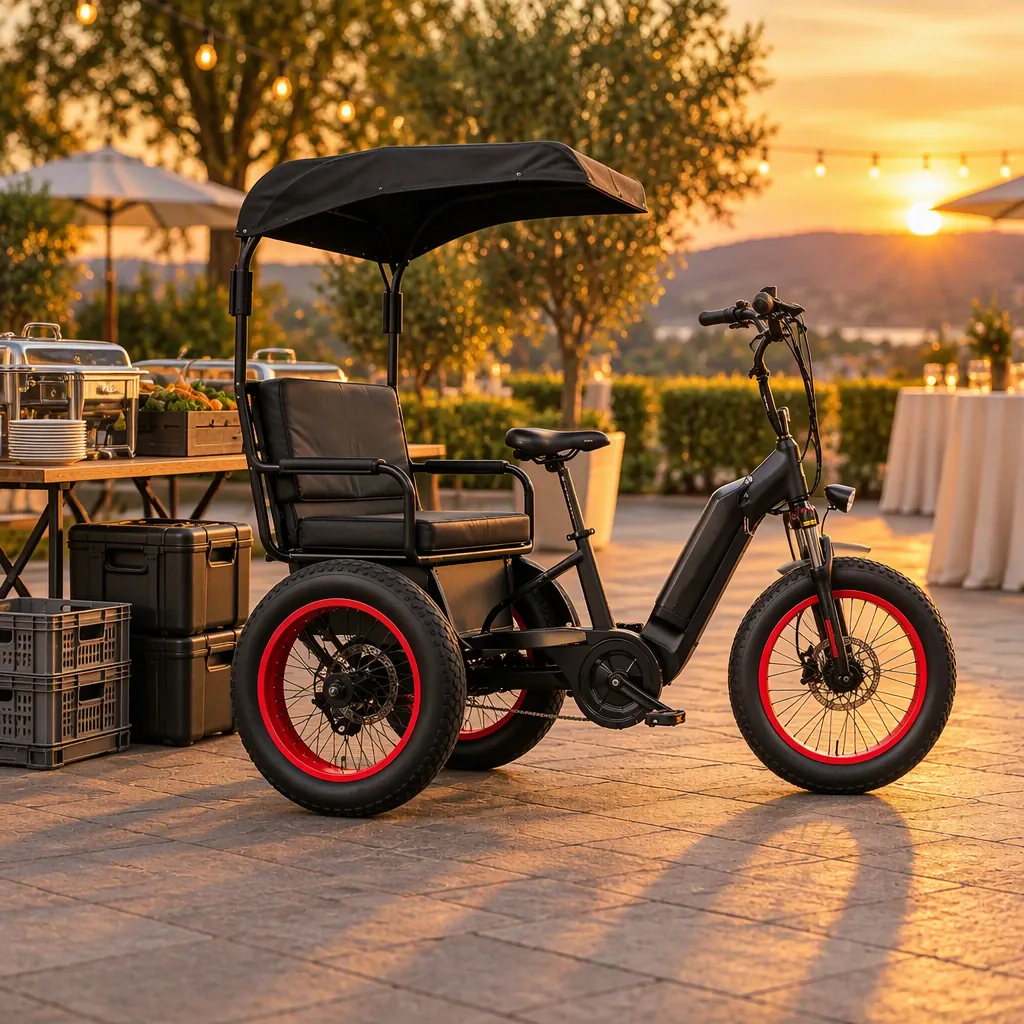
For caterers who also move guests — shuttle between a car park and a marquee, for example — the passenger platform is the alternative: 500–800W, 60V 20–32Ah, 40–60 km range, 2 or 3-person bench, fabric or hard-top canopy, 300 kg total load, with FOB from $850–1,480. The two platforms are not interchangeable: the cargo box cannot seat guests and the passenger bench cannot hold chafing dishes.
What to Fix Before the Season Starts
Event work compresses all the risk into a few hours, so the preparation that pays is the preparation that removes variables.
- Fix the box configuration once. Insulated lining and drop-sides should be decided at order, not retrofitted in June.
- Carry a documented load plan. Which zone holds what, in which order it is loaded, and which order it comes out. This is what makes a two-person crew faster than a three-person crew with no plan.
- Standardise the connector and charger. If the fleet grows, one charger type and one charging routine across every vehicle is worth more than any single feature on one trike.
- Agree venue access in writing. Vehicle permitted on the service surface, distance to the serving point, gradient, and available power. These four answers remove most first-event surprises.
- Confirm the spares that matter. Load-rated tyres in the correct sizes and a spare 5 A charger are the two items that end an event early if missing.
Specify Your Event Catering Trike
Tell us your service pattern — functions per week, guests per function, typical set-up distance and whether the site provides power — and we will map it onto a platform configuration and a box specification, with the FOB band and lead time for your market. OEM programs run from a 50-unit MOQ with 15–30 day production and box customisation adding roughly 10 days.
For the wider context around this duty cycle, see our notes on mobile vending platform selection, the morning bakery and cafe round, florist and fragile-load handling, the multi-temperature grocery round, and fleet charging and depot power planning.
Spec a Catering Trike Around Your Service Window
Send us your service pattern — functions per week, guests per function, set-up distance and site power — and we will return a platform configuration, box specification, FOB band and lead time for your market.
