
The two-wheeler versus three-wheeler decision is the first fork in any e-mobility product line, and it is not a styling choice. The two platforms have different physics at rest, land in different legal classes, and attract different buyers. The bicycle wins on speed, agility, storage density and unit price. The tricycle wins on payload, and on the fact that it stands still under load without anyone holding it up. This guide compares them the way an OEM buyer or distributor has to: stability, legal class, payload arithmetic, running cost, workshop implications, and which buyer profile each platform actually serves after the first season.
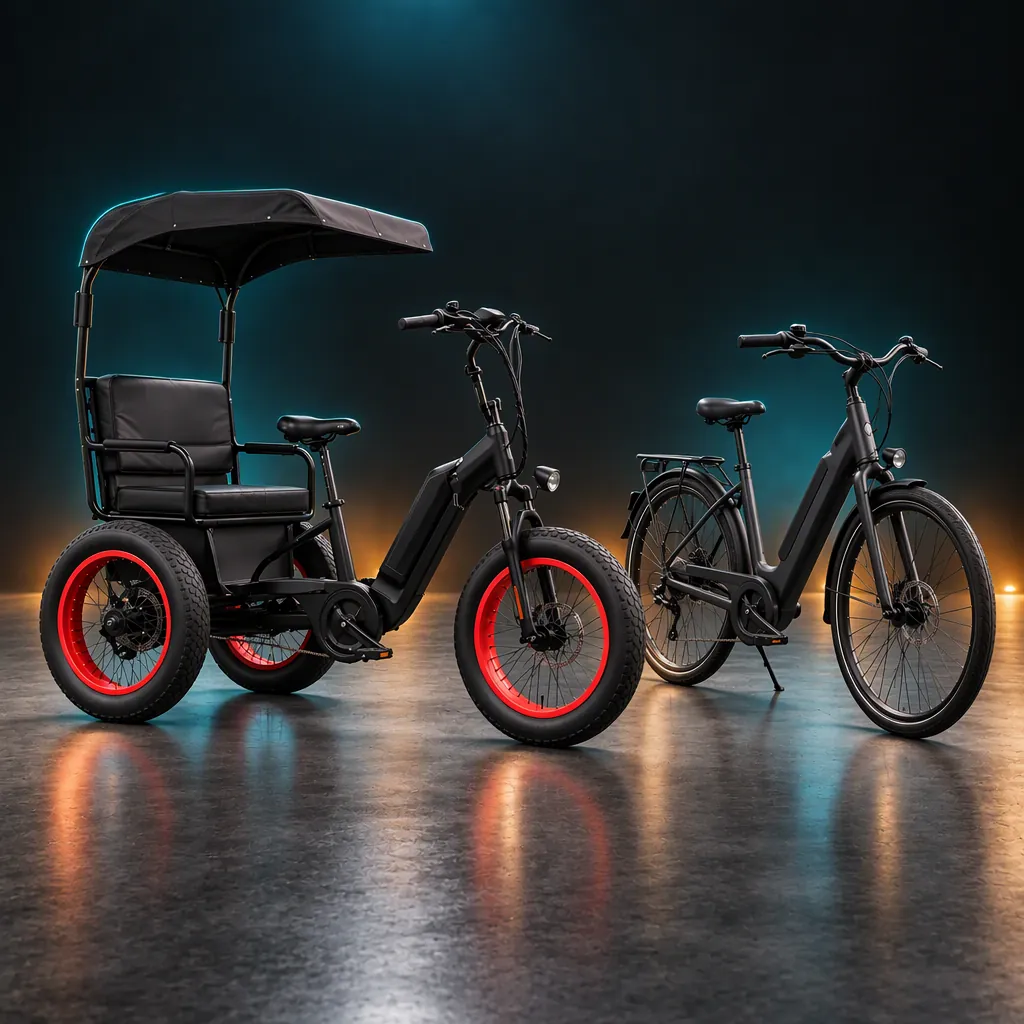
A tricycle in our line is a delta layout: one wheel at the front, two side by side at the rear. That single geometry difference changes the working day more than any line on a spec sheet. On a two-wheeler the rider is the stability system: every stop means a foot down and one arm holding a 22 to 25 kg city commuter upright, which is the published kerb weight of our city commuter platform with the pack fitted. On a delta trike the vehicle is stable at rest, hands are free, and the stop costs seconds instead of half a minute.
This is a zero-speed advantage, not a high-speed one. A loaded cargo trike does not tip when the rider dismounts to open a gate, scan a parcel or hand a crate through a doorway. The same stop on a loaded two-wheeler means deploying a kickstand and thinking about how the load sits. For a courier, a vending operator or a grounds crew that is not comfort, it is throughput: a hundred stops a shift, each one shorter. The seating version of the same architecture is described in our passenger e-tricycle guide.
The third wheel also carries load that a two-wheeler cannot. Two rear wheels share the cargo mass across two contact patches, which is why the tricycle's tyre specification is a load-rated 3.00-12 front and 3.75-12 dual rear rather than an urban 700c or 26 inch tyre. That hardware decision is forced by the payload rating, not chosen for looks.
Trikes vs Bikes: What Changes at a Standstill
For the physics on its own — what decides whether a trike feels planted, and the numbers to ask a factory for — our electric trike stability guide works that question through end to end. The table below answers the part that matters to this comparison: what each platform does at a stop, in a corner, and under load.
| Question | Short answer | Where this is worked through |
|---|---|---|
| Which is more stable when stopped? | The tricycle, clearly. It stands on three contact patches with no rider input, which is where a two-wheeler is weakest. Our delta trike rests on three contact patches with no rider input. | Stability section below |
| Are they stable in a fast corner? | Less so than a bicycle. A delta trike does not lean, so a corner taken quickly shifts weight onto the outer rear wheel instead of banking into it. | Speed and legal class |
| Do they fall over when loaded? | No, provided the load sits inside the box footprint and the 300 kg or 500 kg payload rating. Off-centre loading above the box sides is what tips a trike, not the trike itself. | Cargo arithmetic |
| Which wheels carry the load? | The two rear wheels, side by side, with a differential between them. Front is a single load-rated 3.00-12 tyre. | Payload table |
Where the tricycle's stability advantage comes from
Stability is not a single number you can print on a brochure, which is why the question gets answered so badly elsewhere. On a delta trike it decomposes into four things a buyer can check on a sample.
- Track width against centre of gravity. The two rear wheels sit roughly 900 to 950 mm apart on our cargo platform. The lower and more central the mass sits inside that footprint, the more lateral force it takes to lift a rear wheel. This is why the load deck is between the axles rather than stacked above them, and why a 60 kg battery pack sits under the deck instead of on a rear rack.
- How the rear axle articulates. A rigid single-piece rear axle keeps all three wheels planted but transmits every surface irregularity into the frame. A differential lets the two rear wheels turn at different speeds in a corner, which is what stops the inner wheel scrubbing and the vehicle crabbing on a tight turn. Our cargo platform uses a differential hub with a leaf-spring rear suspension because a loaded trike on a farm track needs both behaviours at once.
- Where the brakes act. A delta trike under braking transfers weight forward onto the single front wheel. Hydraulic disc at the front plus dual drum at the rear is the combination that keeps the rear pair from locking first, which on three wheels is what starts a spin rather than a straight stop. The parking brake matters as much as the service brake, because a trike parked on a slope is the one situation where a self-stable vehicle can still run away.
- Tyre sidewall and pressure. Load-rated 3.00-12 front and 3.75-12 dual rear tyres run stiffer sidewalls than an urban 700c. Under-inflation is the most common cause of a loaded trike feeling vague at the rear, and it is a delivery-driver habit rather than a design fault.
The one stability question a trike genuinely loses is the fast corner, and it is worth being straight about it. A bicycle banks into a corner; the rider's lean moves the centre of gravity inside the turn. A trike stays flat, so the same corner transfers weight outward onto one rear wheel. On a governed 25 km/h cargo trike in a town that never becomes a problem. On a downhill sweeper at 35 km/h with 300 kg in the box, it is the reason the governor exists and the reason our spec sheet quotes a 25 / 35 / 40 km/h setting per market rather than a single top speed. Buyers who need cornering speed should be looking at two wheels, and that trade is set out in the sections below.
Stability at Speed and the Legal Class Fork
Platform choice decides which legal class the product lands in, and the class decides market access. For a two-wheeler the European default is the EPAC: 250W continuous, 25 km/h pedal-assisted cut-off, EN 15194, no licence, no plate, no type approval. In the United States the same machine sits inside the federal low-speed electric bicycle definition at 750W and 20 mph motor-only, split into Class 1, Class 2 and Class 3 by whether it assists or throttles and by whether it reaches 28 mph.
A tricycle can sit in exactly those classes, and a pedalled trike at or under 750W and 20 mph usually does. But heavier cargo and passenger trikes cross the line: in the EU they enter Regulation 168/2013 as L1e or L2e and need whole-vehicle type approval with an eMark, and in the US anything above 750W or above 20 mph falls under state moped or NEV rules. The class-by-market map, including which trike configurations stay licence-free, is in our electric tricycle laws guide for the US and EU and the certification route itself in our EU vs US certification guide.
The second consequence is pack voltage. The two-wheelers we build run 36V or 48V. The cargo tricycle platform runs 60V or 72V, because 300 to 500 kg of rated payload needs more torque and a heavier BMS. Whether 250W, 750W or 1200W is the right rating for a given all-up weight is a separate calculation, worked through in our motor power guide.
| Dimension | Electric bike (city commuter) | Electric cargo tricycle |
|---|---|---|
| Wheels | 2 | 3, one front and two rear |
| Stability at rest | Rider holds it upright or uses a stand | Self-stable, no stand needed |
| Drive | 250W or 350W rear hub, 36V or 48V | 800W, 1000W or 1200W hub with differential, 60V or 72V |
| Battery | 36V 10Ah or 48V 15Ah, removable downtube pack | 60V 32Ah NMC or 72V 40Ah LFP, heavy-duty BMS |
| Rated payload | 120 kg rider plus 15 kg rear rack | 300 kg (EU) or 500 kg (non-EU), 150 to 500 L box |
| Range | 35 to 60 km pedal-assisted | 50 to 80 km at 200 kg on flat ground |
| Top speed | 25 km/h assisted, unlockable to about 32 km/h | 25 to 35 km/h, governor set per market (25 / 35 / 40 available) |
| Kerb weight | 22 to 25 kg with battery | 150 to 220 kg without cargo box |
| Brakes | Mechanical or hydraulic disc, 160 to 180 mm | Hydraulic disc front, dual drum rear, parking brake |
| Tyres | 26 inch or 700c urban | 3.00-12 front, 3.75-12 dual rear, load rated |
| Charging | 2A or 3A charger, 3 to 5 h | 5A charger, 6 to 10 h |
| FOB price range | $420 to $720 | $1,250 to $1,550 (mid tier up to $2,250) |
| MOQ | 50 units | 50 units |
Read the payload row carefully. The two-wheeler figure is a rider plus a rack. The tricycle figure is cargo on top of the vehicle's own 150 to 220 kg. Those are not comparable numbers, and printing them side by side in one catalogue column is the fastest way for a distributor to mislead its own dealers.
Load Stability: Cargo Arithmetic per Kilogram Moved
On payload the platforms stop competing. The cargo tricycle is rated 300 kg in the EU and 500 kg outside it, in a 150 to 500 litre drop-side box, and still returns 50 to 80 km at 200 kg on flat ground. A realistic two-wheeler build carries a rider and a rack load; a reinforced cargo bike frame can take more, but at that point you are buying a specialised machine with cargo-bike pricing and still stopping to balance it.
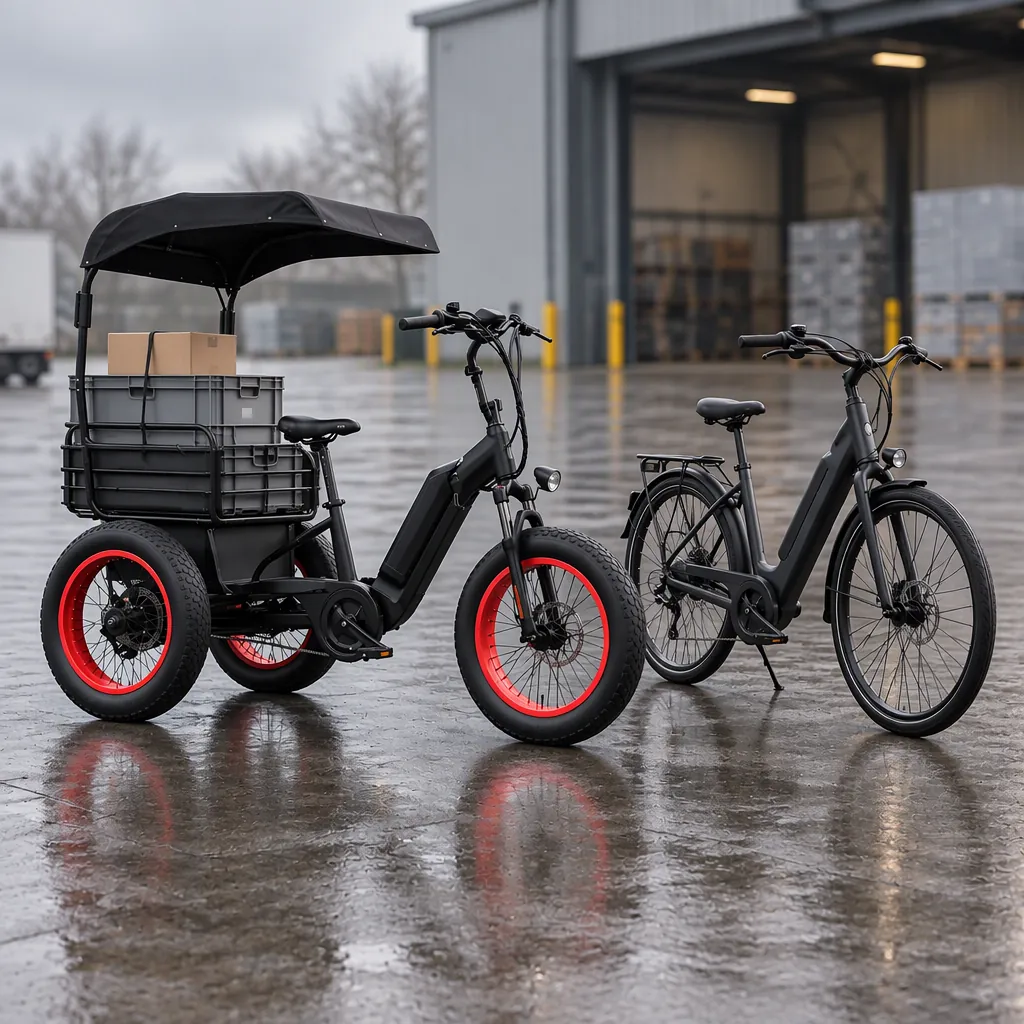
The useful comparison is cost per kilogram delivered, not cost per vehicle. Take a route that is load-limited rather than distance-limited: a beverage run, a parcel relay, a market garden, a grounds crew. If one tricycle trip replaces three bicycle trips, then a $1,400 tricycle against a $600 bicycle is not 2.3 times the cost, it is roughly four fifths of the cost per kilogram moved, before counting the three loading operations the bicycle route needs. This is the reasoning behind the route economics in our cargo delivery fleet guide and the framing in our payload capacity guide.
Where the arithmetic flips back is a route with a lot of empty running. A tricycle that returns empty half the time is carrying 200 kg of vehicle for nothing. That is a route-design problem, not a platform problem, and it is why we ask buyers for the day's route before quoting a box size.
Where a Two-Wheeler Still Wins on Stability and Agility
The tricycle is not universally better, and a line that drops two-wheelers leaves money on the table. The bicycle wins on speed, because 25 to 32 km/h under a rider who can lean through a corner feels quicker than a governed trike tracking flat. It wins on agility, because 22 to 25 kg goes through a doorway, onto a train, into a lift or up a stair, while a 150 to 220 kg trike needs a ramp, a liftgate or a ground-level parking bay. It wins on price, at roughly a third to a half of a tricycle's FOB. And it wins on storage density: a rental operator fits several bicycles in the floor space one trike occupies, which is the whole basis of the fleet sizing in our e-bike rental fleet guide.
Commuter buyers, sport riders and apartment dwellers stay on two wheels. The tricycle's buyers are cargo operators, mobility users, vendors, growers and anyone whose workflow involves stopping and staying stopped. Distributors who carry both tend to sell by use case rather than pushing one platform, and the same logic applies when the alternative is a light commercial vehicle rather than a bicycle, as set out in our cargo trike vs pickup truck comparison.
Running Cost, Tyres and the Workshop
Energy cost per kilometre is close to irrelevant on both platforms next to labour, so it rarely decides anything. What does decide is consumption of consumables and the shape of the workshop. Brake and tyre consumption is the line that moves up on a tricycle: three load-rated tyres instead of two urban tyres, dual drum rear brakes that wear differently from a single disc, and a parking brake that gets used every stop. A fleet that budgets tyres on a per-vehicle basis will underestimate a trike fleet; budget per tonne-kilometre instead.
The servicing competency is the same on both: motor, controller, battery, brake, tyre, wiring. A dealer does not need a second workshop to stock trikes. What changes is the space around the vehicle. A tricycle fleet needs ground-level charging positions rather than wall racks, a way to move a 200 kg vehicle when it is immobilised, and a ramp or liftgate for any service bay with a step. Pack sizing, chemistry and cycle life for either platform are covered in our battery technology guide and our battery pack guide.
Drivetrain choice cuts across both platforms. A hub motor is the default on our commuter bicycles and on the cargo tricycle's rear axle, where a differential splits torque between the two rear wheels; a mid-drive makes more sense when the rider needs to use the bicycle's gears under load. That trade-off is worked through in our hub vs mid-drive guide.
Which Platform Should Your Line Carry? Stability Against Payload
Decide from the buyer profile, not from the product you already stock:
- Commuters, sport and leisure riders, rental fleets - bicycles. Speed, price and storage density win.
- Last-mile parcel, grocery, beverage and freight - cargo trikes. Payload and self-stability win; the fleet maths is in our cargo delivery fleet guide.
- Senior and adaptive mobility - passenger trikes. Seated stability and step-through access win, detailed in our adaptive electric tricycle guide.
- Vendors, growers, grounds and landscape crews - cargo trikes with the right box. The drop-side body is the deciding option, as covered in our landscaping guide and our farm and ranch guide.
Most of the distributors we supply carry both and lead with the use case. The same platform question comes back from the other direction too, when a buyer is comparing a trike with a golf cart or a small utility vehicle rather than with a bicycle, which is why our trike vs golf cart comparison exists.
What Changes When You Order Both
Ordering two platforms from one factory is mostly a documentation and spares problem, not an engineering one. The commercial terms are the same: 50 unit MOQ, 15 to 30 days production, 30 to 45 days for a first order with custom paint or box work, and a sample before the run. The difference is that a mixed container now carries two tyre sizes, two brake architectures and two pack voltages, so the spares kit and the training material have to be separated by platform from the first shipment rather than sorted out later.
Every vehicle passes incoming, in-process and outbound quality gates. Cells are rejected outside a 3 mΩ internal-resistance window or with a 0.02V open-circuit spread, and safety-critical fasteners are torqued and logged at the handlebar clamp, axle and brake caliper. Certification rides with the order as a document package, covering EN 15194 and EN 50604 for the EPAC side, UL 2849 and UL 2271 for the US, eMark for L-category trikes, and UN 38.3 for the cells in both. Units ship as a partial-disassembly load in a 20GP or packed for volume in a 40HQ, braced to survive 40-plus days at sea. Our import guide walks through the loading and landed-cost side if this is your first container.
That is what makes the platform decision reversible, which matters more than it sounds on a two- to three-year dealer plan. A distributor who starts with bicycles and adds tricycles two seasons later is reusing the same dealer network, the same service competency, the same charger and spares suppliers and the same certification paperwork habits, so the only structural change is floor space and a ground-level charging bay. The reverse move is rarer but happens too: operators who bought trikes for a route that turned out to be distance-limited rather than load-limited come back for commuter bicycles to keep the same riders working. Either way, ordering both platforms under one document set, one test regime and one container plan is cheaper than running two sourcing relationships, and it keeps the payload and voltage differences in a single place where your dealers can compare them honestly instead of inferring them from two catalogues printed by two different factories.
Spec a Trike or E-Bike Line for Your Market
Tell us your target buyers and use cases (commuter, cargo, vending, mobility). We will recommend the platform, motor class, battery, and certification path, with payload and brake test data included in the sample phase.
